






















On this page
Analysis Calculators - Aspects, Elements & Strengths represent a powerful category of free astrology tools designed to go beyond the basic birth chart snapshot. Instead of simply listing where planets fall, these calculators examine the dynamic relationships between them: the angular distances (aspects), the elemental makeup (fire, earth, air, water), the modality distribution (cardinal, fixed, mutable), and the relative strength or dignity of each planet. For anyone serious about understanding their natal chart, this is where the real story begins.
These tools answer questions that a standard chart calculator cannot: Which planet dominates your personality? Are you lacking water, making emotional expression a challenge? Do you have a rare grand trine or a stressful T-square? By quantifying these patterns, the calculators turn abstract astrological concepts into actionable insights. Whether you are a beginner or a seasoned astrologer, the YesAstrology suite of analysis calculators provides the clarity needed to interpret your chart with confidence.
Below, we break down every major feature of these analysis tools - from aspect detection and planetary strength to elemental balance and chart patterns - so you can navigate your own chart like a professional astrologer.
Analyze Every Aspect of Your Birth Chart
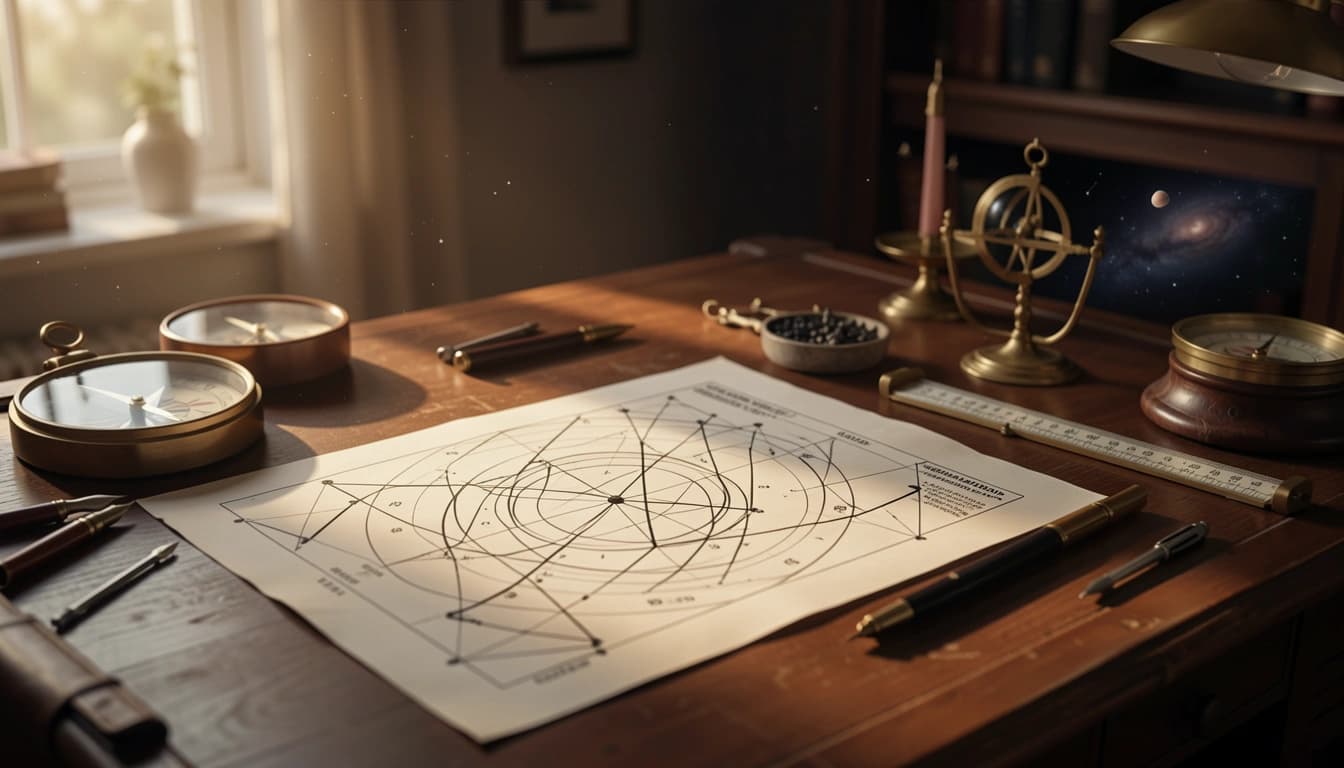
Aspects are the angular relationships between planets in your birth chart. They reveal how different parts of your personality interact - whether they support each other (harmonious aspects) or create friction (challenging aspects). Analysis Calculators automatically compute all major aspects: conjunctions (0°), sextiles (60°), squares (90°), trines (120°), and oppositions (180°). Many also include minor aspects like quincunxes (150°) and semisextiles (30°), which add nuance.
The orbs - the allowed degree of deviation from the exact angle - matter greatly. A conjunction at 0° is intense; at 8° it is still felt but softer. Standard orbs for major aspects are usually 6° to 10° for the Sun and Moon, and 4° to 6° for other planets. Analysis calculators let you adjust orbs or use default settings, giving you control over how strict or generous the aspect detection is. This flexibility is essential for accurate interpretation.
Understanding aspects helps you see the big picture: a chart full of trines suggests natural talent and ease, while many squares indicate areas of growth through challenge. The calculator highlights which aspects are exact (partile) and which are applying or separating, adding a timing dimension to your analysis.
How to Read Your Aspect List
When you run an analysis calculator, the output typically shows a table of aspects sorted by type or planet. Look for the tightest orbs first - those under 2° are extremely potent. Pay attention to aspects involving personal planets (Sun, Moon, Mercury, Venus, Mars) as they affect daily life most. Aspects to outer planets (Jupiter, Saturn, Uranus, Neptune, Pluto) often describe generational traits or long-term themes.
Harmonious aspects (trines, sextiles) indicate flow; challenging aspects (squares, oppositions) indicate tension that drives growth. A chart with no major challenging aspects is rare and often suggests a less dynamic personality. Use the calculator to count how many of each type you have - this ratio is a quick measure of your chart's overall harmony versus friction.
Discover Your Chart's Dominant Energies
Every birth chart has a dominant planet - the celestial body that exerts the strongest influence over your personality. Analysis calculators determine this by scoring each planet based on its sign placement, house position, aspects, and essential dignity. The planet with the highest score becomes your dominant or ruling planet, often more influential than your Sun sign alone.
For example, if your Mars is in Aries (its home sign), in the 1st house, and forming multiple tight aspects, it will likely dominate your chart. This means your drive, assertiveness, and energy levels are central to your identity. Conversely, a weak or debilitated planet (like Venus in Virgo or Saturn in Aries) may indicate an area of life requiring extra effort or development.
The dominant planet calculation also considers accidental dignity - a planet in an angular house (1st, 4th, 7th, 10th) gains extra weight. The tool provides a clear ranking so you can see which planet leads and which are subdued.
Why Your Dominant Planet Matters
Knowing your dominant planet helps you understand your core motivations. A dominant Jupiter suggests a philosophical, expansive nature; a dominant Saturn indicates discipline and a need for structure. This insight is especially useful for career guidance, relationship compatibility, and personal growth. Compare your dominant planet with a partner's - if both are Mars, expect dynamic but potentially competitive energy.
YesAstrology's Dominant Planet Calculator provides a detailed breakdown, including percentage scores for each planet. Use it alongside your aspect analysis for a complete picture.
Explore Planetary Strength and Essential Dignities
Essential dignity measures how comfortable a planet is in a given zodiac sign. A planet in its domicile (e.g., Moon in Cancer) or exaltation (e.g., Sun in Aries) is said to be dignified - it expresses its energy purely and powerfully. A planet in detriment (opposite sign) or fall (opposite exaltation) is debilitated, meaning its energy is strained or expressed with difficulty.
Analysis calculators compute this automatically. They assign points for each condition: domicile (+5), exaltation (+4), triplicity (+3), term (+2), and face (+1). Debilities subtract points. The total score for each planet reveals its essential strength. A planet with a high score acts as a reliable resource; a low-scoring planet may indicate an area where you feel insecure or challenged.
Beyond essential dignity, accidental dignity considers house placement, direct/retrograde motion, and speed. A planet in its own house (e.g., Mars in the 1st) gains accidental strength. Together, essential and accidental dignity give you a complete picture of planetary power in your chart.
How to Use Dignity Scores
When interpreting your chart, start with the most dignified planets - they represent your strengths. A dignified Venus suggests natural charm and artistic talent; a dignified Mercury indicates sharp communication skills. Debilitated planets are growth areas: for example, a debilitated Saturn might mean you struggle with boundaries, but conscious effort can turn this into mastery.
Compare dignity scores across your chart to see which signs and houses are emphasized. If many planets are dignified in fire signs, your chart has a strong creative and action-oriented flavor. Use the calculator's numerical output to validate intuitive readings.
Understand Elements, Modalities and Polarities
The four elements - fire, earth, air, water - describe your fundamental temperament. Three modalities - cardinal, fixed, mutable - describe how you initiate, sustain, or adapt. Two polarities - yin (feminine, receptive) and yang (masculine, assertive) - describe your basic energy orientation. Analysis calculators tally the distribution of planets across these categories to reveal your elemental and modal balance.
An imbalance, such as having no planets in water signs, suggests challenges with emotional expression or intuition. An overabundance of fixed signs indicates stubbornness but also reliability. The polarity score shows whether you lean toward extroversion (yang) or introspection (yin). These distributions are foundational to understanding your chart's overall character.
The calculator usually presents this as a pie chart or bar graph, making it easy to see at a glance. A balanced chart (roughly equal distribution) suggests adaptability; a lopsided chart indicates a strong but potentially rigid personality.
Interpreting Your Elemental Profile
If you have 4+ planets in one element, that element dominates your nature. Fire dominance: passionate, impulsive, creative. Earth dominance: practical, grounded, materialistic. Air dominance: intellectual, social, communicative. Water dominance: emotional, intuitive, sensitive. Missing an element entirely means you need to consciously develop those qualities, often through relationships or life experiences.
Modalities tell you how you act. Cardinal-heavy: you start projects but may struggle to finish. Fixed-heavy: you persevere but resist change. Mutable-heavy: you adapt easily but may lack direction. Use these insights to understand your work style, relationships, and personal growth edge.
Identify Powerful Chart Patterns and Configurations
Chart patterns are geometric arrangements of planets that create a unified theme. The most famous are the grand trine (three planets 120° apart, forming an equilateral triangle), the T-square (two planets in opposition, both square a third), and the grand cross (four planets forming two oppositions and four squares). Analysis calculators detect these patterns automatically.
A grand trine indicates natural talent and ease in the element involved (e.g., a water grand trine suggests psychic abilities). A T-square creates intense drive and tension, pushing the person to overcome obstacles. A grand cross is rare and indicates a life of constant challenge and potential mastery. Other patterns include the yod (two quincunxes pointing to a third planet), the kite (a grand trine with an opposition), and the stellium (three or more planets in one sign or house).
The calculator lists all detected patterns along with their orbs and participating planets. This is one of the most valuable features for advanced interpretation, as it reveals the overarching narrative of your chart.
What to Do When You Find a Pattern
If your chart has a grand trine, focus on developing the talent indicated by the element - but be aware of complacency. A T-square calls for action: the planet at the apex of the square is the key to resolving the tension. For a yod, the apex planet indicates a unique life purpose that may feel fated. Stelliums concentrate energy in one area of life; the house and sign of the stellium tell you where your focus lies.
Use the calculator to check for multiple patterns. A chart can have both a T-square and a grand trine, creating a complex interplay of ease and tension. The analysis tool helps you prioritize which pattern is most exact and therefore most influential.
Measure Balance Across Planets, Signs and Houses
Balance analysis goes beyond elements and modalities to examine the distribution of planets across the twelve signs and houses. Analysis calculators compute the percentage of planets in each sign and house, highlighting which areas of life are emphasized and which are empty. An empty house does not mean nothing happens there - it means the energy of that house is expressed through its ruler.
Sign balance reveals your zodiacal emphasis: if many planets occupy the same sign, that sign's archetype colors your entire personality. House balance shows where your life energy flows: a 10th house emphasis suggests career and public life are central; a 4th house emphasis points to home and family. The calculator also shows the balance between the eastern (self) and western (others) hemispheres, and the northern (private) and southern (public) hemispheres.
This macro view is essential for understanding life priorities and potential blind spots. For example, no planets in the 7th house might mean relationships are not a central focus, or that you need to develop partnership skills through your rising sign ruler.
Using Balance Data for Life Decisions
If your chart is heavily weighted in the southern hemisphere (houses 7-12), you are likely focused on external achievements and relationships. If it is weighted in the northern hemisphere (houses 1-6), you are more introspective and focused on personal development. Use this to understand your natural orientation and where to invest energy for growth.
An empty house is not a weakness: it simply means that house's themes are not highlighted. Look to the ruler of that house's sign for guidance. For instance, if your 7th house cusp is in Gemini and Mercury is well-placed, relationships may still be important but expressed through communication.
Reveal Hidden Strengths in Your Natal Chart
Beyond the obvious aspects and patterns, analysis calculators uncover hidden strengths that even experienced astrologers might miss. These include mutual receptions (two planets in each other's signs, creating a supportive link), midpoints (the point halfway between two planets, often sensitive), and fixed stars that align with planets. Some calculators also detect special degrees like critical degrees (0°, 13°, 26°) or anaretic degrees (29°), which add intensity.
Mutual reception is particularly powerful: for example, if your Venus is in Aries and your Mars is in Libra, they support each other even though both are in detriment. This can turn a weakness into a hidden asset. Midpoints reveal subconscious drives: the Sun/Moon midpoint, for instance, indicates the integration of your conscious and emotional selves.
These subtle factors often explain why a chart feels different from its basic description. A calculator that includes them gives you a competitive edge in self-understanding.
How to Access Hidden Insights
Look for a section in the analysis output labeled "Additional Factors" or "Special Configurations." Mutual receptions are usually listed as pairs of planets. Midpoints are shown as positions like "Sun/Moon = 15° Leo." Fixed stars are rare but potent: for example, Algol at 26° Taurus is associated with intensity and transformation.
Use these hidden strengths to refine your interpretation. A mutual reception can explain why a debilitated planet still functions well. A prominent fixed star can add a fated or genius quality to a planet. The more layers you explore, the more accurate your self-understanding becomes.
Advanced Astrology Analysis for Every Birth Chart
Analysis calculators are not just for beginners. Professional astrologers use them to save time and ensure accuracy. Advanced features include harmonic charts (e.g., 5th harmonic for creativity), declination (planetary latitude, which can create out-of-sign aspects), and solar arc directions (a predictive technique). These tools allow you to layer multiple analytical methods on the same chart.
Harmonic charts reveal hidden patterns: the 5th harmonic highlights creative and romantic themes; the 7th harmonic focuses on relationships. Declination analysis can show parallel aspects, which act like conjunctions. Solar arc directions use the progressed Sun to time events. When combined with the basic aspect and dignity analysis, these advanced tools provide a comprehensive reading.
YesAstrology's calculators are designed to scale with your expertise. Start with the basics and gradually explore the advanced sections as your confidence grows.
Getting Started with Advanced Features
Begin with the harmonic chart that matches your interest: 5th for creativity, 7th for relationships, 9th for philosophy. Look for tight aspects in the harmonic chart - they indicate areas of special talent. For declination, check if any planets have the same declination (within 1°); this creates a parallel that strengthens the connection.
Solar arc directions are best used for timing: when the directed Sun aspects a natal planet, that area of life becomes active. Use the calculator to generate a list of upcoming directions for the current year. This turns your birth chart into a living, evolving map.
AI-Enhanced Birth Chart Analysis Tools
Modern analysis calculators increasingly incorporate artificial intelligence to provide deeper interpretation. AI can recognize patterns that might escape the human eye, such as subtle aspect networks or rare configurations. It can also generate natural-language descriptions of your chart's strengths and challenges, saving you hours of research.
AI-enhanced tools at YesAstrology analyze your chart and produce a personalized report that explains each factor in plain language. The AI is trained on classical and modern astrological principles, ensuring that the interpretations are both traditional and relevant. It can also answer follow-up questions, like "Why is my dominant planet Saturn?" or "What does my T-square mean for my career?"
These tools are especially helpful for beginners who feel overwhelmed by the complexity of traditional astrology. The AI acts as a patient guide, translating the numbers and symbols into actionable advice.
How AI Improves Accuracy
AI analysis reduces human error in orb calculation and pattern detection. It can also cross-reference thousands of chart interpretations to provide the most likely meaning for your specific combination. For example, a T-square involving the Moon, Saturn, and Mars will be interpreted differently than one involving Venus, Jupiter, and Neptune - the AI understands these nuances.
The AI also learns from user feedback, improving its interpretations over time. This means the more people use the calculator, the smarter it becomes. For the user, this translates into increasingly precise and personalized readings.
Find the Best Analysis Calculator for Your Needs
Not all analysis calculators are the same. Some focus on aspects only, while others provide full dignity, element, and pattern analysis. To choose the right tool, first decide what you want to learn. If you are new to astrology, start with an all-in-one calculator that covers aspects, elements, and dominant planet. If you are an advanced student, look for tools that include harmonics, declination, and fixed stars.
YesAstrology offers a suite of free analysis calculators, each designed for a specific purpose. The Dominant Planet Calculator is perfect for identifying your ruling planet. The Annual Profection Calculator helps with timing. The South Node Calculator reveals past-life karma. Combine multiple tools for the most complete picture.
Always check the orbs and dignity system used by the calculator. Some use modern orbs (wider), others use traditional (tighter). Choose the one that aligns with your astrological tradition - but don't be afraid to experiment with both to see which resonates.
Quick Comparison of Calculator Types
| Calculator Type | Best For | Key Output |
|---|---|---|
| Aspect Calculator | Understanding planetary relationships | List of aspects with orbs |
| Dominant Planet | Finding your ruling planet | Planet scores and ranking |
| Element Balance | Seeing elemental strengths/weaknesses | Pie chart of element distribution |
| Dignity Calculator | Assessing planetary power | Essential/accidental dignity scores |
| Pattern Detector | Finding grand trines, T-squares, etc. | List of detected patterns |