On this page
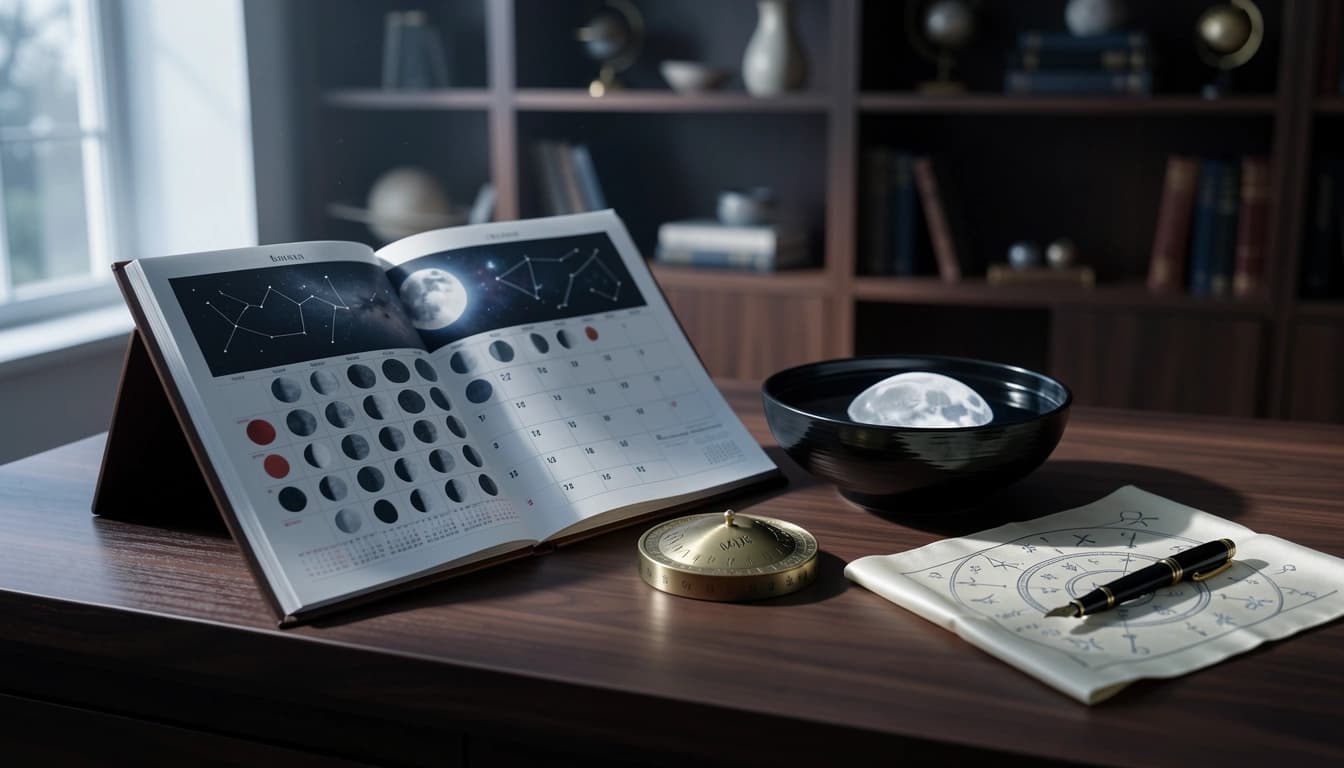
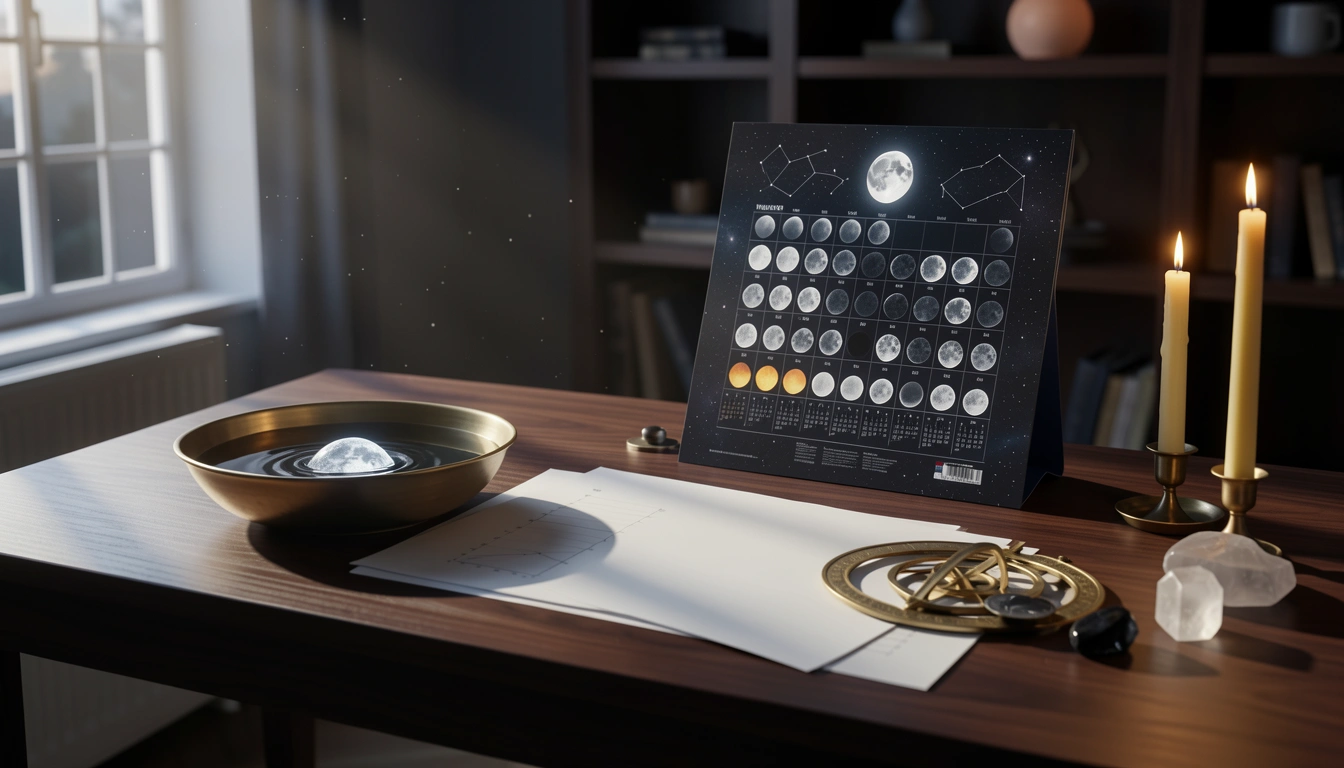
A moon phase calendar lays out the entire lunar cycle month by month, showing exactly when the Moon moves through its new, waxing, full, and waning stages. Instead of guessing which phase you are in today, you get a clear visual map of the Moon's journey: the date and time of the new moon, the first quarter, the full moon, the last quarter, and every shift in between. It also marks void-of-course periods, those stretches when the Moon makes no more major aspects before changing sign, which many astrologers treat as poor timing for starting something new.
The value of a moon phase calendar is practical. You can plan launches, conversations, rest days, and important decisions around the energy of each phase rather than against it. A waxing moon favors building momentum and taking action, a full moon brings culmination and clarity, and a waning moon is better for finishing, editing, and letting go. Having the whole month in front of you means you can see the rhythm ahead and choose your moments with intention.
YesAstrology's Free Moon Phase Calendar works as a calculator that computes the lunar phase for any date you select, then interprets what that phase means across the areas that matter most: love and relationships, career and purpose, and your subconscious inner life. Alongside the phase meanings, it highlights void-of-course windows so you know when to hold off and when to act. Use it as a monthly planning companion, then go deeper with the related premium report when you want a fuller reading of your personal lunar pattern.
What Is a Moon Phase Calendar?
A moon phase calendar is a monthly chart that maps the Moon's eight observable phases — new moon, waxing crescent, first quarter, waxing gibbous, full moon, waning gibbous, third quarter, and waning crescent — along with the exact dates and times each phase peaks in a given month. It also tracks the Moon's daily zodiac sign placement and void-of-course periods, when the Moon makes no further applying aspects before changing signs.
In astrological practice, the phase you are born under sets the tone of your natal Moon: a new moon in Scorpio carries a different emotional signature than a full moon in Taurus, and the waxing crescent favors initiation while the waning phases favor release. The calendar also shows when the Moon transits through each sign — for example, a Moon in Cancer trining natal Venus feels nurturing, while a Moon in Aries squaring natal Saturn brings emotional friction — so you can time rituals, launches, and rest accordingly.
Void-of-course windows are flagged separately because actions begun during them are traditionally considered unlikely to bear fruit: signing a contract while the Moon is void in Libra may stall, whereas the same act once the Moon enters Scorpio and applies to Pluto gains traction. The Free Moon Phase Calendar at YesAstrology lays out a full month at a glance, combining phase timing, sign ingress, and void-of-course spans in one view.
How Does a Moon Phase Calendar Calculator Work?
A moon phase calculator computes the Moon's ecliptic longitude relative to the Sun for a given date and time, then converts that angular separation into one of the eight phases: 0° is new moon, 90° first quarter, 180° full moon, and 270° third quarter. It interpolates between these cardinal points to place intermediate days on the waxing or waning curve, and it cross-references the Moon's longitude against the tropical zodiac to determine which sign the Moon occupies at each moment.
Under the hood, the engine propagates the Moon's orbital position using established ephemeris data (typically a truncated ELP-2000 or similar lunar theory), correcting for the observer's timezone so phase peaks display in local time. Void-of-course detection works by scanning forward from the Moon's current position to its next sign ingress and checking whether any applying aspect to another planet completes before that ingress — if none does, the span from the last separating aspect to the ingress is flagged as void. For example, if the Moon at 15° Leo makes no further conjunction, sextile, square, trine, or opposition before entering Virgo, the calculator marks the remaining Leo transit as void-of-course.
Because the Moon moves roughly 13° per day, its sign changes about every 2.25 days and its phase peaks are accurate to within minutes of the astronomical event. The calculator does not require birth data — you simply select a month, and it returns the full grid of daily phases, sign placements, and void windows. For deeper timing work, YesAstrology pairs this with a tools directory where you can layer the lunar data against your natal chart aspects and house placements.
Calculate Your Free Moon Phase Calendar
The Free Moon Phase Calendar at YesAstrology displays each day's lunar phase, the Moon's zodiac sign, void-of-course (VOC) periods, and timing guidance for the month you select — all without cost or sign-up. It is built on the YesAstrology tools engine, which computes the Moon's geocentric ecliptic longitude for every hour of the month and derives the phase from the Sun–Moon elongation angle.
Under the hood, the calculator converts the Moon's ecliptic longitude into an elongation from the Sun: 0° is New Moon, 90° waxing first quarter, 180° Full Moon, 270° waning last quarter, and the intermediate arcs produce the crescent and gibbous phases. Because the Moon moves roughly 12–13° per day against the zodiac, it completes a full sign in about 2.5 days and a complete phase cycle (synodic month) in 29.53 days — so a single calendar month typically shows one Full Moon and one New Moon, occasionally two (a "blue moon" month) or none visible in a given month's boundaries.
Void-of-course periods are flagged by detecting the Moon's last Ptolemaic aspect (conjunction, sextile, square, trine, or opposition) to any planet before it changes sign. From that final aspect until the sign ingress, the Moon is void — traditionally a poor window for initiating matters that should "stick," such as signing contracts or launching a product, but a good window for routine tasks, follow-ups, and clearing backlogs. For example, if the Moon is at 27° Scorpio forming a trine to Jupiter in Pisces, the VOC window runs from that trine until the Moon crosses into Sagittarius.
The timing guidance column pairs each phase with practical advice: New Moon favors setting intentions and starting projects, waxing phases favor building and negotiating, Full Moon favors culmination, reviews, and emotional release, and waning phases favor editing, closing, and discarding. Because no birth data is required, the calendar works for any date range you browse — enter a month and the engine returns the full grid immediately.
How to Find and Interpret Your Moon Phase Calendar
To find your Moon phase calendar, open the Free Moon Phase Calendar on YesAstrology, choose the month you want, and read the grid day by day: each cell shows the phase icon, the Moon's sign, the exact time of phase changes, and any void-of-course window. To interpret it, track three things in order — the phase (New, Waxing Crescent, First Quarter, Waxing Gibbous, Full, Waning Gibbous, Last Quarter, Waning Crescent), the sign the Moon occupies, and whether the Moon is void.
The phase tells you the developmental stage of any cycle you began. A project started at a New Moon in Capricorn (Sun and Moon conjunct in Capricorn) matures through the First Quarter square — often a friction point where structure is tested — reaches expression at the Full Moon, and is revised during the Last Quarter. Compare this with a cycle begun at a Full Moon in Cancer: you are releasing rather than seeding, so the waning half becomes the productive stretch for editing and letting go.
The Moon's sign colors the emotional register of the day. The Moon in Gemini favors short messages, errands, and dual-track thinking; the Moon in Scorpio favors deep research, financial review, and honest confrontation; the Moon in Libra favors diplomacy and aesthetic choices; the Moon in Aries favors decisive first moves. Cross-reference the sign with your natal chart: if the transiting Moon crosses your 10th house Midheaven in Aries while your natal Mars sits in the 2nd house, public visibility spikes but the push may cost money — a good day to pitch, a poor day to overspend.
Void-of-course windows modify everything above. When the Moon is void in Tries after a conjunction to Saturn, outcomes of new actions tend not to "take" — meetings drift, purchases disappoint, decisions get re-litigated. Schedule those actions after the ingress instead. For deeper timing work, layer transits, solar arcs, and progressions onto the phase calendar: a Full Moon that also opposes your progressed Venus carries far more relational weight than an ordinary Full Moon. When exact birth time is unknown, YesAstrology defaults to a solar-noon chart so planetary signs and aspects remain accurate even without a birth clock, while house cusps (Placidus, Whole Sign, or Equal) are marked as approximate.
What Does Your Moon Phase Calendar Reveal?
A moon phase calendar reveals the exact illuminated percentage of the Moon on each day of the month, the precise moments of the New Moon, First Quarter, Full Moon, and Last Quarter, and the zodiac sign the Moon occupies as it transits — typically spending about 2.5 days in each sign from Aries through Pisces. Because the Moon completes one full cycle every 29.53 days (a synodic month), the calendar shows you where you are in that recurring rhythm and when the next shift occurs.
For example, if the calendar shows the Moon entering Taurus on the 12th and reaching its Full phase there on the 14th, you know that emotional attention will gravitate toward Taurus themes — security, comfort, and material stability — culminating at the Full Moon, when the Sun in Scorpio opposes the Moon and brings those concerns to a visible peak. Similarly, a void-of-course Moon period (marked when the Moon makes its last Ptolemaic aspect — conjunction, sextile, square, trine, or opposition — before leaving its current sign) signals stretches when new initiatives tend to stall, which the calendar flags so you can time important actions around them.
The calendar also lets you compare lunar timing against your natal chart. If your natal Moon sits at 18° Virgo, you can watch for the monthly lunar return — when the transiting Moon re-crosses 18° Virgo — as a recurring emotional reset point. Cross-referencing Full Moons with your natal planets reveals which houses are being activated: a Full Moon conjunct your natal Saturn in the 10th house, for instance, often coincides with public recognition or a career decision reaching completion, while a New Moon trine your natal Jupiter in the 9th expands travel or study plans seeded at that moment.
Under the hood, the Free Moon Phase Calendar computes lunar longitude for each day, derives the phase angle between the Sun and Moon, and maps the Moon's sign placement and void-of-course windows. Because lunar calculations depend only on date and time zone rather than an exact birth hour, the calendar remains accurate even without personal birth data — making it a reliable starting point before layering in fuller chart work such as house cusps or progressed Moon cycles.
Moon Phase Meanings and Core Insights
Each of the eight moon phases carries a distinct interpretive meaning: New Moon (0% illumination) marks initiation and seed-planting; Waxing Crescent brings early momentum; First Quarter (50% waxing) creates a decision-point tension, often a square between Sun and Moon; Waxing Gibbous refines and adjusts; Full Moon (100%) delivers culmination, revelation, and opposition-driven clarity; Waning Gibbous integrates lessons; Last Quarter (50% waning) triggers release and re-evaluation through another Sun–Moon square; and Waning Crescent is the final rest before the cycle restarts.
The zodiac sign the Moon occupies colors how each phase expresses. A New Moon in Aries initiates boldly — new projects led with independence — whereas a New Moon in Libra seeds partnerships and negotiations. A Full Moon in Cancer heightens domestic and emotional matters, often opposing a Capricorn Sun's focus on structure and responsibility, while a Full Moon in Aquarius pits collective ideals against Leo's personal creative expression. If the Full Moon forms a trine to your natal Venus, emotional closure arrives smoothly through affection or art; if it squares your natal Pluto, the same culmination may surface power struggles that demand honest confrontation.
Void-of-course periods deserve special attention in practical timing.
Moon Phase Calendar and Love and Relationships
The Moon phase calendar is a practical timing tool for love and relationships: the New Moon favors setting intentions around partnership, the waxing phases support building connection, the Full Moon brings emotional culminations and revelations, and the waning phases are suited to releasing patterns that no longer serve a bond. Because the Moon completes a full cycle in about 29.5 days, each phase offers a distinct relational quality you can plan around.
To read the calendar against your own chart, note which house the transiting Moon occupies. A Full Moon in your 7th house of partnerships often coincides with a significant moment with a partner — an agreement, a confrontation, or a decision — while a New Moon in the 5th house of romance and pleasure is a strong window for initiating something new with someone you are dating. The Moon's applying aspects matter too: a Moon approaching a trine to Venus suggests easy rapport and receptivity, whereas a Moon squaring Venus or Mars can amplify tension in conversations that would otherwise go smoothly.
Void-of-course periods, which the calendar tracks explicitly, deserve caution in relationship matters. When the Moon makes its last major aspect before changing sign and then travels without forming another, plans made during that window frequently stall or get revised — a text sent under a void Moon may be misread, and a first date scheduled then can feel oddly flat. If you are working with your natal chart, cross-reference the Moon phase with your Venus sign: a waxing Moon in the same element as your Venus (for example, a waxing water Moon with Venus in Cancer) tends to support emotionally open conversation, while a waning Moon in hard aspect to your natal Venus favors apologies, closures, and letting go rather than new beginnings.
For deeper relational analysis, the calendar pairs naturally with synastry and composite work. The Moon phase in effect at the moment two people meet or commit often echoes the tone of the relationship's early chapters, and tracking lunations against a shared composite chart shows when the relationship itself is entering a waxing or waning chapter.
Moon Phase Calendar and Career and Purpose
The Moon phase calendar helps you time career actions: New Moons are for planting professional intentions and launching initiatives, the waxing Moon supports building momentum and gaining traction, Full Moons illuminate results and turning points in public-facing work, and the waning Moon is best for editing, wrapping up projects, and clearing professional clutter. The calendar's void-of-course markers flag periods when signings, negotiations, and applications tend to lose momentum.
House placement sharpens the reading considerably. A New Moon falling in your 10th house of career and Midheaven is one of the strongest annual windows for accepting a role, announcing a venture, or reframing your public identity, whereas a New Moon in your 6th house of daily work and routines is better used to restructure your schedule, systems, and health habits that underpin sustained output. A Full Moon in the 2nd house of income often coincides with a financial reckoning — a rate increase, a contract conclusion, or a decision about what your work is actually worth — while a Full Moon in the 11th house can surface developments involving sponsors, communities, and long-term professional networks.
Planetary context matters as much as the phase itself. A waxing Moon conjoining Jupiter expands opportunity and visibility, making it favorable for pitches and applications; a waxing Moon square Saturn brings friction and demands revision, which is useful for stress-testing a plan but poor for celebrations or launches. If your Midheaven sits in Capricorn, lunations in Capricorn carry extra weight for your vocation, and a Full Moon opposing your natal Sun in the 4th house can pull attention toward home or private life at the very moment career matters peak — recognizing that tension in advance lets you schedule deliberately rather than reactively.
Timing cycles layer on top of the monthly lunation rhythm. Transiting Saturn's slow movement through your 10th house sets a multi-year theme of earned responsibility, while secondary progressions and solar arcs mark longer arcs of professional maturation; the Moon phase calendar shows where within those larger cycles each individual month offers the most workable opening. For a full house-by-house breakdown of professional potential, the Birth Chart Houses Premium Analysis Report expands on these dynamics.
Moon Phase Calendar and Subconscious Inner Life and Expression
A moon phase calendar maps the four primary lunation stages — New Moon, First Quarter, Full Moon, and Last Quarter — across a full month, showing exactly when the Sun–Moon angle reaches 0°, 90°, 180°, and 270°. These phases govern the subconscious layer of experience: the New Moon (Sun conjunct Moon) turns attention inward toward seeding and intention, while the Full Moon (Sun opposite Moon) externalizes what has been gestating, bringing hidden material into conscious expression.
Because the Moon moves through the entire zodiac in roughly 27.3 days, each phase also inherits a sign placement that colors its psychological register. A Full Moon in Capricorn, for example, opposes the Sun in Cancer and illuminates the tension between public duty (10th house themes) and private emotional security (4th house themes), whereas a Full Moon in Leo squares the fixed earth of a Taurus Sun, forcing a confrontation between creative self-expression and material stability. The calendar renders these sign placements visible day by day, so you can see which houses of your own chart the lunation activates.
Under the hood, the calculator computes the Moon's ecliptic longitude for each day and compares it to the Sun's longitude to derive the illuminated fraction and phase name. When you supply an exact birth time, house cusps are derived using the Placidus system by default (Whole Sign and Equal House are also selectable), anchoring each lunation to a precise house in your natal chart. Without a birth time, the tool defaults to a solar-noon chart, which preserves planetary sign and aspect accuracy while leaving house placement approximate — useful for reading phase timing even when the hour of birth is unknown.
Practical use is straightforward: check the calendar for the upcoming New Moon to set intentions aligned with its sign, then track the waxing crescent through First Quarter (a square aspect that tests the seed) to the Full Moon, when the opposition demands integration of what has emerged. Transits of the progressed Moon and solar arc activations of your natal lunations layer onto this monthly rhythm, marking longer cycles when a phase theme recurs in your life. You can explore the full set of complementary readings in our Tools directory.
Void of Course Moon Periods and Timing Guidance
The Moon is void of course from the moment it makes its last Ptolemaic aspect (conjunction, sextile, square, trine, or opposition) in its current sign until it enters the next sign — a window that can last from a few minutes to more than two days. Astrological timing tradition holds that actions begun during this interval tend to stall, drift, or fail to produce the intended result, because the Moon no longer forms applying aspects to other planets to carry the initiative forward.
The nature of the void period is colored by the last aspect made. If the Moon's final contact is a trine to Jupiter in Sagittarius, the void often feels buoyant and unfocused — plans expand loosely but rarely commit. If the last aspect is a square to Saturn in the 10th house, the void tends toward obstruction and delay in career matters. A void following an opposition to Pluto may bring an emotional release that dissipates before any concrete outcome settles. The calendar marks each void window with its start time, end time, and the sign the Moon is voiding from and entering into, so you can see the full arc at a glance.
Timing guidance during void-of-course periods falls into three practical categories. First, avoid initiating actions that require a definite outcome: signing contracts, launching products, starting medical procedures, or making formal requests. Second, favor void-friendly activities — routine administrative work, brainstorming, exercise, rest, and completing tasks already in motion. Third, if an event must occur during a void, note the Moon's sign and house placement at the moment of the event; the chart of that moment will show a Moon that never completes its aspect pattern, which often explains why the outcome feels ambiguous or requires a later redo.
Technically, the calculator determines void status by stepping the Moon's longitude forward through its ephemeris, identifying the final applying aspect before the sign ingress, and comparing that timestamp to the ingress time itself. Because the Moon moves roughly 12–13° per day, these windows shift by about an hour each day, which is why a static printed calendar can drift out of sync — the tool recomputes them live for your selected month and time zone. For a deeper reading of how these windows interact with your natal Moon placement, see the related premium report available with this tool.

Moon Phase Calendar vs Lunar Calendar
A moon phase calendar shows the four principal phases — new moon, first quarter, full moon, and last quarter — with their exact dates and times, while a lunar calendar tracks the Moon's day-by-day position through the zodiac signs and its void-of-course periods. In short: a phase calendar tells you what illumination the Moon carries, and a lunar calendar tells you where the Moon is and what it is doing astrologically on any given day.
The distinction matters when you are timing actions. A moon phase calendar marks the moment the Sun-Moon elongation reaches 0° (new), 90° (first quarter), 180° (full), and 270° (last quarter) — these are the lunation turning points that activate your natal planets by conjunction, square, and opposition. For example, a full moon at 15° Taurus forms an exact opposition to any natal Sun or Mercury near 15° Scorpio, while a first quarter square to your natal Venus in Leo describes a friction point in relationships rather than a phase of the Moon itself.
A lunar calendar, by contrast, is continuous: it lists the Moon's sign every day (Cancer Moon, Leo Moon, and so on), its void-of-course intervals when the Moon makes no further applying aspects before changing sign, and often its perigee/apogee distance. Void-of-course periods are invisible on a phase calendar — a Moon can be waxing gibbous and simultaneously void, which is why practitioners consult both. The Free Moon Phase Calendar at YesAstrology combines these views into a single monthly grid so you can see phase timing alongside void-of-course windows and daily lunar guidance in one place.
How Accurate Is a Moon Phase Calendar?
A well-computed moon phase calendar is accurate to within a few minutes of the true astronomical instant, because the Moon's orbit is one of the most precisely measured motions in the sky. The four principal phases depend only on the Sun-Moon elongation angle, which modern ephemerides (based on the ELP-2000/82 lunar theory) resolve to better than a tenth of an arcsecond — so the listed time of a full moon is typically correct to the minute, adjusted to your local time zone.
Accuracy degrades only at the edges: minor phases like waxing crescent or waning gibbous are conventionally assigned to the midpoint of a range rather than a single instant, and the Moon's illuminated fraction shifts continuously, so a calendar showing "78% illuminated" is a snapshot of one moment within that day. Time zone and daylight-saving handling is the other variable — a full moon at 02:14 UTC on March 3 falls on March 2 for readers in New York (21:14 EST) but March 3 for readers in Berlin (03:14 CET).
For astrological work, the phase timing feeds directly into transit interpretation: a lunar eclipse, for instance, occurs only at a full moon conjunct the lunar Nodes, and the exact orb matters — a Moon at 27° Pisces opposing a natal Sun at 29° Virgo is within a 2° orb and reads strongly, while 24° Pisces vs 29° Virgo (5° wide) is looser. Void-of-course calculations are equally precise, since they depend on the last applying aspect of the Moon before sign change, computed from the same ephemeris. If you want the phase times verified against your own location, the Free Moon Phase Calendar on YesAstrology displays them in your selected time zone alongside the void-of-course intervals for each day of the month.
Practical Advice and Next Steps for Using Your Moon Calendar
To use your moon calendar effectively, open the Free Moon Phase Calendar, set your month and location, then mark three anchor dates: the New Moon for initiating, the First Quarter for adjusting, and the Full Moon for culmination — each one tied to the zodiac sign the Moon occupies as it forms its conjunction, square, and opposition to the Sun. Void-of-course windows are flagged alongside these phases so you can see exactly when the Moon makes its final major aspect before changing sign, which is the period best reserved for routine tasks rather than launches.
Build a simple weekly rhythm around the Moon's sign placement: a Moon in Capricorn favors structured planning and 10th house career matters, while a Moon in Cancer turns attention to 4th house home and family needs. When the Moon applies a trine to Venus, schedule social or creative work; when it squares Saturn, expect friction with deadlines or authority and hold off on signing contracts. For example, a Full Moon in Scorpio opposing the Sun in Taurus often coincides with financial or emotional culminations tied to 2nd house income versus 8th house shared resources.
Under the hood, the calendar computes lunar longitude from your selected date and timezone, derives each phase from exact Sun–Moon angular separation (0° conjunction for New Moon, 90° square for First Quarter, 180° opposition for Full Moon, 270° for Last Quarter), and detects void-of-course status by checking whether the Moon's next sign ingress follows its final Ptolemaic aspect (conjunction, sextile, square, trine, or opposition). Because the Moon moves roughly 13° per day, phase times shift daily — always check the exact timestamp rather than assuming a phase lands on the same calendar date each month.
Next steps: bookmark the calendar, cross-reference the highlighted dates against your own chart's Ascendant and house cusps (Placidus, Whole Sign, or Equal House — the phase meaning activates whichever houses the transiting Moon rules or occupies), and keep a short log of what occurred at each New and Full Moon. Over several lunations, patterns emerge — repeated Full Moons falling in your 7th house, for instance, tend to surface partnership themes that a single reading would miss. For deeper timing work, layer secondary progressions and solar arc directions onto the same dates to see when a lunar trigger matures into a longer cycle.