On this page
The Astrological Events & Celestial Moon Calendar is your definitive guide to the cosmos in motion. This living ephemeris tracks every significant celestial event - from New Moons and Full Moons to planetary retrogrades, solar and lunar eclipses, and the seasonal turning points of the equinoxes and solstices. Unlike a standard calendar, this tool is built for astrological practice, offering precise UTC timings that automatically adjust to your local timezone when synced to your device.
Understanding these cosmic rhythms is essential for anyone who wants to align their personal energy with the wider planetary cycles. The Moon's phases govern emotional tides and intuitive clarity, while retrogrades and eclipses act as cosmic recalibration points. By using the Astrological Events & Celestial Moon Calendar, you gain a practical framework for timing important decisions, setting intentions, and navigating periods of change with greater awareness. This guide walks you through each event type, explains its astrological meaning, and shows you exactly how to interpret and apply these transits to your own birth chart.
For further reading, you can also explore Home.
Explore Astrology Calendar Events
The astrology calendar is far more than a list of dates - it is a dynamic map of planetary movement that reveals the energetic weather of each day. Every event, from a subtle Moon phase shift to a dramatic eclipse, carries a specific astrological signature that influences collective moods and individual experiences. Learning to read this calendar means understanding the interplay between the Moon's rapid transit through the zodiac, the slower movements of the outer planets, and the rare alignments that create pivotal moments.
When you open the calendar, you will see a rich tapestry of symbols: lunar phase icons, planetary glyphs for retrograde periods, and markers for eclipses and seasonal shifts. Each event is timestamped in Coordinated Universal Time (UTC), ensuring accuracy regardless of where you live. The calendar is designed to be both a reference tool for advanced astrologers and an accessible guide for beginners. You can filter by event type, scroll through months or years, and click on any date to see a detailed breakdown of the day's astrological aspects.
Why an Astrology Calendar Differs from a Standard Calendar
A standard calendar marks appointments and deadlines in clock time. An astrology calendar, by contrast, tracks planetary positions and angular relationships that shift continuously. The Moon, for example, changes signs every 2.5 days and completes a full cycle from New to New in about 29.5 days. Mercury turns retrograde three to four times a year for roughly three weeks each time. These are not fixed dates like holidays - they are astronomical events with precise beginning and ending points that vary by year.
This difference matters because astrological timing is not arbitrary. A New Moon in Capricorn carries a completely different energetic signature than a New Moon in Cancer. A Mercury retrograde in an air sign behaves differently than one in an earth sign. The astrology calendar captures these nuances by pairing each event with its zodiac sign and degree position, giving you the context you need to interpret its meaning accurately.
Today’s Astrology Calendar and Celestial Events
Knowing what is happening in the sky right now is the first step toward conscious alignment with cosmic energy. Today’s astrology calendar shows you the Moon’s current sign and phase, any active retrograde periods, and the major aspects forming between planets. This snapshot helps you understand why you might feel more emotional, restless, or focused on a particular day without knowing why.
The Moon’s placement is often the most immediately felt influence. When the Moon is in a fire sign like Aries or Leo, energy tends to be bold and impulsive. In water signs like Pisces or Scorpio, emotions run deeper and intuition sharpens. Today’s aspects - such as a Moon square Saturn or a Venus trine Jupiter - add layers of complexity that can support or challenge your plans. By checking the daily calendar, you can choose the best times for important conversations, creative work, or rest.
How to Read Today’s Celestial Snapshot
Start by noting the Moon’s sign and phase. A waxing Moon (from New to Full) is generally a time for building momentum, while a waning Moon (from Full to New) favors release and completion. Then look for any planets in retrograde - these are marked with an “R” symbol. Finally, scan the aspect list for conjunctions, squares, trines, and oppositions involving personal planets (Sun, Moon, Mercury, Venus, Mars) as these have the most noticeable effects on daily life.
For example, if today shows a New Moon conjunct Mercury in Gemini, expect a surge of mental energy perfect for brainstorming and starting a writing project. If Venus is square Saturn, romantic or financial matters may feel restricted or serious. The calendar provides these details at a glance, allowing you to plan your day with astrological intelligence.
Full Moon Calendar and Full Moon Dates
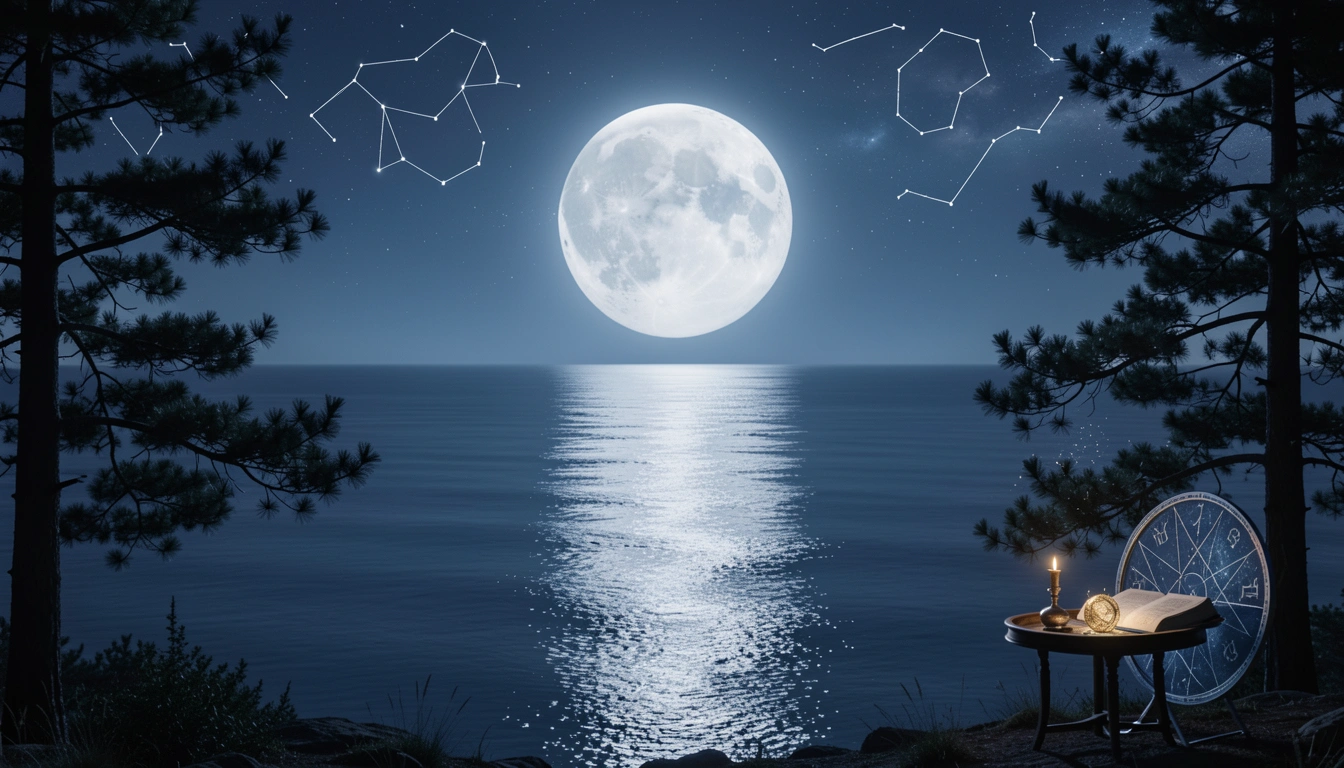
Full Moons are among the most powerful and visible events in the astrology calendar. They occur when the Sun and Moon are in exact opposition, with the Earth between them, fully illuminating the lunar face. Astrologically, a Full Moon represents culmination, revelation, and emotional peak. Whatever was seeded during the corresponding New Moon reaches a point of fruition or clarity now.
Each Full Moon falls in a specific zodiac sign, which colors its expression. A Full Moon in Aries brings assertive, fiery emotions and a need for independence. A Full Moon in Taurus grounds energy into physical comfort and material security. The calendar lists every Full Moon for the year with its exact UTC time, zodiac sign, and degree. This allows you to prepare for the emotional intensity that often builds in the 48 hours before and after the exact opposition. Many practitioners use Full Moons for releasing rituals, gratitude practices, and making conscious decisions about what to let go of.
Interpreting Your Full Moon Experience
To understand how a specific Full Moon affects you personally, look at which house it falls in within your birth chart. The house reveals the life area most activated - for example, a Full Moon in your 7th house highlights relationships and partnerships, while a 10th house Full Moon brings career matters into focus. Also note any aspects the Full Moon makes to your natal planets. A Full Moon conjunct your natal Venus may amplify love and beauty themes, while a square to Saturn could bring up feelings of restriction or responsibility.
The sign of the Full Moon also matters for collective themes. A Full Moon in Pisces often brings heightened intuition, dreams, and a sense of merging with the collective. A Full Moon in Virgo calls attention to health routines, details, and service. The calendar provides the raw data; your birth chart gives it personal meaning.
New Moon Calendar and New Moon Dates
New Moons mark the beginning of the lunar cycle, when the Sun and Moon are conjunct in the same zodiac sign. This alignment creates a dark sky, symbolically representing a blank slate. Astrologically, New Moons are the premier time for setting intentions, planting seeds, and initiating new projects. The energy is inward, receptive, and fertile - ideal for visioning rather than executing.
The sign of each New Moon determines the thematic flavor of the intentions you set. A New Moon in Capricorn supports career goals and long-term structures. A New Moon in Cancer nurtures home and family intentions. The calendar provides the exact date, time, and sign for every New Moon of the year. For best results, set your intentions within the first 24 hours after the exact New Moon, while the energy is still fresh and building. Write them down, speak them aloud, or create a small ritual to anchor your desires into the lunar cycle.
New Moon Intention Setting Ritual
Begin by finding a quiet space where you will not be disturbed. Light a candle that corresponds to the sign of the New Moon - a green candle for Taurus, a red candle for Aries, and so on. Take several deep breaths to center yourself. Write down your intentions on a piece of paper using present tense language, as if they are already manifesting. Be specific: instead of “I want more money,” write “I am gratefully receiving a new income stream of $X per month.”
Fold the paper and place it under the candle or on your altar. Sit in silence for a few minutes, visualizing your intentions as already real. When you are ready, blow out the candle. Keep the paper somewhere you will see it daily until the next New Moon, reinforcing your commitment. The calendar helps you schedule this ritual on the correct date, ensuring your intentions are planted at the most energetically potent moment.
Supermoon Dates and Astrological Meaning
A Supermoon occurs when a Full Moon or New Moon coincides with the Moon’s closest approach to Earth in its elliptical orbit, known as perigee. This makes the Moon appear larger and brighter in the sky than usual. Astrologically, Supermoons amplify the energy of whatever lunar phase is occurring. A Super Full Moon intensifies emotions, revelations, and culminations, often bringing dramatic releases or breakthroughs. A Super New Moon supercharges intention setting, making it an exceptionally powerful time for new beginnings.
Not all Supermoons are equal - the degree of amplification depends on how close the Moon is to perigee at the exact moment of the phase. The calendar identifies Supermoons clearly, noting both the date and the Moon’s distance from Earth. During a Supermoon, you may notice stronger tides, more vivid dreams, and heightened sensitivity in yourself and others. It is a time to be gentle with your nervous system and to honor the intensity rather than resist it. Many astrologers consider Supermoons as periods of accelerated karma, where events unfold faster and with greater impact.
Mercury Retrograde Calendar and Dates
Mercury retrograde is perhaps the most well-known astrological event, occurring three to four times each year for approximately three weeks. During this period, Mercury appears to move backward from our perspective on Earth. Astrologically, Mercury rules communication, travel, technology, and contracts. When retrograde, these areas tend to experience delays, misunderstandings, and technical glitches. The purpose is not to cause chaos but to invite review, reflection, and revision.
The calendar provides the exact start and end dates for each Mercury retrograde period, including the shadow phases - the two weeks before and after the retrograde when effects are felt more subtly. The sign Mercury retrogrades through is crucial. A retrograde in an earth sign like Taurus may manifest as financial or value-related delays, while a retrograde in a water sign like Scorpio can stir up deep psychological material. Knowing the dates allows you to plan ahead: avoid signing major contracts, back up your data, allow extra travel time, and double-check all communications.
Surviving and Thriving During Mercury Retrograde
Rather than fearing Mercury retrograde, learn to work with its energy. Use the pre-retrograde shadow period to complete projects and tie up loose ends. During the retrograde itself, shift your focus inward: revisit old ideas, reconnect with people from your past, and reflect on what needs revision. This is an excellent time for editing, research, and meditation. Avoid launching new ventures or making irreversible commitments until Mercury stations direct and the post-shadow period clears.
If a misunderstanding occurs, practice patience. Mercury retrograde often reveals flaws in systems or communication that need fixing. The calendar helps you track each phase so you can adjust your schedule accordingly. For example, if a job interview falls during a Mercury retrograde, treat it as a exploratory conversation rather than a final decision. The information gained may prove valuable later.
Venus Retrograde and Other Planetary Retrogrades
Venus retrograde occurs approximately every 18 months, lasting about six weeks. During this period, themes of love, beauty, money, and values come under review. Relationships from the past may resurface, and our sense of self-worth can be questioned. Venus retrograde is not a time to start a new relationship or make major financial investments; it is a time to reassess what and who you truly value.
Other planets also retrograde periodically: Mars every two years for about two months, Jupiter annually for four months, Saturn annually for four and a half months, and the outer planets (Uranus, Neptune, Pluto) for roughly half the year each. The calendar tracks all of these, providing the exact dates and signs for each retrograde station. Slower-moving planets like Saturn and Pluto have generational effects, while Venus and Mars retrograde periods are more personal. Understanding which planets are retrograde at any given time helps you contextualize collective and personal challenges.
How to Work with Venus Retrograde
During Venus retrograde, avoid getting married, getting engaged, or making expensive purchases. Instead, use the period to reflect on your relationship patterns. Journal about what you truly need from partnerships. Reconnect with an old friend or creative hobby you have neglected. If an ex reappears, proceed with caution - the retrograde energy often brings people back only to show you what is not meant to last.
Financially, Venus retrograde is ideal for budgeting, auditing expenses, and reassessing your spending habits. It is a poor time for speculative investments. The calendar helps you mark the Venus retrograde period so you can make conscious choices rather than reactive ones. When Venus stations direct, you can move forward with greater clarity about what you truly desire.
Solar Eclipse Calendar and Astrology
A solar eclipse occurs when the Moon passes between the Earth and the Sun, blocking the Sun’s light either partially or totally. Astrologically, solar eclipses are amplified New Moons. They mark powerful new beginnings, often sudden and fated. Eclipses tend to accelerate timelines and bring events that feel destined or out of our control. They occur in pairs (solar and lunar) roughly every six months, during eclipse seasons.
The calendar lists every solar eclipse with its type (total, annular, or partial), date, UTC time, and zodiac sign. A total solar eclipse is the most potent, often associated with major life shifts. The sign and house of the eclipse in your birth chart indicate the area of life where change will manifest. Unlike a regular New Moon, an eclipse can bring external events that force new directions. The calendar helps you prepare by showing when eclipse seasons begin, allowing you to avoid launching critical initiatives during these intense periods.
Navigating Solar Eclipse Energy
During a solar eclipse, resist the urge to force outcomes. The energy is too volatile for clear intention setting. Instead, observe what unfolds without attachment. Eclipses often reveal hidden truths or create sudden opportunities that redirect your path. If you feel disoriented, that is normal - the fog typically lifts within a few days after the eclipse.
To work with a solar eclipse, note the house it activates in your birth chart. If it falls in your 1st house, expect changes to your identity or appearance. In the 7th house, relationships may transform. The calendar provides the raw astronomical data; your birth chart interpretation gives it personal relevance. Avoid making permanent decisions during the eclipse window itself, but pay close attention to what arises.
For further reading, you can also explore Tools.
Lunar Eclipse Calendar and Astrology
A lunar eclipse occurs when the Earth passes between the Sun and the Moon, casting its shadow on the lunar surface. This is an amplified Full Moon, bringing culminations, emotional releases, and endings. Lunar eclipses often trigger sudden realizations about relationships, emotional patterns, or situations that have been building for months. They are powerful times for letting go of what no longer serves you.
The calendar identifies each lunar eclipse by type (total, partial, or penumbral), date, UTC time, and zodiac sign. A total lunar eclipse, sometimes called a Blood Moon, is especially intense. The sign of the eclipse colors the emotional themes: a lunar eclipse in Sagittarius may challenge your beliefs or sense of freedom, while one in Taurus could involve financial or security issues. Because lunar eclipses affect the Moon, which rules emotions and the subconscious, they can feel deeply personal and cathartic.
Releasing Rituals for Lunar Eclipses
A lunar eclipse is an ideal time for a release ceremony. Write down what you wish to let go of - old patterns, grudges, fears, or situations that have reached their natural end. Burn the paper safely in a fireproof bowl, visualizing the release as the smoke rises. Alternatively, you can bury the paper or throw it into running water, honoring the element of your choice.
After the ritual, take time to rest. Lunar eclipses can be emotionally draining. Avoid immediately jumping into new projects; instead, allow a few days for integration. The calendar helps you schedule your release work on or near the exact eclipse time for maximum potency. Remember that what ends during a lunar eclipse often makes space for something more aligned to begin at the next solar eclipse.
Equinox and Solstice Dates in Astrology
The equinoxes and solstices mark the cardinal turning points of the solar year and are considered major astrological events. The Spring Equinox (around March 20) occurs when the Sun enters Aries, initiating the astrological new year in the tropical zodiac. The Autumn Equinox (around September 22) occurs when the Sun enters Libra, balancing day and night. The Summer Solstice (around June 21) marks the Sun’s ingress into Cancer and the longest day of the year, while the Winter Solstice (around December 21) marks the Sun’s ingress into Capricorn and the shortest day.
These dates are fixed astronomically but can vary by a day or two each year. The calendar provides the exact UTC time for each ingress. Spiritually, equinoxes are times of balance and reflection, ideal for setting intentions around harmony and equilibrium. Solstices represent extremes of light and dark, making them powerful for celebrating growth (summer) or honoring rest and inner work (winter). Each quarter shift resets the seasonal energy and offers a natural checkpoint for your goals.
Using Equinoxes and Solstices for Seasonal Planning
At the Spring Equinox, set intentions for growth and new initiatives. This is the astrological new year, making it an excellent time for goal setting. At the Summer Solstice, celebrate your achievements and soak in the expansive energy. The Autumn Equinox calls for gratitude and harvest - assess what you have accomplished and what needs completion. The Winter Solstice invites deep rest, introspection, and planning for the cycle ahead.
Mark these dates in your personal calendar and create small rituals to honor each shift. Even a moment of quiet reflection can align you with the Earth’s natural rhythms. The astrology calendar ensures you never miss these essential waypoints in the solar year.
Planetary Transits in the Astrology Calendar
A planetary transit occurs when a planet in the sky forms an aspect to a point in your birth chart. While the calendar shows all current planetary positions, the most significant transits involve the slower-moving planets - Jupiter, Saturn, Uranus, Neptune, and Pluto - as they activate your natal planets and house cusps. These transits mark major life chapters and developmental milestones.
The calendar tracks the daily positions of all planets, but for personal transit interpretation, you need your birth chart. For example, when transiting Saturn opposes your natal Sun, you may face a period of identity testing and responsibility. When Jupiter transits your natal Venus, love and abundance flow more easily. The calendar provides the raw positional data; your birth chart provides the interpretive key. By checking the calendar regularly, you can anticipate upcoming transits and prepare for their effects.
Key Transits to Watch in the Calendar
Jupiter transits last about four to six weeks in each sign and bring expansion to the house they occupy. Saturn transits last about two and a half years per sign and bring structure, lessons, and maturation. The outer planet transits are generational but become personal when they aspect your natal planets. Uranus transits bring sudden change and liberation, Neptune brings dissolution and spiritual longing, and Pluto brings transformation and power dynamics.
The calendar highlights when planets change signs, as these ingress dates are particularly potent. For example, when Jupiter enters Gemini, themes of communication and learning expand. When Saturn enters Pisces, boundaries around spirituality and creativity tighten. Bookmark these dates in your calendar to stay ahead of the cosmic curve.
Major Planetary Aspects and Conjunctions
Planetary aspects are the angular relationships between planets as seen from Earth, and they form the dynamic grammar of astrological interpretation. The calendar lists major aspects such as conjunctions (0 degrees), sextiles (60 degrees), squares (90 degrees), trines (120 degrees), and oppositions (180 degrees). Each aspect has a quality: conjunctions blend planetary energies, sextiles and trines are harmonious, squares and oppositions create tension and growth.
Some aspects are rare and significant enough to be standalone calendar events. A Jupiter-Saturn conjunction, for example, occurs every 20 years and marks a shift in social and economic cycles. A Mars-Saturn conjunction can indicate periods of frustration or disciplined action. The calendar flags these major aspects, providing the exact date and orb (the allowable degree of separation). Understanding these aspects helps you anticipate collective moods and personal challenges.
Interpreting Aspect Patterns in the Calendar
When a major aspect is exact, its energy peaks. For example, a Sun-Pluto conjunction can feel intensely powerful and transformative. A Venus-Mars trine supports romance and creative collaboration. The calendar shows the orb, so you know how many days the aspect is in effect. Tighter orbs (0-3 degrees) are more intense; wider orbs (up to 8 degrees for personal planets) still carry influence but are less focused.
Pay special attention to stelliums - three or more planets in conjunction within a small orb. These concentrate energy in one sign and house, creating a focal point for the month or year. The calendar makes stelliums easy to spot, helping you identify periods of intense focus in a particular area of life.
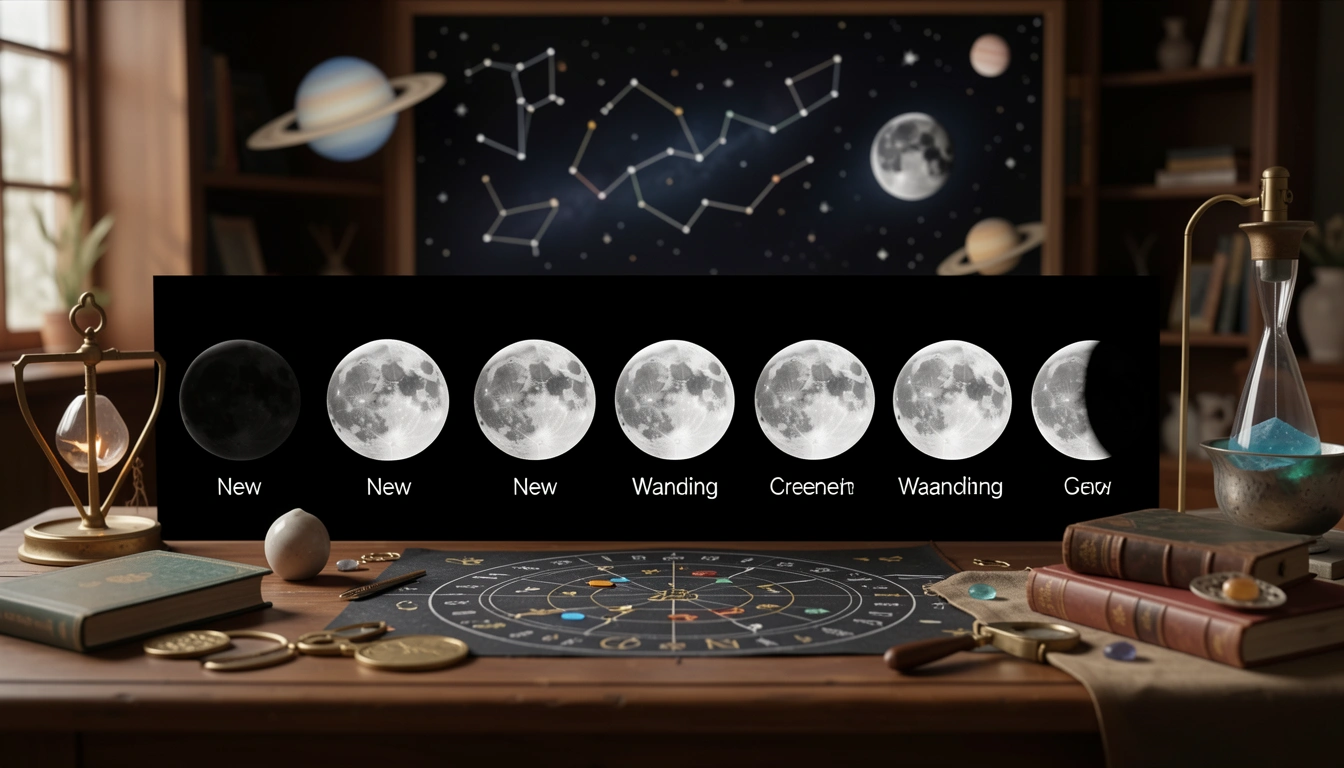
Moon Phases and Their Astrological Meaning
The Moon’s eight phases - New, Waxing Crescent, First Quarter, Waxing Gibbous, Full, Waning Gibbous, Last Quarter, and Waning Crescent - each carry a distinct energetic signature. The calendar tracks not just the New and Full Moons but the entire cycle, allowing you to align your activities with the Moon’s monthly rhythm. The Waxing phases (New to Full) are ideal for building, initiating, and growing. The Waning phases (Full to New) support releasing, reflecting, and clearing.
The First Quarter Moon brings a crisis of action - a challenge that tests your New Moon intentions. The Last Quarter Moon invites surrender and forgiveness. By following the daily phase, you can time your efforts for maximum efficiency. For example, start a new fitness routine at the New Moon, push through challenges at the First Quarter, celebrate progress at the Full Moon, and rest and review during the Waning phases. The calendar makes this lunar wisdom accessible at a glance.
Daily Moon Phase Practice
Check the Moon phase each morning. During the Waxing Crescent, take one small action toward a goal. At the First Quarter, address any obstacles. At the Full Moon, practice gratitude and release. During the Waning Gibbous, share your knowledge. At the Last Quarter, forgive yourself and others. During the Waning Crescent, rest and dream.
This simple practice connects you to the lunar cycle and helps you work with natural rhythms rather than against them. The calendar provides the exact phase and time of each shift, so you never lose track of where the Moon is in its journey.
Monthly Astrology Calendar Events
Each month brings a unique astrological landscape shaped by the Sun’s sign, the Moon’s phases, and the transits of faster-moving planets. A monthly overview helps you see the big picture before diving into daily details. The calendar organizes events by month, showing the key themes for each period. For example, a month with a New Moon in your career house and a Full Moon in your relationship house will have a distinct rhythm of professional initiation followed by relational culmination.
Monthly calendars also highlight planetary sign ingresses, which mark shifts in collective energy. When the Sun enters a new sign, the general mood changes. When Mercury enters a new sign, the style of communication shifts. By scanning the monthly view, you can identify the most favorable windows for specific activities, such as travel, romance, or financial planning. The monthly layout is designed for quick scanning and practical application.
Planning Your Month with Astrology
At the start of each month, review the calendar for major events: New and Full Moons, retrogrades, eclipses, and sign ingresses. Identify which events fall in significant houses of your birth chart. Block out the three days around each event for focused attention. Schedule important launches or decisions during favorable Moon phases and avoid them during eclipses or retrograde periods.
For example, if a New Moon in your 2nd house of finances occurs mid-month, plan to set financial intentions on that date. If a Mercury retrograde begins in your 3rd house of communication, double-check all contracts and emails during that period. The monthly calendar becomes your strategic planning tool, helping you navigate each month with cosmic awareness.
Yearly Astrology Calendar and Important Dates
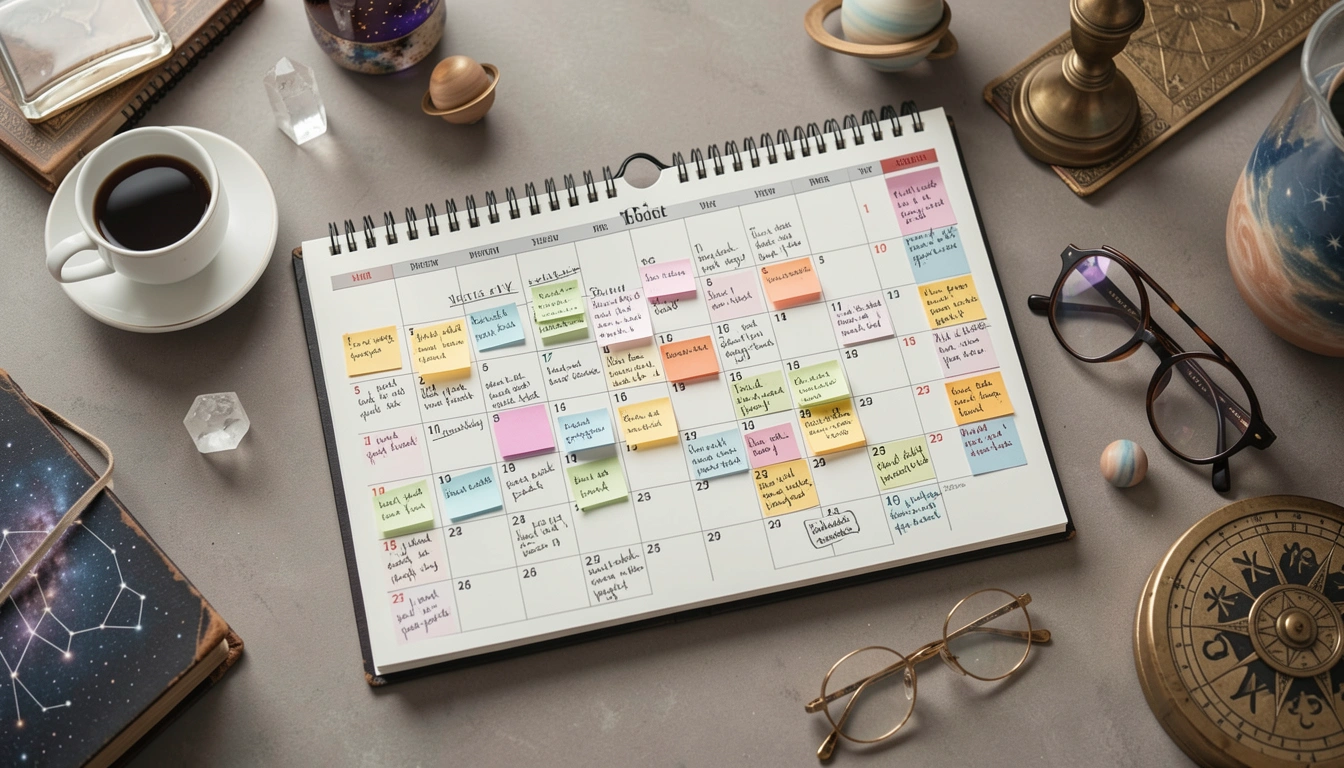
A yearly astrology calendar provides a comprehensive overview of the entire astrological year, typically starting at the Spring Equinox or January 1. It includes all major events: every New and Full Moon, all retrograde periods, eclipse seasons, equinoxes and solstices, and significant planetary ingresses and aspects. This macro view allows you to plan your entire year around cosmic rhythms.
The yearly calendar reveals larger cycles, such as the Jupiter-Saturn conjunction every 20 years or the Saturn-Pluto conjunction every 33 years. It also shows the progression of eclipse families (Saros series) and the annual patterns of retrograde periods. By printing or syncing the yearly calendar, you can anticipate busy or challenging periods months in advance. For example, you might plan a major vacation during a period with few challenging aspects, or schedule a career launch near a Jupiter transit.
How to Use the Yearly Calendar for Long-Term Planning
Start by identifying the major planetary ingresses for the year - when Jupiter, Saturn, Uranus, Neptune, or Pluto change signs. These are often the most significant events of the year. Then note the eclipse seasons (typically two per year, each lasting about a month). Avoid launching major life changes during eclipse seasons unless the change is initiated by external circumstances.
Mark the Mercury retrograde periods and plan your travel and contract signing around them. Identify the best months for romance (when Venus is strong in her domicile or exaltation) and for career (when Mars or Saturn are well-aspected). The yearly calendar is your roadmap; use it to align your personal goals with the planetary schedule.
For further reading, you can also explore Blog.