On this page
The Free BaZi / Four Pillars of Destiny Calculator is a powerful online tool that computes your Chinese Solar Calendar birth chart using the exact year, month, day, and hour of your birth. Unlike Western astrology which focuses on planetary positions, BaZi (also known as Four Pillars of Destiny) maps your destiny through four pillars, each consisting of a Heavenly Stem and an Earthly Branch. These eight characters form the core of your life blueprint in Chinese metaphysics.
This calculator instantly generates your complete BaZi chart, revealing the interaction of the Five Elements (Wood, Fire, Earth, Metal, Water) and their Yin/Yang polarity. Whether you are new to Chinese astrology or an experienced practitioner, the tool provides a clear, structured output that includes your Day Master, Ten Gods, Element strengths, and Luck Pillars for major life cycles. No registration or payment is required.
Understanding your BaZi chart can help you identify natural talents, career paths, relationship compatibility, and even timing for major decisions. The calculator handles the complex calendrical calculations behind the Chinese Solar Calendar, converting your Gregorian birth date into the correct Heavenly Stems and Earthly Branches automatically.
For further reading, you can also explore Analysis Calculators — Aspects, Elements & Strengths.
What Is BaZi and the Four Pillars of Destiny?
BaZi, literally meaning "Eight Characters" in Chinese, is a sophisticated system of destiny analysis rooted in Chinese astrology and the I Ching philosophy. It is also called the Four Pillars of Destiny because your birth data is arranged into four columns: Year Pillar, Month Pillar, Day Pillar, and Hour Pillar. Each pillar contains one Heavenly Stem and one Earthly Branch, giving eight characters total.
The Four Pillars represent different domains of your life. The Year Pillar reflects your ancestry and early environment. The Month Pillar shows your upbringing and career path. The Day Pillar, especially the Heavenly Stem (called the Day Master), represents your core self and personality. The Hour Pillar indicates your later years, children, and inner desires. Together, these four pillars create a unique energetic fingerprint that influences your entire life journey.
Unlike simple zodiac signs, BaZi offers a dynamic and nuanced view of fate. The interactions between the Five Elements within your chart determine strengths, weaknesses, opportunities, and challenges. The system also incorporates Luck Pillars, which are ten-year cycles that show how your energy shifts over time. This makes BaZi both a personality typing tool and a predictive system for life planning.
Origins and Philosophy
BaZi originated over a thousand years ago during the Tang Dynasty in China. It was refined by master astrologers like Xu Ziping, who systematized the use of Heavenly Stems and Earthly Branches into the Four Pillars framework. The philosophy is deeply connected to Taoist cosmology, which sees the universe as a constant interplay of Yin and Yang energy and the Five Elements. Your birth chart is considered a snapshot of this universal energy at the exact moment you were born.
In BaZi, fate is not completely fixed. While the chart reveals inherent tendencies and life patterns, personal choices, environment, and self-awareness can modify outcomes. This balance between destiny and free will makes BaZi a practical guide for self-improvement and strategic decision-making. The Free BaZi / Four Pillars of Destiny Calculator gives you access to this ancient wisdom instantly.
How Does a BaZi Calculator Work?
A BaZi calculator works by converting your Gregorian birth date and time into the Chinese Solar Calendar system. This is not a simple lookup table. The calculation involves complex astronomical data including solar terms, which mark the beginning of each Chinese month. The Year Pillar changes at the solar term Li Chun (around February 4), not on Chinese New Year. Similarly, the Month Pillar shifts at each solar term boundary, roughly every 30 days.
The Day Pillar is calculated using a continuous day count from a fixed reference point in Chinese history. This requires precise calendrical algorithms that account for leap years and the exact rotation of the Earth. The Hour Pillar depends on your birth time within a two-hour Chinese double-hour period (Shichen). Each double-hour corresponds to one of the twelve Earthly Branches. The calculator also determines the Heavenly Stem for each pillar based on the stem-branch pairing cycle, which repeats every 60 combinations.
Once the eight characters are established, the calculator maps them to the Five Elements and their Yin/Yang polarity. It then calculates the strength of each element in your chart, identifies the Day Master, and generates the Ten Gods which describe your relationships with different life aspects like wealth, power, and creativity. The entire process happens in seconds with the Free BaZi / Four Pillars of Destiny Calculator, saving you hours of manual computation.
The Role of Solar Terms
Solar terms are a crucial component of BaZi calculation because they define the start of each Chinese month. There are 24 solar terms in a year, each lasting about 15 days. The Month Pillar changes at the first day of a solar term, not on the 1st of a lunar month. For example, the month of the Tiger (Yin) begins at Li Chun, and the month of the Rabbit (Mao) begins at Jing Zhe (around March 6). If you are born near these boundaries, the exact time and date of the solar term must be used to determine your correct Month Pillar. The calculator automatically handles this precision.

Generate Your Free BaZi Chart Online
Generating your BaZi chart with the Free BaZi / Four Pillars of Destiny Calculator is straightforward. You need your exact birth date and time. Enter the year, month, day, and hour of your birth. If you do not know your birth time, you can still generate a chart, but the Hour Pillar will be unknown, which reduces accuracy for later life analysis and Luck Pillar timing. For the best results, use the exact time from your birth certificate.
After entering your details, click calculate. The tool instantly displays your Four Pillars in a clear table format. Each pillar shows the Heavenly Stem and Earthly Branch, along with their associated element and Yin/Yang nature. Below the pillars, you will see the Five Element breakdown, showing which elements are strong or weak in your chart. The Day Master is highlighted prominently because it is the most important reference point for all further interpretation.
The calculator also provides your Luck Pillars, which are ten-year cycles starting from a specific age determined by your birth data and gender. These cycles show how your energy changes over your lifetime. You can use this information to plan career moves, relationships, and personal development. The entire process is free and does not require any account creation. For a deeper analysis, you can explore the BaZi / Four Pillars of Destiny Premium Analysis Report which offers an extended interpretation guide.
Required Input Fields
The calculator requires the following inputs: birth date (day, month, year), birth time (hour and minute), and gender. The gender is needed because the direction of Luck Pillars (male or female, Yang or Yin year) differs depending on the gender and the Yin/Yang nature of the Year Pillar's Heavenly Stem. If you select 'time unknown', the calculator will still generate the Year, Month, and Day Pillars but will leave the Hour Pillar blank. This is acceptable for a general personality reading but less reliable for predictive work.
How to Read Your Four Pillars of Destiny Chart
Reading a BaZi chart begins with understanding the structure of the four pillars. The chart is arranged from top to bottom: Year, Month, Day, and Hour. Each pillar has two rows: the Heavenly Stem (top) and the Earthly Branch (bottom). The Heavenly Stems are associated with the Five Elements in their pure Yang or Yin form. The Earthly Branches contain hidden Heavenly Stems, which represent the deeper energies within each branch.
The most important element in the chart is the Day Master, which is the Heavenly Stem of the Day Pillar. This represents you. All other pillars and elements are analyzed in relation to the Day Master. For example, if your Day Master is Yang Wood (Jia), then the element that controls Wood is Metal, which represents challenges or authority in your life. The element that Wood generates is Fire, which represents your output, creativity, or speech. The element that generates Wood is Water, representing support, resources, or motherly influence.
The Five Element balance is shown in the calculator output. A balanced chart has a moderate amount of each element, with the Day Master being neither too strong nor too weak. Extreme imbalances can indicate specific life themes. For instance, a very strong Day Master with no controlling element may indicate stubbornness or overconfidence, while a very weak Day Master may indicate lack of vitality or susceptibility to external influences. The Free BaZi / Four Pillars of Destiny Calculator provides a visual element strength indicator to help you assess this balance at a glance.
Step-by-Step Reading Guide
- Identify your Day Master - Locate the Heavenly Stem in the Day Pillar. This is your core self.
- Check the Five Element balance - Look at the element strength chart. Which elements are abundant? Which are missing or weak?
- Analyze the Month Pillar - The Earthly Branch of the Month Pillar shows the season of your birth, which heavily influences element strength.
- Examine the Ten Gods - Each pillar's Heavenly Stem and Earthly Branch create a relationship with the Day Master, revealing aspects like wealth, power, and relationships.
- Review Luck Pillars - See which element cycles are coming in the next ten-year periods and how they interact with your chart.
The Four Pillars: Year, Month, Day and Hour
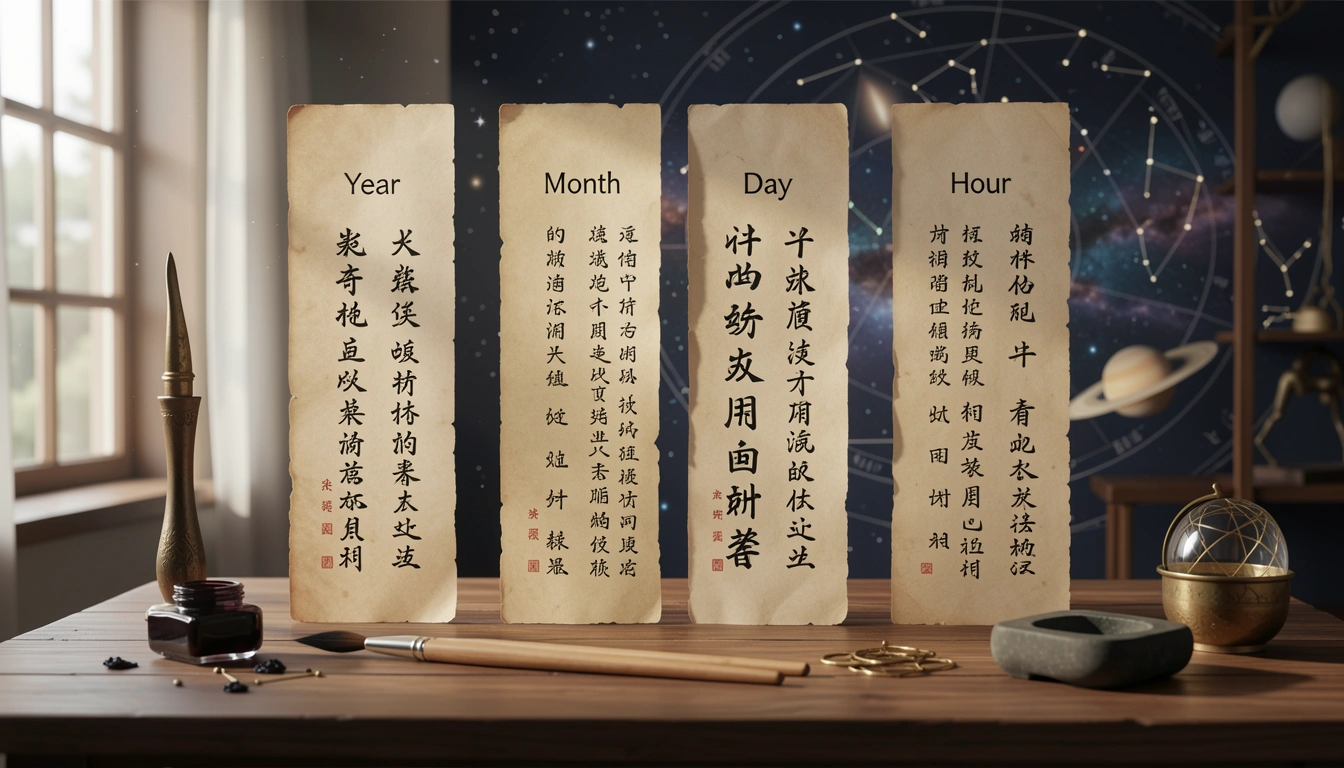
The Four Pillars are the foundation of your BaZi chart. Each pillar represents a different domain of your life and a different time frame. The Year Pillar corresponds to your early childhood, family background, and ancestral influences. It also represents your relationship with authority figures and society at large. The Earthly Branch of the Year Pillar is also used in Chinese zodiac, but BaZi considers the entire pillar, not just the animal sign.
The Month Pillar represents your teenage years and early adulthood, your career path, and your relationship with parents and mentors. It is the strongest pillar in terms of element influence because it reflects the season of your birth. For example, someone born in summer will have a naturally strong Fire element in the Month Pillar, which can either support or clash with the Day Master.
The Day Pillar is the most personal pillar. Its Heavenly Stem is your Day Master, representing your identity, physical body, and core personality. The Earthly Branch of the Day Pillar represents your spouse or partner in traditional BaZi. This branch also contains hidden stems that indicate your inner emotional world. The Hour Pillar represents your later years, children, and your legacy. It also reveals your hidden ambitions and what you do in private. The Hour Pillar is also crucial for determining the accuracy of Luck Pillar start ages.
Pillar Interactions
The pillars do not exist in isolation. They interact through combinations, clashes, and harmonies. For example, a clash between the Year and Month pillars may indicate early family conflict or a change in career direction. A combination between the Day and Hour pillars can indicate a happy marriage or successful children. The Free BaZi / Four Pillars of Destiny Calculator identifies these interactions automatically, but understanding them requires knowledge of the 60-cycle combinations and the twelve Earthly Branch clashes.
What Is the Day Master in BaZi?
The Day Master is the Heavenly Stem of the Day Pillar and is the single most important element in your BaZi chart. It represents your essential self, your vitality, and your core personality. In Chinese, it is called Ri Zhu or Ri Gan. Think of it as the protagonist of your life story. Every other element in the chart is analyzed in relation to the Day Master. Without identifying your Day Master, you cannot interpret a BaZi chart meaningfully.
There are ten possible Day Masters, corresponding to the ten Heavenly Stems. Each stem has a Yin or Yang polarity and is associated with one of the Five Elements. For example, Jia (Yang Wood) is like a tall tree, strong and upright. Yi (Yin Wood) is like a flowering plant, flexible and creative. Bing (Yang Fire) is like the sun, warm and radiant. Ding (Yin Fire) is like a candle flame, gentle but persistent. Wu (Yang Earth) is like a mountain, stable and reliable. Ji (Yin Earth) is like fertile soil, nurturing and adaptable. Geng (Yang Metal) is like a sword, sharp and decisive. Xin (Yin Metal) is like jewelry, refined and precious. Ren (Yang Water) is like a river, powerful and flowing. Gui (Yin Water) is like rain, subtle and intuitive.
The strength of your Day Master is determined by the season of your birth, the support from other stems and branches, and the presence of helpful or harmful elements. A strong Day Master indicates robust health, confidence, and resilience. A weak Day Master suggests sensitivity, adaptability, or a need for external support. The calculator shows your Day Master prominently and indicates its strength relative to the other elements in your chart.
How to Find Your Day Master
Your Day Master is automatically displayed in the Free BaZi / Four Pillars of Destiny Calculator output. Look for the top character in the Day Pillar column. It will be one of the ten Heavenly Stems. The calculator also shows the element and polarity of your Day Master. For a quick reference, if you know your birth date, you can find your Day Master by looking up the Heavenly Stem for that day in a BaZi calendar, but the calculator does this instantly for any date in history.

BaZi Five Elements and Their Meaning
The Five Elements (Wu Xing) are Wood, Fire, Earth, Metal, and Water. In BaZi, these elements are not just physical substances but represent different types of energy, personality traits, and life experiences. Each element has a creative and a controlling relationship with the others. The creative cycle is: Wood feeds Fire, Fire creates Earth (ash), Earth bears Metal, Metal carries Water, and Water nourishes Wood. The controlling cycle is: Wood parts Earth, Earth absorbs Water, Water quenches Fire, Fire melts Metal, and Metal cuts Wood.
In your BaZi chart, the balance of these elements determines your strengths and weaknesses. An abundance of Wood may indicate a strong will, growth, and creativity, but also stubbornness if uncontrolled. Too much Fire can make you passionate but also impulsive or aggressive. Excess Earth brings stability and reliability but can lead to stagnation or worry. Plenty of Metal gives discipline and precision but can make you rigid or critical. Surplus Water provides intuition and adaptability but may cause emotional overwhelm or indecision.
The calculator provides a visual element strength chart, often as a bar graph or percentage table. This shows you which elements are dominant, which are weak, and which are missing entirely. Missing elements are not necessarily bad, but they indicate areas of life that may require conscious development. For example, a chart with no Water element might indicate a person who struggles with emotional expression or intuition. The Five Element analysis is a foundational step in BaZi interpretation.
Element Strengths and Weaknesses
The strength of each element is determined by several factors: the season of birth (e.g., Wood is strong in spring), the number of occurrences of that element in the chart, the support from the Earthly Branches (which contain hidden stems), and the interactions between pillars. The Free BaZi / Four Pillars of Destiny Calculator computes all these factors to give you a reliable element strength reading. You can use this information to identify which elements need to be strengthened or reduced through lifestyle choices, colors, directions, or career paths.
Yin and Yang in the Four Pillars
Yin and Yang are fundamental to BaZi. Every Heavenly Stem and Earthly Branch has a Yin or Yang polarity. This polarity affects how the energy of that element manifests. Yang energy is outward, active, assertive, and masculine. Yin energy is inward, receptive, passive, and feminine. In a BaZi chart, the balance of Yin and Yang across the eight characters influences your personality and behavior patterns.
For example, a chart with many Yang stems and branches may indicate a person who is extroverted, direct, and action-oriented. A chart with many Yin characters may indicate a person who is introspective, subtle, and diplomatic. However, the ideal balance varies by individual. A chart that is too Yang can be aggressive or overbearing, while a chart that is too Yin can be indecisive or withdrawn. The goal is not to have equal numbers of Yin and Yang but to have a harmonious dynamic that supports the Day Master.
The polarity also affects the interactions between pillars. Yang elements tend to clash more directly, while Yin elements may combine or harmonize more subtly. The calculator indicates the Yin/Yang nature of each stem and branch. When interpreting your chart, pay attention to the overall Yin/Yang ratio and how it aligns with your natural tendencies. The Free BaZi / Four Pillars of Destiny Calculator makes this easy by labeling each character clearly.
Yin-Yang Balance in Practice
To assess your Yin-Yang balance, count the number of Yang stems and branches versus Yin stems and branches in your chart. A rough guideline: 4-6 Yang characters out of 8 is balanced. More than 6 Yang may indicate excessive aggression or impulsiveness. Fewer than 4 Yang may indicate passivity or lack of drive. However, the Day Master's own polarity also matters. A Yang Day Master may handle more Yang energy well, while a Yin Day Master may thrive with more Yin support. The calculator provides this count automatically in the element analysis section.
What Do the Ten Heavenly Stems Mean?
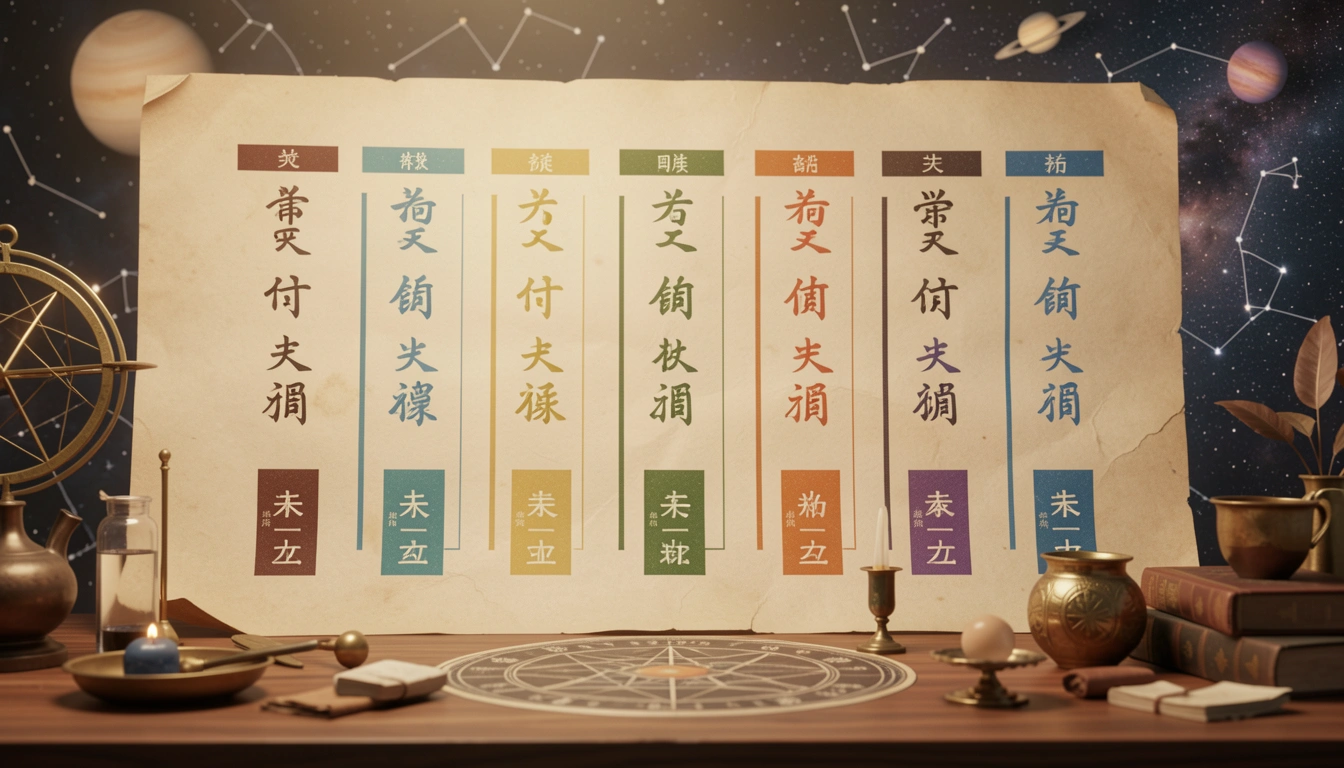
The Ten Heavenly Stems are the building blocks of the Heavenly Stems in BaZi. They are: Jia (Yang Wood), Yi (Yin Wood), Bing (Yang Fire), Ding (Yin Fire), Wu (Yang Earth), Ji (Yin Earth), Geng (Yang Metal), Xin (Yin Metal), Ren (Yang Water), and Gui (Yin Water). Each stem has a unique personality profile and life expression. In your chart, the stems appear in each pillar and also as hidden stems within the Earthly Branches.
Jia (Yang Wood) represents leadership, growth, and ambition. People with strong Jia energy are often pioneers, entrepreneurs, or leaders. Yi (Yin Wood) represents flexibility, creativity, and diplomacy. Yi people are often artists, counselors, or designers. Bing (Yang Fire) represents warmth, charisma, and visibility. Bing individuals are often performers, speakers, or public figures. Ding (Yin Fire) represents gentleness, persistence, and inner light. Ding people are often healers, writers, or spiritual guides.
Wu (Yang Earth) represents stability, reliability, and practicality. Wu individuals are often managers, builders, or farmers. Ji (Yin Earth) represents nurturing, adaptability, and resourcefulness. Ji people are often teachers, nurses, or chefs. Geng (Yang Metal) represents strength, discipline, and decisiveness. Geng individuals are often surgeons, judges, or military leaders. Xin (Yin Metal) represents refinement, beauty, and precision. Xin people are often jewelers, artists, or critics. Ren (Yang Water) represents wisdom, depth, and flow. Ren individuals are often philosophers, scientists, or travelers. Gui (Yin Water) represents intuition, mystery, and subtlety. Gui people are often psychics, poets, or researchers.
Stem Combinations and Clashes
Certain Heavenly Stems have special relationships. For example, Jia and Ji combine to form Earth. Bing and Xin combine to form Water. Wu and Gui combine to form Fire. These combinations modify the energy of the stems involved. There are also clashes, such as Jia and Geng, which create conflict. The Free BaZi / Four Pillars of Destiny Calculator identifies these combinations and clashes in your chart, but understanding their implications requires further study. The premium report provides detailed interpretations of these interactions.
Understanding the Twelve Earthly Branches
The Twelve Earthly Branches are: Zi (Rat, Water), Chou (Ox, Earth), Yin (Tiger, Wood), Mao (Rabbit, Wood), Chen (Dragon, Earth), Si (Snake, Fire), Wu (Horse, Fire), Wei (Goat, Earth), Shen (Monkey, Metal), You (Rooster, Metal), Xu (Dog, Earth), and Hai (Pig, Water). Each branch is associated with an animal sign, an element, and a season. However, in BaZi, the branches are more than just animal signs. They contain hidden Heavenly Stems that reveal deeper layers of energy.
Each Earthly Branch contains a main hidden stem and sometimes secondary hidden stems. For example, the branch Zi (Rat) contains only Gui Water. The branch Yin (Tiger) contains Jia Wood, Bing Fire, and Wu Earth. These hidden stems add complexity to the chart because they represent energies that are not immediately visible but influence the pillar's overall nature. The calculator reveals the hidden stems for each branch, giving you a complete picture of the energy within each pillar.
The Earthly Branches also interact through combinations, clashes, and harms. For example, Zi and Chou combine to form Earth. Zi and Wu clash, creating conflict. Zi and Wei harm each other, causing subtle friction. These interactions can indicate relationship dynamics, health issues, or timing of events. The Free BaZi / Four Pillars of Destiny Calculator highlights these interactions in the chart output, making it easier for beginners to spot important patterns.
Branch Combinations and Clashes
There are six combinations (Liu He), three harmonies (San He), and six clashes (Liu Chong) among the Earthly Branches. For example, the San He of Water involves Shen, Zi, and Chen. If these three branches appear in your chart, they create a powerful Water structure that can dominate the chart. The six clashes are between opposite branches: Zi-Wu, Chou-Wei, Yin-Shen, Mao-You, Chen-Xu, and Si-Hai. A clash between pillars can indicate tension or sudden changes. The calculator identifies all these relationships automatically.
BaZi Ten Gods and Personality Patterns
The Ten Gods (Shi Shen) are a classification system that describes the relationships between each Heavenly Stem in your chart and your Day Master. They are: Direct Wealth, Indirect Wealth, Direct Officer, Indirect Officer, Direct Resource, Indirect Resource, Friend, Rob Wealth, Eating God, and Hurting Officer. Each of these represents a different aspect of life, such as money, career, education, relationships, and creativity.
Direct Wealth (Zheng Cai) represents stable income, salary, and wife (for a male chart). Indirect Wealth (Pian Cai) represents speculative money, investments, and father (for a male chart). Direct Officer (Zheng Guan) represents authority, career advancement, and husband (for a female chart). Indirect Officer (Pian Guan) represents challenges, power struggles, and discipline. Direct Resource (Zheng Yin) represents education, mother (for a male chart), and support. Indirect Resource (Pian Yin) represents intuition, spirituality, and unconventional knowledge.
Friend (Bi Jian) represents siblings, peers, and competition. Rob Wealth (Jie Cai) represents friends who may take your resources, or business partners. Eating God (Shi Shen) represents talent, creativity, and enjoyment. Hurting Officer (Shang Guan) represents expression, rebellion, and intelligence. The presence and strength of these Ten Gods in your chart reveal your natural tendencies in these life areas. The Free BaZi / Four Pillars of Destiny Calculator lists the Ten Gods for each pillar, helping you understand your personality and life patterns at a glance.
How to Interpret Ten Gods
To interpret the Ten Gods, first identify which ones appear in your Year, Month, Day, and Hour pillars. For example, if Direct Wealth appears in the Month Pillar, it may indicate a career in finance or a stable income. If Hurting Officer appears in the Hour Pillar, it may indicate a creative or rebellious child. The combination of multiple Ten Gods can create complex patterns. The premium report provides a detailed interpretation of each Ten God in your specific chart context.
BaZi Luck Pillars and Life Cycles
Luck Pillars (Da Yun) are ten-year cycles that represent the shifting energy patterns throughout your life. They are calculated based on your birth data and gender. The first Luck Pillar starts at a specific age, determined by the number of days between your birth and the next solar term (for Yang male or Yin female) or the previous solar term (for Yin male or Yang female). Each Luck Pillar consists of a Heavenly Stem and an Earthly Branch, which together create a new energy influence on your natal chart.
The Luck Pillars show how external circumstances and internal growth opportunities change over time. For example, if your current Luck Pillar brings a strong Water element, and your chart is weak in Water, you may experience a period of increased intuition, emotional depth, and support from others. Conversely, if the Luck Pillar brings an element that clashes with your Day Master, you may face challenges or conflicts during that decade.
The Free BaZi / Four Pillars of Destiny Calculator generates your Luck Pillars automatically, showing the start age for each cycle and the stem-branch pair. You can see which decades are favorable for career advancement, relationships, or personal development. The calculator also indicates the current Luck Pillar you are in, based on your birth date and the current date. This makes it a practical tool for planning major life decisions.
Annual and Monthly Luck
In addition to Luck Pillars, BaZi also uses Annual Luck (Liu Nian) and Monthly Luck (Yue Yun) for finer timing. The Annual Luck is the energy of each Chinese New Year, which interacts with your natal chart and Luck Pillar. The Monthly Luck changes every solar term (about every 30 days). While the Free BaZi / Four Pillars of Destiny Calculator focuses on the main Luck Pillars, the premium report includes annual and monthly luck analysis for more precise timing.

BaZi Wealth, Career and Relationship Indicators
BaZi provides specific indicators for wealth, career, and relationships through the Ten Gods and element analysis. Wealth is indicated by the presence and strength of Direct Wealth and Indirect Wealth in the chart. A strong Wealth element (usually Earth or Metal depending on the Day Master) in the appropriate pillar can indicate financial success. The Earthly Branches also play a role; for example, the branch Chen (Dragon) is associated with wealth storage.
Career is indicated by the Direct Officer and Indirect Officer stars. A strong Officer element in the Month Pillar or in a Luck Pillar can indicate career advancement, leadership roles, or public recognition. The combination of Officer and Resource stars suggests a career in education, law, or management. The presence of Hurting Officer can indicate a career in creative fields or entrepreneurship. The element of the Officer also matters; for example, Metal Officer suggests a career in finance or law, while Fire Officer suggests a career in media or entertainment.
Relationships are indicated by the Spouse Star in the Day Pillar. For a male, the Spouse Star is Direct Wealth (the element that the Day Master controls). For a female, the Spouse Star is Direct Officer (the element that controls the Day Master). The Earthly Branch of the Day Pillar also represents the spouse or partner. A harmonious branch with the Day Master indicates a good relationship, while a clashing branch may indicate conflict. The presence of multiple Wealth or Officer stars can indicate multiple relationships or a focus on career over romance. The Free BaZi / Four Pillars of Destiny Calculator highlights these indicators in your chart output.
Interpreting Wealth Stars
To interpret your wealth potential, look at the strength of the Wealth element in your chart. If your Day Master is strong and the Wealth element is also strong and well-placed, you have good financial prospects. If the Wealth element is weak or missing, you may need to develop wealth through other means, such as partnerships or creative ventures. The Luck Pillars can also bring Wealth elements at specific times, indicating periods of financial opportunity.
How Birth Time Affects Your BaZi Chart
Birth time is critical for calculating the Hour Pillar, which is the fourth pillar in your BaZi chart. The Hour Pillar represents your later years, children, and inner self. Without an accurate birth time, the Hour Pillar cannot be determined, and the chart is incomplete. This affects not only the personality analysis but also the calculation of Luck Pillars, because the start age of the first Luck Pillar depends on the Hour Pillar and the solar term count.
Each two-hour period in Chinese timekeeping corresponds to one of the twelve Earthly Branches. For example, the hour of the Rat (Zi) is from 11:00 PM to 12:59 AM. The hour of the Ox (Chou) is from 1:00 AM to 2:59 AM, and so on. The exact minute of birth matters because if you are born near the boundary between two double-hours, you may fall into a different branch. The Free BaZi / Four Pillars of Destiny Calculator uses the exact time you enter to determine the correct Hour Pillar.
If you do not know your birth time, the calculator can still generate the Year, Month, and Day Pillars, but the Hour Pillar will be left blank. This is common for many people. In such cases, the analysis will focus on the first three pillars, which still provide valuable insights into personality, career, and early life. However, for a complete reading, especially for later life and Luck Pillar timing, knowing your birth time is highly recommended. You can also use the Birth Time Rectification Calculator to estimate your birth time based on life events.
What If Birth Time Is Unknown?
If your birth time is unknown, you can still get a useful BaZi reading from the first three pillars. The Year Pillar gives insights into your family and early environment. The Month Pillar reveals your career path

BaZi Chart Strength and Element Balance
Once you have your Four Pillars chart in hand, the next step is to figure out whether your Day Master is strong or weak—and how balanced the five elements are across your entire chart. This isn't just an academic exercise; it directly affects which elements bring you luck and which ones might trip you up.
How to assess chart strength. Your Day Master's strength depends on three things: the season it was born in, the support it gets from other pillars, and the presence of helpful Earthly Branches. For example, a Wood Day Master born in spring (the Wood season) is naturally robust, while one born in autumn (Metal season) may struggle because Metal chops Wood. A strong Day Master can handle direct wealth and power elements without getting overwhelmed. A weak one needs nourishing elements like an output or resource to thrive.
The five-element balance. Ideally, no single element dominates your chart completely. If you have four or five same-element pillars, that's an extreme—you'll likely need the opposing element to bring harmony. For instance, a chart with too much Fire might lack Water, leading to burnout or impulsiveness. A balanced chart typically has at least one appearance of each element across the four pillars, or a clear productive cycle (like Wood feeding Fire, Fire creating Earth, etc.).
What imbalance looks like. If your chart is missing an element entirely, that area of life often feels blocked or delayed. Missing Water might mean difficulty with emotional depth or career flow. Missing Earth could show up as instability or trouble with boundaries. The missing element also becomes your 'favorable element'—the one you want to activate through colors, directions, or career choices.
Using the calculator. Most free BaZi calculators automatically compute your chart's element distribution and flag imbalances. Look for a pie chart or bar graph showing the percentage of each element. If Wood and Fire dominate, for example, you'll likely benefit from Metal and Water to cut and cool things down. The calculator also tells you your 'useful god'—the element that balances your chart best—which is your go-to for lucky colors, career fields, and even partner selection.
For further reading, you can also explore Free Birth Chart Houses Calculator.