On this page
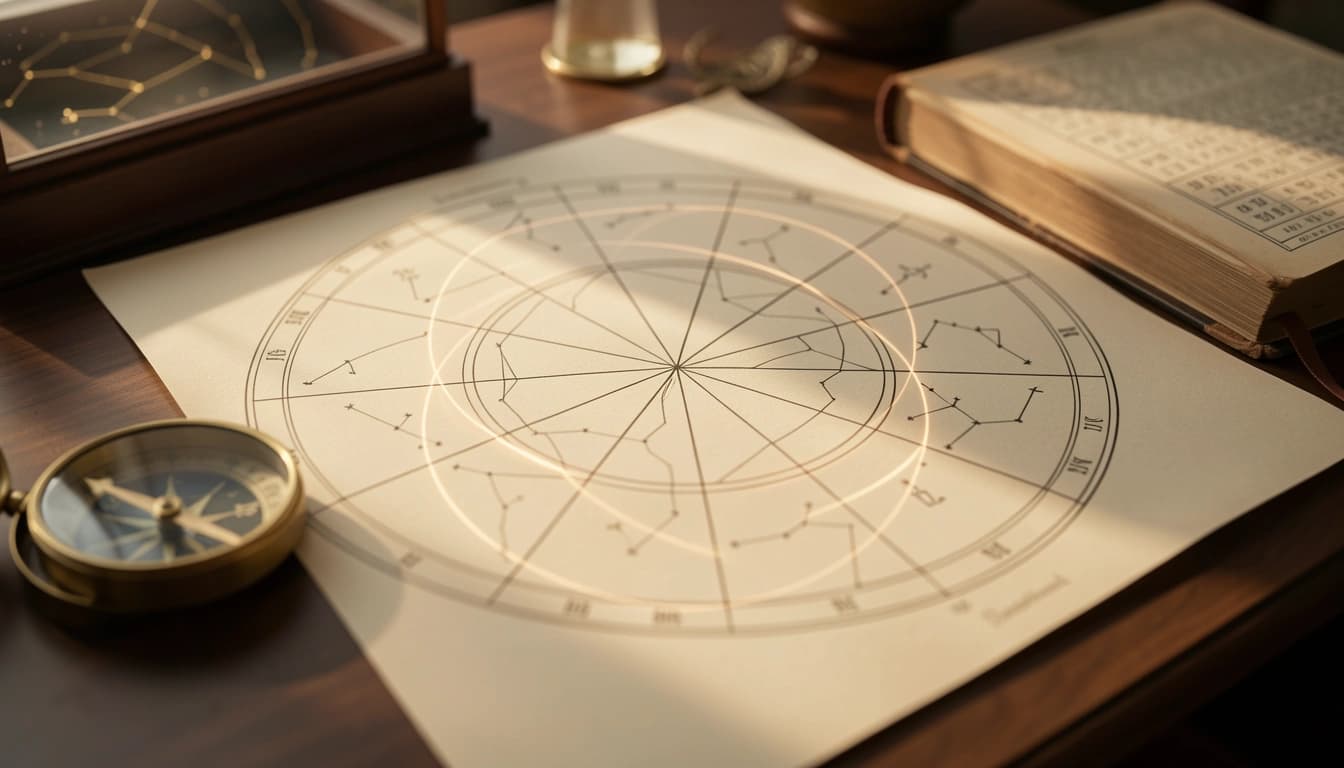
The Whole Sign Houses Calculator generates your birth chart using the oldest documented house system in Western astrology. Instead of dividing the sky into unequal slices based on time and location, this method assigns each of the twelve houses to an entire 30-degree zodiac sign. The result is a clean, intuitive chart where every planet in a given sign belongs to the same house, making interpretation more straightforward and consistent with traditional Hellenistic practice.
This calculator is ideal for anyone studying ancient astrology techniques, exploring house rulers and sign-based dignity, or simply wanting a clearer view of how planetary energy flows through your chart. By entering your birth date, time, and location, you receive a complete Whole Sign chart that shows your Ascendant, the sign on each house cusp, every planet placement, and the natural planetary ruler for each house. No complex degree calculations or house cusp adjustments are needed.
Whether you are comparing house systems, learning traditional astrology, or seeking a stable framework for predictive work, the Whole Sign Houses Calculator provides a reliable, historically grounded foundation. It works equally well for natal analysis, transit tracking, and synastry, and it pairs naturally with other tools like the Chart Calculators on YesAstrology.
What Are Whole Sign Houses in Astrology?
Whole Sign Houses is the oldest known house system in Western astrology, dating back to Hellenistic practitioners around the 2nd century BCE. In this system, each house corresponds to an entire zodiac sign, beginning at the exact degree of the Ascendant. If your Ascendant is at 15 degrees Aries, the entire sign of Aries becomes your 1st house, Taurus becomes your 2nd house, Gemini your 3rd, and so on around the zodiac wheel.
This method contrasts sharply with quadrant systems like Placidus, which split signs unevenly and create intercepted houses. Whole Sign houses never intercept a sign, and every planet in a given sign automatically falls into the same house. This structural simplicity makes the system especially valuable for traditional techniques such as house rulership, triplicity lords, and zodiacal releasing.
Modern astrologers often turn to Whole Sign houses for its logical consistency and historical authenticity. It was the standard system used by Ptolemy, Valens, and other foundational astrologers. If you are studying ancient texts or working with Hellenistic methods, this calculator gives you the exact chart format those authors used.
Historical Origins of the Whole Sign System
The Whole Sign house system emerged in the Hellenistic period and remained the dominant method for nearly a thousand years. Manuscripts from authors like Dorotheus of Sidon and Vettius Valens describe charts exclusively in Whole Sign terms. They did not calculate house cusps by degree; they simply assigned each sign to a house starting from the Ascendant sign.
This system was later overshadowed by quadrant methods during the medieval and Renaissance periods, but it never disappeared entirely. The revival of Hellenistic astrology in the late 20th century brought Whole Sign houses back into mainstream practice. Today, it is one of the most popular systems among traditional astrologers and is frequently taught in foundational astrology courses.
Generate Your Whole Sign Houses Chart
Using the Whole Sign Houses Calculator is simple and requires the same birth data as any natal chart tool. Enter your date of birth, exact time of birth, and birth location. The calculator then computes your Ascendant degree and automatically assigns each zodiac sign to a house starting from that Ascendant sign. The result is a full chart wheel with house cusps aligned to 0 degrees of each sign.
Unlike Placidus or Koch calculators, there is no need to specify a house system preference. The tool is purpose-built for Whole Sign houses, so the output is always consistent. You will see your Ascendant sign and degree, the sign on each of the twelve houses, the position of every planet in its sign and house, and the planetary ruler for each house based on traditional rulerships.
The chart is displayed both as a visual wheel and a text table, making it easy to copy, save, or share. You can also generate transit charts and synastry overlays using the Whole Sign system for comparison work. For deeper analysis, consider pairing this tool with the Free Birth Chart Calculator to see how your chart looks under different house systems side by side.
What Data You Need
To generate an accurate Whole Sign chart, you need your birth date, exact birth time (including time zone), and birthplace. The Ascendant changes approximately every two hours, so an accurate birth time is essential for determining the correct Ascendant sign and therefore the correct house sequence.
If you do not know your birth time, the calculator can still produce a chart using a default time (usually noon or sunrise), but the Ascendant and house placements will be approximate. For precise Whole Sign analysis, a certified birth time from a birth certificate is recommended.

How the Whole Sign House System Works
The Whole Sign system operates on a simple principle: each house is exactly 30 degrees wide, matching the length of a zodiac sign. The 1st house begins at the exact degree of the Ascendant, but the entire sign containing the Ascendant becomes the 1st house. The next sign clockwise becomes the 2nd house, and so forth. This means the house cusp is always at 0 degrees of the sign, not at the Ascendant degree itself.
For example, if your Ascendant is at 22 degrees Leo, the 1st house spans the entire sign of Leo (0 to 30 degrees), even though the Ascendant point is at 22 degrees. The 2nd house then begins at 0 degrees Virgo, the 3rd at 0 degrees Libra, and so on. This creates a chart where every planet in Leo is in the 1st house, every planet in Virgo is in the 2nd, and no planet is ever in a different house than its sign would suggest.
This alignment between sign and house makes the Whole Sign system exceptionally easy to read. It also eliminates intercepted houses, where a sign is completely contained within a house without appearing on a cusp. Every sign appears exactly once on a house cusp, and every house contains exactly one sign.
The Role of the Ascendant
The Ascendant is the cornerstone of the Whole Sign system. It determines which sign becomes the 1st house and thus the entire house sequence. The exact degree of the Ascendant still matters for timing techniques like primary directions and for determining the strength of planets, but it does not create a house cusp at that degree.
In practice, this means two people born on the same day with Ascendants at 1 degree and 29 degrees of the same sign will have identical house assignments. Only the Ascendant degree itself differs, which affects the angularity of planets and the timing of transits to the Ascendant point.
How to Read a Whole Sign Houses Chart
Reading a Whole Sign chart is more straightforward than reading a quadrant chart because the house and sign boundaries are identical. Start by locating your Ascendant sign, which is the sign rising on the eastern horizon at your birth. This sign is your 1st house. From there, move counterclockwise through the zodiac: the next sign is your 2nd house, the next your 3rd, and so on.
Each planet appears in a specific sign and therefore in a specific house. For example, if Venus is in Libra and your 7th house is Libra, then Venus is in your 7th house. There is no ambiguity about whether a planet at 29 degrees of a sign belongs to one house or the next. Every planet in Libra is in the same house, regardless of degree.
To interpret the chart, note the sign on each house cusp. The sign reveals the general energy of that area of life, and the planetary ruler of that sign becomes the house ruler. For instance, if your 4th house is Capricorn, Saturn rules your 4th house. The condition of Saturn by sign, house, and aspects tells you about your home, family, and roots.
Step-by-Step Reading Guide
1. Identify the Ascendant sign and degree. This is your 1st house. 2. List each house and the sign that occupies it. 3. Note any planets in each house. 4. Identify the planetary ruler of each house (the traditional ruler of the sign on the cusp). 5. Evaluate the condition of each ruler by sign, house placement, and aspects. 6. Synthesize the house placements and rulerships into a coherent narrative.
This method works for both natal charts and transit charts. For transits, simply note which house the transiting planet is passing through based on the natal house assignments, which remain fixed for life.

Find Your Whole Sign Ascendant and Houses
Your Whole Sign Ascendant is the same as your standard Ascendant, calculated from your birth time, date, and location. The calculator determines the exact degree of the Ascendant and then assigns the entire sign containing that degree to the 1st house. The remaining signs follow in zodiacal order.
For example, if your Ascendant is at 5 degrees Scorpio, then Scorpio is your 1st house, Sagittarius is your 2nd, Capricorn your 3rd, and so on. If your Ascendant is at 28 degrees Scorpio, the same house assignments apply. Only the Ascendant degree itself shifts, which can affect the timing of transits and the angularity of planets near the Ascendant.
To find your houses, simply look at the sign on each house cusp in the chart output. The calculator displays this clearly in both wheel and table formats. You can also manually determine your houses by noting your Ascendant sign and counting forward through the zodiac.
Example House Sequence
If your Ascendant is Gemini: 1st house Gemini, 2nd house Cancer, 3rd house Leo, 4th house Virgo, 5th house Libra, 6th house Scorpio, 7th house Sagittarius, 8th house Capricorn, 9th house Aquarius, 10th house Pisces, 11th house Aries, 12th house Taurus. This sequence is fixed once the Ascendant sign is known.
Understand Planets in Whole Sign Houses
In the Whole Sign system, a planet's house placement is determined solely by the sign it occupies. If Mars is in Aries and your 1st house is Aries, then Mars is in your 1st house regardless of whether Mars is at 1 degree or 29 degrees Aries. This removes the ambiguity that sometimes occurs in quadrant systems where a planet near the end of a sign may fall into the next house.
This clarity is especially useful when interpreting planetary dignity and debility. A planet in its own sign is automatically in a house ruled by itself, which strengthens its expression. A planet in its fall or detriment may struggle regardless of house placement, but the house shows the area of life where that struggle manifests.
When analyzing a planet in Whole Sign houses, consider both the sign (how the planet expresses) and the house (where it expresses). Also consider the condition of the house ruler, which provides additional context. For example, Venus in the 10th house in Libra is dignified and focused on career, but if Venus is in Scorpio in the 10th house, it may face challenges that affect public reputation.
Planets Near the End of a Sign
A planet at 29 degrees of a sign is still firmly in that sign and therefore in that house. However, it is considered to be in the "last degree" or anaretic degree, which can add urgency or a sense of culmination. The house assignment does not change, but the planetary expression may feel more intense or transitional.

Explore the Meaning of All Twelve Houses
Each of the twelve houses in Whole Sign astrology governs a specific area of life. The 1st house represents self, appearance, and personality. The 2nd house covers finances, values, and possessions. The 3rd house rules communication, siblings, and short journeys. The 4th house relates to home, family, and roots. The 5th house governs creativity, romance, and children. The 6th house deals with health, daily routine, and service.
The 7th house focuses on partnerships and marriage. The 8th house covers shared resources, transformation, and the occult. The 9th house rules higher education, travel, and philosophy. The 10th house represents career, reputation, and public standing. The 11th house governs friendships, groups, and aspirations. The 12th house deals with solitude, subconscious, and hidden matters.
Because each house is a full sign, the sign on the cusp strongly colors that area of life. A 4th house in Cancer feels nurturing and protective, while a 4th house in Capricorn feels structured and reserved. The planetary ruler of that sign further refines the interpretation.
Houses and Their Natural Sign Rulers
In Whole Sign astrology, each house has a natural affinity with a sign, though the actual sign on the house depends on the Ascendant. The natural sequence is: 1st house Aries, 2nd Taurus, 3rd Gemini, 4th Cancer, 5th Leo, 6th Virgo, 7th Libra, 8th Scorpio, 9th Sagittarius, 10th Capricorn, 11th Aquarius, 12th Pisces. This natural order helps when learning house meanings but does not override the actual chart.
Whole Sign Houses and House Rulers
In the Whole Sign system, the ruler of a house is the traditional planetary ruler of the sign on that house's cusp. For example, if the 2nd house cusp is Taurus, Venus rules the 2nd house. If the 2nd house cusp is Aries, Mars rules the 2nd house. This is the same as in any other house system, but the assignment is unambiguous because each house cusp is a whole sign.
The condition of the house ruler is critical for interpretation. A well-placed ruler in its own sign or exaltation strengthens the affairs of that house. A debilitated or afflicted ruler may indicate challenges in that area. The house where the ruler actually falls also matters. For instance, if the ruler of the 4th house (home) is in the 10th house (career), home and career are linked.
Whole Sign houses make it easy to see these connections because the house ruler is always the ruler of the sign on the cusp, and that planet's position is unambiguous. This clarity supports traditional techniques like house rulership exchanges, mutual reception, and the use of triplicity lords.
How to Find Your House Rulers
1. Note the sign on each house cusp from the chart output. 2. Identify the traditional ruler of that sign (Mars for Aries, Venus for Taurus, Mercury for Gemini, Moon for Cancer, Sun for Leo, Mercury for Virgo, Venus for Libra, Pluto for Scorpio, Jupiter for Sagittarius, Saturn for Capricorn, Uranus for Aquarius, Neptune for Pisces). 3. Find that planet in the chart to see which sign and house it occupies. 4. Interpret the ruler's condition.

How Signs Become Houses in This System
The Whole Sign system creates a direct one-to-one correspondence between signs and houses. The sign on the Ascendant becomes the 1st house, the next sign becomes the 2nd, and so on. This means the zodiac itself forms the house structure, with no additional division. The houses are literally the signs in sequence.
This is fundamentally different from quadrant systems where houses are divisions of the local space, not the zodiac. In Whole Sign, the houses are tied to the ecliptic and the seasonal cycle of the signs. The 1st house always corresponds to the sign rising at birth, which is a specific slice of the ecliptic. The other houses follow in order.
This alignment makes the Whole Sign system particularly elegant for traditional astrology. Techniques like zodiacal releasing, which rely on the order of signs, integrate naturally with house meanings. The houses become a kind of "second zodiac" that mirrors the first, with each house carrying the essence of its sign.
Why This Matters for Interpretation
Because houses are signs, the natural qualities of each sign infuse the house. A 5th house in Leo expresses creativity with flair and drama. A 5th house in Virgo expresses creativity through detail and service. The sign gives texture to the house theme, and the house ruler adds another layer. This layered meaning is what makes Whole Sign interpretation so rich.
Whole Sign Houses vs. Placidus Houses
The most common house system in modern Western astrology is Placidus, which divides the sky into unequal houses based on the time it takes for a degree of the ecliptic to rise. This creates houses of varying sizes and can cause intercepted signs, where a sign is completely enclosed within a house without appearing on a cusp. Whole Sign houses, by contrast, are always equal in size and never intercept signs.
In Placidus, a planet at 29 degrees of a sign may fall into the next house if that sign is intercepted or if the house cusp falls at a different degree. In Whole Sign, that same planet would remain in the sign's house. This difference can shift planetary placements by one or even two houses, especially for people born at extreme latitudes.
Many astrologers find that Whole Sign houses provide a more consistent and logical framework, especially for traditional techniques. Placidus is still widely used for modern psychological astrology and for charts where the focus is on angularity and house cusp aspects. The choice between them often depends on the astrologer's training and the specific question being asked.
Key Differences at a Glance
| Feature | Whole Sign | Placidus |
|---|---|---|
| House size | Always 30 degrees | Varies by latitude |
| Intercepted signs | None | Common at high latitudes |
| House cusp degree | 0 degrees of sign | Varies by degree |
| Planet house assignment | By sign only | By degree and house cusp |
| Historical use | Hellenistic to medieval | Renaissance to modern |
Whole Sign Houses vs. Equal Houses
Equal house systems also divide the chart into twelve 30-degree houses, but they do so starting from the Ascendant degree rather than the Ascendant sign. In Equal houses, the 1st house cusp is at the exact Ascendant degree, and each subsequent house cusp is exactly 30 degrees later. This means the 1st house cusp is a specific degree, not the entire sign.
In Whole Sign, the 1st house cusp is at 0 degrees of the Ascendant sign, not at the Ascendant degree. This subtle difference can shift house cusps by up to 29 degrees. For example, if your Ascendant is at 28 degrees Leo, in Equal houses the 1st house cusp is 28 Leo, while in Whole Sign it is 0 Leo. The 2nd house cusp in Equal houses would be 28 Virgo, while in Whole Sign it is 0 Virgo.
This means that in Equal houses, planets near the end of a sign may fall into the next house. In Whole Sign, they stay in the sign's house. Equal houses are often used in modern astrology for their simplicity, but Whole Sign has the advantage of aligning houses with sign rulerships, which is essential for traditional techniques.
Which Is More Traditional?
Whole Sign is the older and more historically documented system. Equal houses appeared later, likely in the medieval period, and were used by some Arabic and Renaissance astrologers. For Hellenistic reconstruction, Whole Sign is the correct choice. For general modern use, both systems are valid, but Whole Sign offers better integration with sign-based rulerships.
Why House Placements May Change
If you are used to a Placidus or Equal house chart, switching to Whole Sign may shift some of your planetary house placements. This is normal and does not mean one system is wrong. The shift occurs because each system defines house boundaries differently. A planet that is in the 12th house in Placidus may appear in the 1st house in Whole Sign, especially if it is near the Ascendant degree.
These shifts are most common for planets near the cusp of a house in quadrant systems. For example, a planet at 28 degrees Scorpio in a Placidus chart where the 1st house cusp is 29 Scorpio would be in the 12th house. In Whole Sign, with the 1st house being the entire sign of Scorpio, that same planet would be in the 1st house. This can significantly change the interpretation.
It is important to remember that both systems are valid tools. The Whole Sign system is not more accurate, but it is more consistent with traditional rulership logic. If you are exploring Hellenistic techniques, use Whole Sign. If you are doing modern psychological work, you may prefer Placidus. The calculator lets you see both and decide for yourself.
Common Shifts by House
Planets near the 1st house cusp in Placidus often shift to the 12th or 1st house in Whole Sign. Planets near the 10th house cusp may shift between the 9th, 10th, or 11th. The most dramatic shifts occur at high latitudes where Placidus houses are very unequal. In Whole Sign, these shifts do not occur because house boundaries are fixed.

How Birth Time Affects Whole Sign Houses
Birth time is crucial in Whole Sign astrology because it determines the Ascendant sign. The Ascendant changes signs approximately every two hours, so a difference of even 30 minutes can sometimes shift the Ascendant sign and therefore all house assignments. If you are born at 6:00 AM with an Ascendant in Gemini, your 1st house is Gemini. If your actual birth time is 5:30 AM with an Ascendant in Taurus, your entire chart changes.
Once the Ascendant sign is determined, the house sequence is fixed. The exact degree of the Ascendant within that sign does not affect which sign is on each house, but it does affect the angularity of planets and the timing of transits. A planet at 0 degrees of a sign is more angular than one at 29 degrees, even though both are in the same house.
For accurate Whole Sign charts, use the most precise birth time available. If you only know the date and approximate time, you can still generate a chart, but the Ascendant and house assignments may be uncertain. The calculator includes a "time unknown" option that uses a default time, but this is not recommended for serious analysis.
What If Birth Time Is Unknown?
If you do not know your birth time, you can still use the calculator with a noon or sunrise default. The resulting chart will show the Sun, Moon, and planets by sign, but the Ascendant and house placements will be approximate. For a more reliable chart, consider using the Birth Chart Without Accurate Time tool, which provides a chart with the Ascendant omitted.
Which House System Is Right for You?
The choice between house systems ultimately depends on your astrological goals. If you are studying traditional Hellenistic astrology, practicing ancient predictive techniques, or seeking a clear, rule-based framework, Whole Sign houses are the obvious choice. They are historically authentic and logically consistent with sign-based rulerships.
If you are more interested in modern psychological astrology, house cusp aspects, or work with clients at extreme latitudes, Placidus or Equal houses may feel more appropriate. Many astrologers use multiple systems for different purposes. For example, you might use Whole Sign for natal analysis and Placidus for transit timing.
The Whole Sign Houses Calculator gives you a reliable tool for exploring the traditional approach. You can compare your Whole Sign chart with a Placidus chart from another calculator and see which resonates more with your experience. There is no single correct system, but understanding the differences empowers you to make an informed choice.
Practical Recommendations
- For Hellenistic study: Use Whole Sign exclusively.
- For modern counseling: Try Placidus or Equal, but compare with Whole Sign.
- For predictive work: Whole Sign works well for zodiacal releasing and profections.
- For high-latitude births: Whole Sign avoids the extreme house size distortions of Placidus.
- For beginners: Whole Sign is easier to learn because houses match signs.