On this page
A Free Synastry Chart Calculator is the most direct way to understand how two people interact on an astrological level. By overlaying one person's birth chart onto another's, synastry reveals the planetary exchanges that shape attraction, conflict, and long-term compatibility. Whether you are exploring a romantic partner, a close friend, or a business collaborator, a synastry chart provides an objective map of the energetic dynamics at play.
Using your exact birth date, time, and location, the calculator computes the angular relationships between planets in both charts. These angles, called aspects, highlight areas of natural harmony or tension. The free tool also shows which houses each person's planets fall into in the other's chart, offering detailed insight into how each person influences specific life areas of the other. Before diving into synastry, make sure you have your individual birth chart ready.
This guide walks you through what a synastry chart shows, how to interpret the most important factors, and what to look for in love, friendship, and family relationships. By the end, you will be able to read any synastry chart with confidence and clarity.
What Is a Synastry Chart in Astrology?
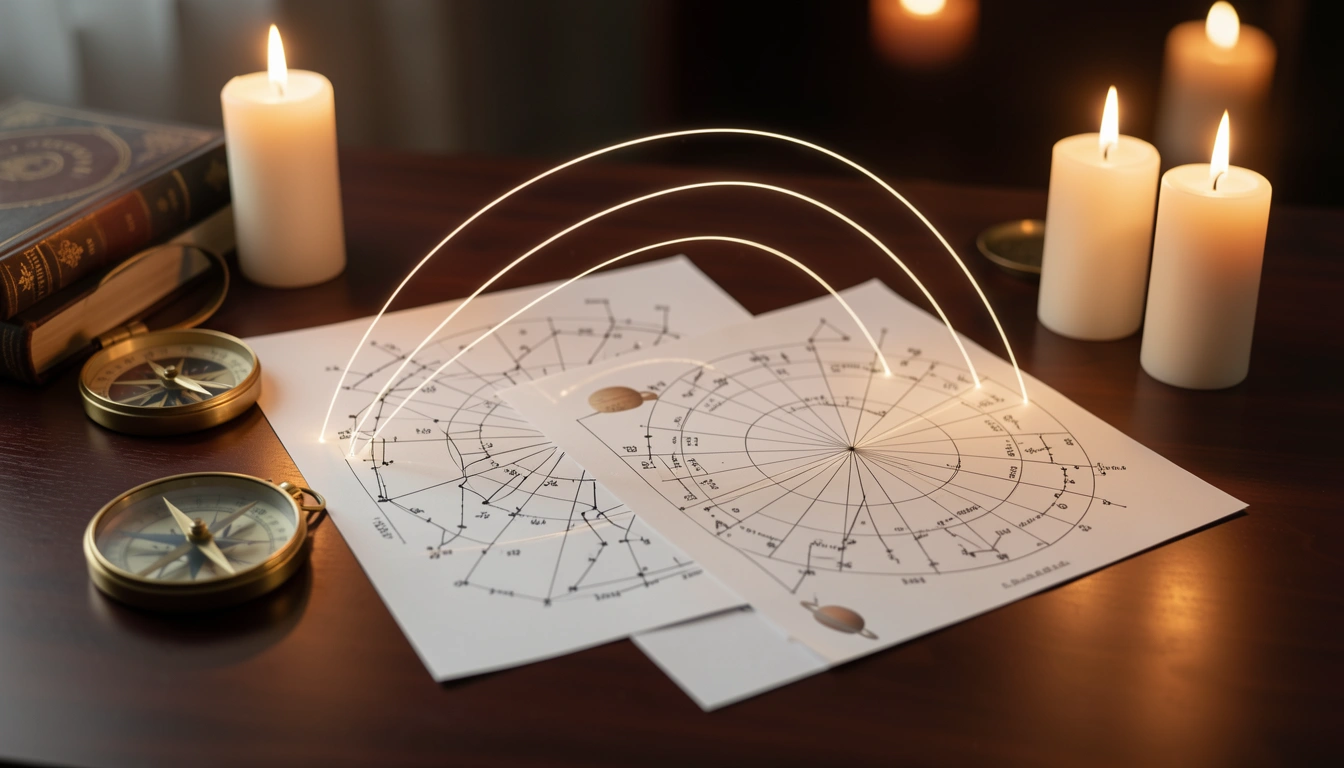
A synastry chart is an astrological comparison of two individuals' birth charts. It is created by overlaying the positions of planets, houses, and angles from one chart onto the other. This overlay reveals the specific interactions between the two people's planetary energies, showing where they naturally harmonize and where they may experience friction. Synastry is one of the most widely used techniques in relationship astrology because it provides a personalized, degree-specific analysis rather than generic sun sign compatibility.
The core purpose of a synastry chart is to map the dynamic between two individuals across multiple dimensions: emotional connection, communication style, sexual attraction, values, and long-term goals. For example, if your Moon falls in your partner's 4th house, you are likely to feel emotionally nurtured in their presence. If their Mars squares your Venus, there may be initial magnetic attraction that later requires negotiation around wants and needs. The chart combines planetary placements with house overlays to give a full picture of how each person affects the other's daily life and inner world.
Unlike a composite chart, which creates a single new chart from the midpoint of both people's planets, synastry keeps both identities distinct. This makes it especially useful for understanding how each person experiences the relationship differently. A synastry chart is also highly effective for analyzing any interpersonal dynamic, not just romantic ones. It works equally well for friendships, family relationships, and professional partnerships.
For further reading, you can also explore Chart Calculators — Natal, Transit & Return Charts.
The Difference Between Synastry and Natal Charts
A natal chart is a snapshot of the sky at the moment of your birth, representing your inherent personality traits, strengths, and challenges. Synastry, by contrast, is a relational chart that shows how two natal charts interact. While a natal chart tells you about yourself, synastry tells you about the chemistry and compatibility between you and another person. The same natal planet can behave very differently in different synastry configurations, depending on the aspects and house overlays involved.
How Does a Synastry Chart Calculator Work?
The Free Synastry Chart Calculator uses the birth data of two individuals to generate an accurate comparison. You enter each person's date of birth, exact time, and location. The calculator then computes the positions of the Sun, Moon, planets, and important angles (Ascendant, Midheaven) for both charts. It calculates the angular difference between each pair of planets from the two charts, using specific orb allowances to determine which aspects are active.
Standard orbs in synastry typically range from 0 to 8 degrees, with conjunctions and oppositions often given wider orbs (up to 10 degrees) and minor aspects tighter orbs (2-4 degrees). The calculator also determines house overlays: that is, which houses in person A's chart contain person B's planets, and vice versa. This is critical because the house shows the life area where the influence is felt most strongly. Most calculators also allow you to choose between house systems, with Placidus being the default and Whole Sign a popular alternative.
The tool outputs a visual chart or table listing all aspects with their angles, and often a color-coded wheel. Some advanced calculators include a breakdown by element and modality, and highlight the most powerful configurations like grand trines or T-squares. The free version on YesAstrology provides all core features needed for a thorough synastry reading without any premium paywall, making it accessible for beginners and experienced astrologers alike.
Planetary Aspects and Orbs
Aspects are the angular relationships between two planets. The five major aspects used in synastry are conjunction (0 degrees), sextile (60 degrees), square (90 degrees), trine (120 degrees), and opposition (180 degrees). Each brings a different quality: conjunctions fuse energies, sextiles and trines flow easily, squares create tension, and oppositions create polarity. Orbs determine how wide the angle can be while still being considered active. In synastry, a tighter orb (under 3 degrees) indicates a more intense and noticeable connection between those planets.
House Overlay Calculation
House overlays show where the other person's planets fall in your natal houses. This is computed by taking the planetary coordinates from one chart and seeing which house cusp they fall into in the other chart. The result tells you which life area that person primarily activates for you. For example, if their Sun lands in your 10th house, they may motivate your career ambitions or public role. Overlays are one of the most revealing parts of synastry because they ground planetary energies into real-world contexts.
Generate Your Free Synastry Chart Online
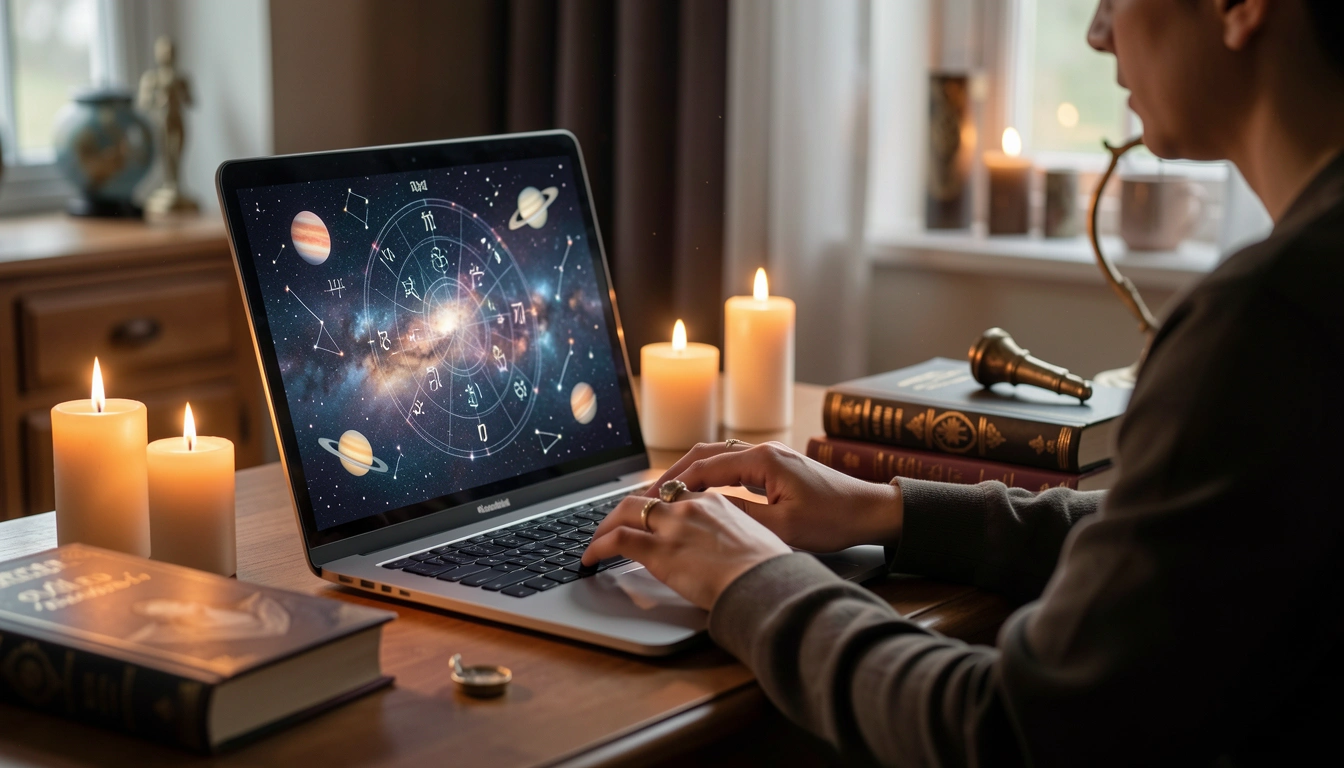
Using the Free Synastry Chart Calculator at YesAstrology is straightforward. Navigate to the synastry tool page and enter the birth details for both individuals: full name for labeling, date of birth, exact time (including AM/PM), and city or coordinates. If you know the time zone, the calculator adjusts automatically. For best accuracy, use the exact birth time from a birth certificate or reliable source. If the time is unknown, you can still get a meaningful reading, but the moon sign and house positions may shift slightly.
After entering both sets of data, click the calculate button. Within seconds, a detailed synastry chart appears. It includes a wheel showing the planetary positions of both individuals, a table of aspects with their orbs, and a list of house overlays. The results are interactive: you can hover over aspects to see interpretations, expand overlays to read their meaning, and even download the chart for offline study. The tool is fully responsive and works on mobile, tablet, and desktop devices.
You do not need an account or payment to generate a chart. The free version includes all essential features. For an even more comprehensive analysis, you can choose the premium report option, which provides a professionally authored interpretation of your synastry chart, covering strengths, challenges, and advice for nurturing the relationship. Start by exploring the free chart and then deepen your understanding with the integrated resources on the site.
Step-by-Step Guide to Getting Your Chart
1. Go to the synastry calculator tool on YesAstrology. 2. Enter Person A's birth data: name, date, time, city. 3. Enter Person B's birth data similarly. 4. Select your preferred house system (default Placidus). 5. Click 'Calculate Synastry.' 6. Review the generated chart, aspect table, and overlay list. 7. Use the built-in interpretation hints or follow the reading guide below for a deeper analysis. You can also save or print the chart for personal reference.
How to Read a Synastry Chart
Reading a synastry chart begins with identifying the most significant aspects and overlays. Start with the personal planets: Sun, Moon, Mercury, Venus, and Mars. These represent core identity, emotions, communication, love, and drive. Hard aspects (squares and oppositions) between these planets often indicate areas that require conscious effort, while soft aspects (sextiles and trines) indicate natural ease. The house overlays for these planets also matter greatly: where someone's personal planets fall in your chart tells you which area of life they activate.
Next, look at the outer planets: Jupiter, Saturn, Uranus, Neptune, and Pluto. Jupiter aspects generally bring expansion and luck, while Saturn aspects bring commitment or restrictions. Uranus brings excitement but also instability, Neptune brings dreaminess and possible illusion, and Pluto brings intensity and transformation. Pay special attention when these outer planets make close aspects to your personal planets, as they can indicate karmic or fated connections.
Finally, check the Ascendant and Midheaven overlays. Aspects from the other person's planets to your Ascendant affect the immediate chemistry and how you present yourself around them. Aspects to your Midheaven relate to shared goals and public life. A well-aspected Venus-Ascendant link often indicates physical attraction, while a Saturn-Ascendant link may feel heavy but can build a lasting foundation. The key is to balance both the positive flow and the challenging aspects, because every relationship has both.
Start with the Sun, Moon, and Rising
The Sun, Moon, and Ascendant (rising sign) are the three most personal points in any chart. In synastry, how these three connect between two people sets the tone for the entire relationship. Sun-Sun aspects show core identity alignment. Moon-Moon aspects indicate emotional resonance. Rising-Rising or Sun-Ascendant aspects often create an immediate sense of recognition. If these three are harmoniously linked, the relationship has a strong foundation for mutual understanding.
Look at Venus and Mars
Venus represents love, affection, and what we find beautiful. Mars represents desire, passion, and assertiveness. In synastry, Venus-Mars aspects are one of the strongest indicators of romantic and sexual attraction. A Venus-Mars conjunction can feel magnetic and irresistible, while a Venus-Mars square might bring tension that fuels passion but also frustration. Also check Venus-Venus for shared values and Mars-Mars for compatible energy levels.
What Does Synastry Reveal About a Relationship?
Synastry reveals the energetic blueprint of a relationship by showing where two people naturally complement each other and where they must work to find balance. It highlights strengths such as effortless communication (Mercury trine Mercury), emotional comfort (Moon in the other's 4th house), and shared passions (Mars conjunct Venus). It also reveals challenges, such as constant disagreements (Sun square Mars) or emotional withdrawal (Moon opposite Saturn). By identifying these patterns, you gain insight into the relationship's true dynamics.
Beyond individual aspects, synastry shows the overall 'theme' of the connection. A chart dominated by fire and air aspects may feel exciting and spontaneous but lack grounding. A chart heavy on earth and water might feel secure but could risk stagnation. The distribution of elements and modes in the synastry aspects tells you about the relationship's temperament. Additionally, the presence of repeating aspects (like multiple conjunctions between personal planets) emphasizes key areas of focus.
Synastry also reveals the timing of relationship phases through transits and progressions applied to the synastry chart. For example, when transiting Jupiter aspects a Sun-Moon conjunction in your synastry, the relationship may experience a period of growth and joy. But when transiting Saturn squares that same point, there may be a test of commitment. Understanding these cycles helps you navigate the relationship with greater awareness and patience.
Attraction Indicators
Attraction shows strongly through Venus-Mars aspects, Sun-Ascendant links, and personal planet conjunctions to the other's Ascendant. Moon-Venus aspects indicate emotional warmth and affection. Also, when the ruler of your 1st house aspects the other's Venus or Mars, you feel an immediate pull. The stronger the attraction indicators, the more magnetic the initial meeting feels, but they don't guarantee long-term harmony.
Conflict Points
Conflict in synastry often arises from square aspects between personal planets, especially Sun-Mars, Moon-Mars, and Mercury-Pluto. Mars square Venus can create a push-pull dynamic around intimacy. Saturn square the Moon can lead to emotional austerity. Overlays to the 12th house can bring hidden resentments or misunderstandings. Recognizing these potential friction points allows both people to address issues proactively rather than letting them accumulate.
Sun, Moon and Rising Sign Synastry
The Sun, Moon, and Rising signs represent the core triad of identity, emotion, and outward expression in astrology. In synastry, these three points act as the primary filters through which partners experience each other. A harmonious aspect between your Sun and your partner's Moon, for example, creates a deep emotional understanding where they instinctively know how to support you. Similarly, a trine between your Ascendant and your partner's Sun often results in an effortless, natural chemistry from the first meeting.
The strength of these connections depends on the aspect type and the participating signs. Sun conjunct Moon between partners is one of the most powerful soulmate indicators, blending ego and emotion into a unified experience. Sun opposite Sun, on the other hand, can create a 'yin-yang' dynamic where two people feel both attracted and challenged by each other's differences. The house placement of these interactions further contextualizes them: your partner's Sun in your 1st house makes you feel seen and validated, while the same Sun in your 12th house may bring hidden dynamics or spiritual lessons.
When all three of these points are positively linked in synastry, the relationship often feels fated, easy, and deeply fulfilling. If they are challenged, the partners may constantly feel misunderstood or out of sync. However, even challenging Sun-Moon-Ascendant aspects can be overcome with conscious effort and mature communication. The awareness these aspects provide is the first step toward growth.
Sun Sign Compatibility
Sun sign synastry is the most talked about but only part of the picture. Two Suns in the same element (fire, earth, air, water) generally get along well. Opposing signs can attract but require compromise. More important than the sun sign itself are the aspects the Suns make to each other and to other planets. A Sun-Moon trine between different signs can be more harmonious than a Sun-Sun conjunction with a square to an outer planet.
Moon Sign Emotional Connection
The Moon governs emotions, instincts, and subconscious needs. In synastry, Moon-Moon aspects show how two people feel about each other, often on a non-verbal level. Conjunct Moons often feel like soulmates, while Moon square Moon can trigger emotional insecurity. Moon trine Moon provides a nurturing emotional bond. Also, the Moon's house overlay in the partner's chart reveals where you provide emotional security for them.
Venus and Mars Synastry for Love and Attraction
Venus and Mars are the two relationship powerhouses in synastry. Venus represents love, affection, values, and what we find beautiful. Mars represents desire, passion, assertiveness, and how we pursue what we want. When these two planets from different charts interact, they create the fundamental chemistry that drives romantic attraction. A Venus-Mars conjunction is often described as 'love at first sight' energy, while a Venus-Mars square can produce a heated push-pull dynamic.
Not all Venus-Mars aspects are romantic; they can also indicate strong friendship or creative partnership. But in a romantic context, these aspects are the strongest predictors of sexual chemistry. Venus trine Mars flows effortlessly, while Venus sextile Mars gives a comfortable attraction. Mars opposite Venus can be intense and passionate, but each person may feel like the other speaks a different love language. The house overlays for Venus and Mars also matter: Venus in the partner's 5th house brings fun and romance, while Mars in the 8th house brings deep sexual intensity.
Beyond Venus-Mars interactions, also check Venus-Venus for shared values and Mars-Mars for compatible drive. Venus square Venus can indicate different ideas of romance, while Mars square Mars may lead to power struggles. Positive Venus-Venus and Mars-Mars aspects can smooth over challenges. In a healthy relationship, these planets balance each other, with Venus adding tenderness and Mars adding vitality.
Venus Aspects in Synastry
Venus aspects to personal planets beyond Mars also matter. Venus conjunct the Sun can create a very charming and affectionate bond. Venus trine Jupiter brings generosity and joy. Venus square Saturn may indicate a relationship that feels blocked or unrequited, but can deepen over time. Venus-Neptune aspects can be dreamy but may also create unrealistic expectations. Each Venus aspect adds a different flavor to the romantic side of the connection.
Mars Aspects in Synastry
Mars aspects show how two people assert themselves and express desire. Mars conjunct Mars creates high energy and competitive drive. Mars trine Sun supports mutual motivation. Mars square Moon can cause emotional arguments. Mars opposite Pluto can be a source of intense power dynamics. Mars-Neptune aspects may lead to passive-aggression or confusion about what each person wants. Mars aspects are especially important for understanding physical intimacy and conflict styles.
Synastry Aspects and Relationship Dynamics
The aspects between two people's planets are the building blocks of synastry. They define the quality of the interaction: easy or challenging, supportive or confrontational. Conjunctions merge energies, sextiles offer opportunity, trines provide flow, squares create tension, and oppositions establish polarity. Each aspect type has a distinct effect on relationship dynamics. A chart with many trines and sextiles may feel harmonious, but sometimes lacks the friction needed for growth. Conversely, a chart heavy with squares and oppositions can be passionate and transformative if both partners rise to the occasion.
The most dynamic relationships tend to have a mix of hard and soft aspects. Hard aspects (squares, oppositions, some conjunctions) generate chemistry and evolution. Soft aspects (sextiles, trines) provide comfort and mutual support. A lack of major aspects between personal planets can lead to a platonic or unemotional bond. The presence of strong aspects to outer planets like Pluto or Saturn can indicate a deeply transformative or karmic relationship that feels destined, even if challenging.
Also consider the strength of each aspect based on orb and planetary dignity. An aspect within 1 degree is extremely potent. If one of the planets is in its domicile or exaltation, its energy is expressed more constructively. For example, Venus in Libra trine Mars in Gemini is very easy, while Venus in Aries square Mars in Cancer may require more effort. The zodiacal sign adds nuance to how the aspect manifests in day-to-day interactions.
Conjunctions, Sextiles, Trines, Squares, Oppositions
Conjunctions: Fusion and intensity. Sextiles: Opportunity and gentle cooperation. Trines: Flow and natural understanding. Squares: Tension and growth through friction. Oppositions: Polarity and the need for balance. Each aspect type plays a role in the relationship ecosystem. A relationship with only trines may be pleasant but lack passion, while one with many oppositions may be dynamic but require constant negotiation.
Understanding Conjunctions, Squares and Oppositions
Conjunctions, squares, and oppositions are the three strongest aspect types in synastry. Conjunctions (0 degrees) occur when two planets from different charts occupy the same sign and degree. This creates a fusion of energies: whatever those two planets represent will be closely intertwined in the relationship. A Sun-Moon conjunction can feel like soulmates, while a Mars-Pluto conjunction can be intensely transformative, sometimes possessive. The conjunctions in your synastry chart highlight the areas where you and your partner are most deeply merged.
Squares (90 degrees) indicate tension and friction. In synastry, squares between personal planets often show where the relationship will be tested. For example, Moon square Mars can trigger emotional outbursts, and Venus square Saturn can make one person feel restricted in expressing love. However, squares also provide the energy for growth. They create challenges that force both partners to develop patience, communication, and compromise. Without squares, a relationship might lack the motivation to evolve beyond surface level.
Oppositions (180 degrees) bring polarity and the need for balance. In synastry, an opposition can create a powerful attraction because each person possesses something the other lacks. Sun opposite Moon can lead to a deep complementary bond, but also misunderstanding if each person expects the other to be more like themselves. Oppositions work best when both individuals respect their differences and see them as strengths rather than obstacles. They often indicate a relationship that brings out hidden parts of each person's psyche.
Conjunctions: Fusion and Intensity
When planets from two charts are within a few degrees of each other, they form a conjunction. This is the most powerful aspect in synastry because it merges the planets' energies. The nature of the conjunction depends on the planets involved. A Venus-Mars conjunction creates strong romantic chemistry. A Saturn-Sun conjunction can feel heavy but builds long-term commitment. Conjunctions to the Ascendant or Midheaven are especially potent for chemistry and shared goals.
Squares: Tension and Growth
Squares between personal planets often indicate where the relationship will face friction. The tension can be motivating or draining, depending on how it is handled. Moon square Venus may indicate emotional needs conflicting with expressions of love. Sun square Uranus can bring instability but also excitement. The key is to recognize that squares are not deal-breakers; they are areas requiring conscious work and open communication.
The 7th House and Partnership Compatibility
The 7th house in astrology is the house of partnerships, marriage, and committed relationships. In synastry, when one person's planets fall into the other's 7th house, it creates a strong focus on partnership and often indicates a serious, marriage-oriented connection. Sun or Venus in the 7th house of the partner's chart can feel like 'the one,' while Saturn in the 7th house may bring a sense of duty or karmic responsibility. The 7th house overlays are among the most important for long-term commitment.
Planets in the 7th house in synastry also activate the partner's approach to relationships. For example, if your Mars lands in your partner's 7th house, they may perceive you as assertive and passionate in the partnership, but also possibly confrontational. Jupiter in the 7th house brings expansion and optimism, but can also lead to over-idealization. The ruler of the 7th house and its condition in both charts adds another layer: if the 7th house ruler is well-aspected in the natal chart, the synastry overlays will be more easily integrated.
Also look at aspects to the 7th house cusp itself. The degree of the 7th house cusp is sensitive to conjunctions from the partner's planets, especially the Sun, Moon, and Venus. Such conjunctions often indicate a powerful pull toward partnership with that person. Similarly, if the partner's Saturn is exactly conjunct your 7th house cusp, the relationship may feel fated but laden with responsibility. The 7th house overlays should be interpreted in conjunction with the 1st house overlays, as the two axes represent the balance between self and other.
Planets in the 7th House in Synastry
When a partner's planet is in your 7th house, they strongly affect your approach to committed relationships. Examples: Sun in 7th - they embody your ideal partner; Moon in 7th - they understand your emotional needs; Venus in 7th - they bring love and harmony; Mars in 7th - they energize and sometimes challenge your partnership; Saturn in 7th - they represent stability or restriction; Jupiter in 7th - they expand your horizons in relationships; Pluto in 7th - they transform your idea of partnership.
7th House Ruler Aspects
The planet that rules the 7th house cusp (the sign on the 7th house) in each chart is also important. If the ruler of your 7th house makes strong aspects to a partner's personal planets, it reinforces the theme of partnership in the relationship. For example, if your 7th house is ruled by Venus, and your partner's Mars trines your Venus, it harmonizes your approach to romance with their drive.
Synastry House Overlays Explained
House overlays are a foundational part of synastry interpretation. They show where the other person's planets fall in your natal houses. The house indicates the area of life most affected by that person's presence. For example, a partner's Moon in your 4th house makes you feel emotionally at home with them, while their Mars in your 10th house might motivate your career but also bring ambition-related conflicts. Every house overlay has both positive and challenging potentials, depending on the planet and aspects involved.
The angular houses (1st, 4th, 7th, 10th) are the most impactful in synastry. When a partner's planets land in any of these houses, the relationship has a strong effect on your identity, home life, partnership, or career. The succedent houses (2nd, 5th, 8th, 11th) relate to values, creativity, intimacy, and friendships. The cadent houses (3rd, 6th, 9th, 12th) connect to communication, daily routines, philosophy, and spirituality. A balanced overlay spread across all houses indicates a well-rounded relationship that touches many parts of life.
Not all overlays are equally active. A planet falling right on a house cusp is especially potent. Also, the condition of the planet in its own chart matters: a poorly placed planet will express its energy less constructively in the overlay. For example, a partner's debilitated Mars may create more conflict than passion in your 5th house. Always consider the dignity of the planet in its own chart before interpreting the overlay. House overlays work together with aspects to give a complete picture.
Angular Houses (1,4,7,10) in Synastry
When a partner's planet lands in your 1st house, they strongly influence your identity and self-expression. In your 4th house, they affect your home and emotional foundation. In your 7th house, they become a key partner. In your 10th house, they impact your career and public image. Angular house overlays make the relationship central to your life, for better or worse.
Succeedent and Cadent Houses
Succeedent houses (2,5,8,11) relate to resources, romance, transformation, and social networks. A partner's Venus in your 5th house enhances romance and fun. Pluto in your 8th house can lead to deep emotional and sexual bonding. Cadent houses (3,6,9,12) involve communication, work, exploration, and secrets. Mercury in your 3rd house creates mental rapport. Saturn in your 12th house may bring karmic lessons or hidden challenges.
Karmic Connections in Synastry
Karmic connections in synastry are aspects and overlays that suggest a deeper, possibly fated bond that carries lessons from past lives or from a soul contract. The strongest indicators include aspects involving the Lunar Nodes, Saturn, and Pluto. When the North Node of one person aspects personal planets of the other, it often signifies that they have met to help each other evolve. A South Node connection can feel very familiar but may also hold patterns that need to be released.
Saturn aspects in synastry, especially to personal planets, indicate a relationship that feels heavy with responsibility or karmic debt. Saturn can feel restrictive, but it also builds lasting structure if both partners are willing to work. Pluto aspects, especially Pluto to Sun, Moon, or Venus, indicate a deeply transformative, sometimes obsessive bond. Pluto challenges you to shed old layers and grow, often through intense emotional experiences.
Karmic connections are not necessarily negative. They often feel profound and unforgettable. However, they may require more effort to maintain equilibrium. If the relationship has many karmic indicators, it is wise to approach it with mindfulness, honoring the growth it brings while also setting healthy boundaries. Recognizing that some bonds are meant to teach rather than last forever can bring peace and clarity.
North and South Node Aspects
When your partner's planet conjuncts your North Node, they represent qualities you are meant to develop. It can feel intimidating but ultimately liberating. Conjunctions to the South Node feel familiar and easy, but may keep you stuck in old patterns. Node aspects to the Sun, Moon, or Venus are especially potent for karmic relationship themes. Node aspects to Saturn or Pluto reinforce fateful encounters.
Saturn Synastry
Saturn aspects in synastry often come with a sense of duty, maturity, and sometimes limitation. Saturn conjunct Venus can mean a love that takes time to blossom or feels blocked initially. Saturn trine Moon provides stability. Saturn square Sun can feel like the partner is too critical or restrictive. The key is to recognize Saturn's lessons and build a solid foundation rather than resisting the discipline it demands.
Emotional and Physical Compatibility in Synastry
Emotional compatibility in synastry is largely governed by Moon and Venus interactions. A harmonious Moon-Moon aspect ensures that both people feel safe and understood emotionally. Moon trine or sextile Moon creates a natural empathy. Venus-Moon aspects add affection and tenderness. On the other hand, Moon square Saturn or Moon opposite Pluto can indicate emotional withholding or intense emotional reactions that require conscious healing. The emotional tone of the relationship is often set by the Moon overlay and aspects.
Physical compatibility is more influenced by Mars and Venus-Mars aspects. Mars aspects to the Moon also play a role, as they show how physical energy interacts with emotional needs. A well-aspected Mars (trine Sun, sextile Venus) typically indicates satisfying physical connection. Mars square Moon can mean that physical expression is sometimes at odds with emotional needs, leading to arguments or unmet desires. The 5th house and 8th house overlays also contribute to physical chemistry: Venus or Mars in the partner's 5th house enhances romance, while in the 8th house it deepens sexual intimacy.
For a balanced relationship, both emotional and physical compatibility need to be present, but they don't have to be equal. Some couples thrive with strong emotional resonance and moderate physical passion; others bond primarily through intense physical chemistry. The synastry chart reveals which domain is dominant, allowing partners to understand their relationship style and work on the areas that are weaker. Open communication about both emotional needs and physical desires is key to maintaining harmony.
Emotional Compatibility Markers
Key markers: Moon conjunct Moon (deep emotional bond), Moon trine Venus (affectionate and nurturing), Moon in the other's 4th house (emotional home), Moon sextile Sun (mutual understanding). Challenging markers: Moon square Mars (emotional arguments), Moon opposite Saturn (emotional distance), Moon square Pluto (intense power struggles). The presence of positive emotional markers supports a resilient relationship even when other areas are tough.
Physical Attraction Indicators
Strong indicators: Venus conjunct Mars (magnetic chemistry), Mars in the other's 5th house (romantic and playful), Venus in the other's 8th house (deep sensual connection), Mars trine Sun (mutual drive). Mars square Venus can also indicate strong attraction but with friction. The element balance also matters: fire and air signs often have more spontaneous physical connection, while earth and water prefer a slower, more sensual approach.
Long-Term Relationship Potential in a Synastry Chart
To assess long-term potential, look for stability indicators such as Saturn aspects, Jupiter aspects, and overlays to the 4th, 7th, and 10th houses. Saturn aspects to personal planets, especially when harmonious (trine, sextile), indicate a relationship built on mutual respect and responsibility that can withstand challenges. Saturn conjunct Venus or Saturn trine Moon often leads to a lasting commitment. Jupiter aspects add optimism, expansion, and a sense of shared adventure that keeps the relationship growing.
House overlays to the 4th house suggest a strong foundation for living together or building a family. Jupiter in the 7th house can indicate a happy marriage, while Saturn in the 7th house may signal a delayed but ultimately stable partnership. Also check the rulers of the 4th, 7th, and 10th houses in both charts and their synastry aspects. If the rulers are well-connected, the relationship has strong structural support for the long haul.
However, long-term potential also requires that both individuals are personally ready for commitment. Even the most favorable synastry chart cannot overcome personal immaturity or mismatched life goals. Synastry shows compatibility potential, but the actual outcome depends on the choices each person makes. Use the chart as a guide to understand the strengths and challenges, and communicate openly about your shared vision for the future.
Saturn as Commitment
Saturn aspects in synastry are often necessary for longevity. A relationship without any Saturn contacts may feel fun but lack the endurance for serious commitment. Saturn trine or sextile Venus or Moon provides a sense of duty and loyalty. Saturn conjunct the Sun can create a very serious bond, but both partners must ensure it does not become oppressive. Saturn opposite personal planets can indicate karmic testing that, if passed, leads to a very strong union.
Jupiter as Expansion
Jupiter aspects bring growth, luck, and happiness to a relationship. Jupiter conjunct Venus is one of the best aspects for a happy, generous partnership. Jupiter trine Sun supports shared confidence and optimism. Jupiter in the other's 9th house can indicate shared travel, education, or spiritual growth. Jupiter can also over-expand, so watch for Jupiter square Mercury (over-promising) or Jupiter square Saturn (boom-bust cycles).
How Birth Time Affects Synastry Results
Birth time is crucial for an accurate synastry reading because it determines the Ascendant, the house cusps, and the Moon's sign (which changes every 2-2.5 hours). Without a precise birth time, the house placements and the Ascendant can be incorrect by several degrees. Since house overlays are a major component of synastry, inaccurate birth time can shift a partner's planet from one house to another, significantly changing the interpretation. For example, a planet that actually falls in the 7th house might appear in the 6th house with a wrong time, altering the relationship's theme.
The Moon also moves quickly. A difference of even 30 minutes can move the Moon by about 0.5 degrees, which might change a Moon-Moon conjunction to a wide orb or even a different sign if the Moon was near a cusp. Similarly, the exact degree of the Midheaven and Ascendant are time-sensitive. For the most reliable synastry, use a birth certificate or hospital record. If you only have an approximate time, you can still gain insights from the Sun, Mercury, Venus, and Mars aspects, which move more slowly.
If the birth time is completely unknown, you can use a 'noon chart' or 'sunrise chart' as a starting point, but consider the results experimental for house overlays and Moon aspects. Some calculators offer a 'birth time unknown' option that assumes 12:00 PM. For serious relationship analysis, birth time rectification is recommended. The YesAstrology Free Synastry Chart Calculator allows you to adjust the time and see how the result changes, which can be educational even with estimated times.
Dealing with Unknown Birth Time
If birth time is unknown, focus on aspects between slower planets (Sun, Mercury, Venus, Mars, Jupiter, Saturn) and use the houses based on a default Ascendant. Avoid drawing strong conclusions about Moon aspects or house overlays. The synastry chart still has value for identifying major themes. You can also ask relatives for time estimates or use life events to narrow down the time (birth time rectification).
Rectification
Birth time rectification is an advanced technique where an astrologer adjusts the birth time until the chart accurately reflects major life events. This can be done by correlating transits, progressions, and professional milestones. For synastry, even a rectified time with an accuracy of ±30 minutes is better than a completely unknown time. Several online tools and professional astrologers offer rectification services.
For further reading, you can also explore Synastry Chart Premium Analysis Report.