On this page
The Free Secondary Progressed Moon Calendar & Phase Calculator is your gateway to understanding the slow, steady inner evolution of your emotional world. While your Natal Moon represents your instinctive emotional nature, the Progressed Moon reveals how your feelings, needs, and responses mature over time. Using the symbolic day-for-a-year progression system, this tool maps your Progressed Moon’s journey through the zodiac and houses, highlighting key dates of sign changes and phase shifts. Whether you are navigating a life transition or simply curious about your emotional growth, this calculator provides a clear, personalized timeline.
Your Progressed Moon moves approximately 12 to 15 degrees per year, completing a full zodiac cycle in about 27 to 28 years. Each sign change brings a distinct emotional quality that lasts roughly 2.5 years. This tool calculates your exact Progressed Moon position for any date, identifies when it changes sign or house, and tracks the phase of the progressed lunar cycle (from New Moon to Balsamic). It is an essential resource for anyone serious about predictive astrology, personal development, or timing emotional decisions.
In the sections below, you will learn how to generate your chart, interpret sign and house placements, understand the progressed moon phases, and compare this technique with transits and primary directions. Use this knowledge to align your inner calendar with your outer life.
What Is the Secondary Progressed Moon?
The Secondary Progressed Moon is a predictive astrology technique that maps your emotional evolution using the symbolic equation: one day after birth equals one year of life. This means the Moon’s position on your 30th day after birth corresponds to your 30th year of life. The Progressed Moon moves faster than any other progressed planet, making it the most sensitive timing indicator for emotional shifts, changing needs, and evolving relationships.
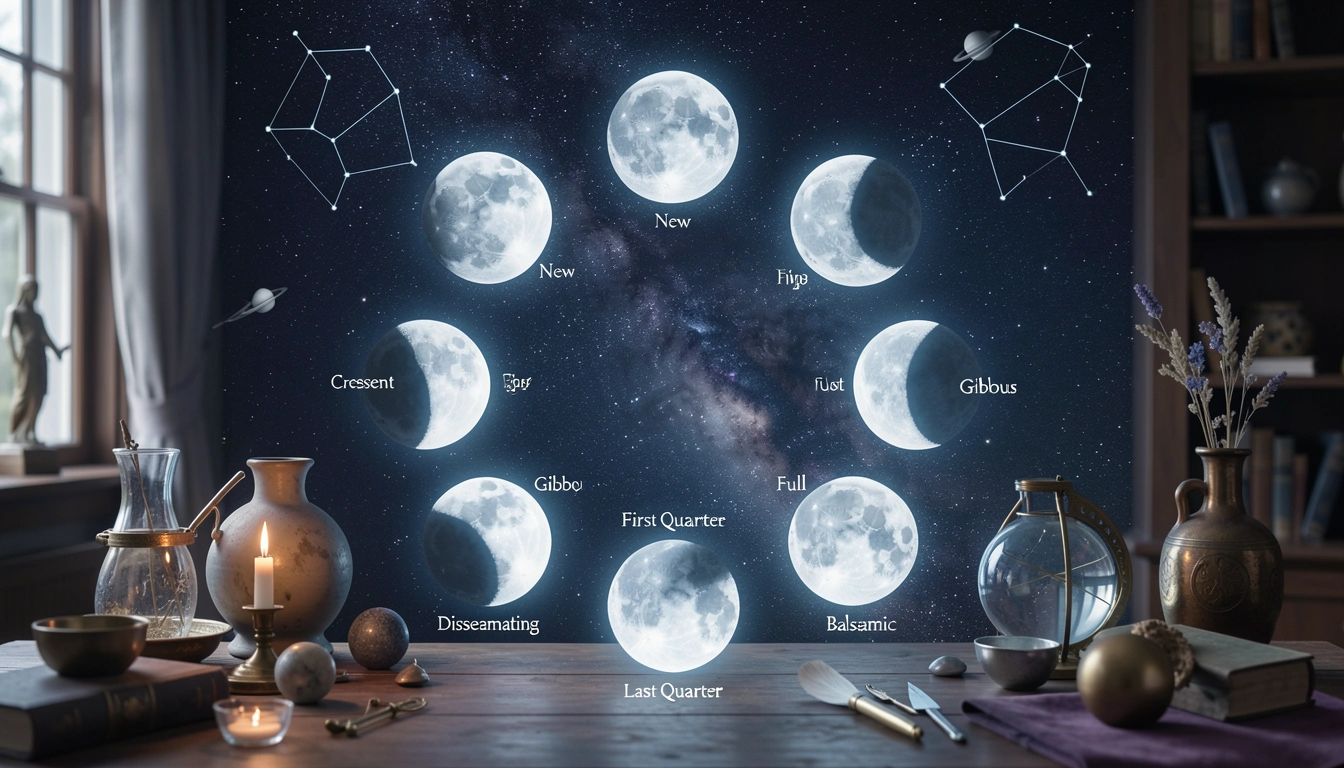
Unlike the Natal Moon, which stays fixed in your birth chart, the Progressed Moon travels through all twelve signs and houses over approximately 27 to 28 years. Each sign change marks a visible shift in how you feel, what you seek for security, and how you express care. House ingresses indicate which life area becomes the focus of emotional growth. The progressed moon also goes through its own phases (New, Crescent, First Quarter, Gibbous, Full, Disseminating, Last Quarter, Balsamic), each lasting about 3.5 years and carrying a specific developmental theme.
In practice, the Progressed Moon is used to time major life events, career changes, relationship shifts, and personal milestones. It is especially valuable when combined with transits and solar returns. For a deeper understanding of how this fits into your overall progression chart, explore the Secondary Progressions Calculator, which provides a full progression report.
The Day-for-a-Year Formula
The formula is simple: count the number of days between your birth date and the target date (the date you want to progress to). Each day equals one year of life. For example, if you were born on January 1, 1990, and want to know your progressed moon on your 30th birthday, you look at the Moon’s position on January 31, 1990 – 30 days after birth. The exact degree, minute, and zodiac sign of that Moon become your progressed moon for age 30.
This method requires an accurate birth time and location, as the Moon moves about 13 degrees per day. A few hours’ difference in birth time can shift the progressed moon by half a degree, affecting sign change dates. The Free Secondary Progressed Moon Calendar & Phase Calculator performs this calculation automatically, using your precise birth data to generate a personalized timeline.
Why the Moon Is the Fastest Progressed Planet
Among all progressed planets, the Moon moves the fastest – about 0.5 to 1 degree per day of life, which translates to 0.5 to 1 degree per year of life. This is because the Moon orbits Earth in about 27.3 days, so its progressed motion covers the entire zodiac in roughly 27.3 years. Other progressed planets, like the Sun (1 degree per year) or Mars (0.5 degrees per year), move much slower, making the Moon the most responsive timing indicator for emotional and psychological changes.
Because of its speed, the Progressed Moon changes sign every 2 to 2.5 years and changes house every 2 to 3 years (depending on house size). This creates a consistent rhythm of emotional renewal and focus, making it easier to track personal growth chapters.
How Does a Progressed Moon Calculator Work?
A Progressed Moon calculator uses your birth date, time, and location to compute the exact position of the Moon on a given number of days after birth, corresponding to your age. The Free Secondary Progressed Moon Calendar & Phase Calculator on YesAstrology does this instantly, applying the day-for-a-year formula with high precision. It calculates the progressed Moon’s zodiac sign, degree, house placement, and phase within the progressed lunar cycle.
The calculator also identifies key dates: when your progressed Moon enters a new sign or house, and when it reaches major phase shifts (e.g., progressed New Moon to Full Moon). These dates are presented in a calendar format, showing the exact day and time of each transition. The tool uses the Placidus house system by default, but you can adjust the house system to Whole Sign, Equal, or Koch if you have a preference. Accurate birth time is required for house calculations; without it, the tool will still show sign and degree but not house ingresses.
To use the calculator, simply enter your birth details and click “Calculate”. You will receive a comprehensive report including a timeline of progressed moon events for your entire life. For a deeper dive into the interpretive meanings of each transition, consider the Secondary Progressed Moon Calendar & Phase Premium Analysis Report, which includes detailed interpretations for each sign, house, and aspect.
Required Input Data
For the most accurate results, you need: your exact birth date (day, month, year), your birth time (hour and minute, including AM/PM), and your birth city or location. The calculator uses this to determine your Natal Moon position and then computes the progressed position for each year. If birth time is unknown, the tool can still calculate the progressed Moon’s zodiac sign and degree, but house ingresses will be approximate. You can also use the Free Birth Chart Calculator Without Accurate Time to get a baseline chart before progressing.
Calculation Output
The output includes a list of dates from your birth to the present (or any custom date range), showing the progressed Moon’s position in degrees, minutes, sign, and house. It also highlights the phase of the progressed lunar cycle (e.g., progressed New Moon, Crescent, etc.). The calendar view shows upcoming sign changes and house ingresses, making it easy to plan ahead. The tool also calculates aspects between the progressed Moon and your natal planets, which we will discuss in a later section.

Generate Your Free Progressed Moon Chart
Generating your free progressed moon chart is straightforward. Visit the Free Secondary Progressed Moon Calendar & Phase Calculator page on YesAstrology, enter your birth details, and click “Generate Chart”. Within seconds, you will receive a custom chart showing your progressed Moon position for the current date, along with a timeline of past and future sign changes. The chart is presented in a clear, easy-to-read format that includes both the progressed Moon and its aspects to your natal planets.
This free chart is an excellent starting point for anyone new to progressions. You can use it to identify which progressed moon sign you are currently in, when it last changed, and when it will change again. For example, if you are in your progressed Moon in Leo, you are likely in a period of increased self-expression and creativity. If it is about to move into Virgo, you may soon shift toward analytical self-care and practical routines.
The chart also includes the progressed moon phase, which is calculated from the Sun-Moon angle in the progressed chart. This phase adds another layer of meaning, as each phase represents a different developmental task. The generated chart is downloadable and printable, so you can reference it anytime. For a more in-depth analysis that combines your progressed moon with other progressions and transits, the premium Premium Analysis Report offers personalized interpretations.
Find Your Secondary Progressed Moon Sign
Your Secondary Progressed Moon sign is the zodiac sign that the progressed Moon occupies at a given age. To find it, use the calculator and look at the current date or the age you are interested in. The sign is listed along with the degree. For example, if your progressed Moon is at 15 degrees Aries, you are in a progressed Aries Moon phase. This sign changes every 2 to 2.5 years, marking distinct emotional chapters in your life.
Each progressed moon sign brings a different emotional flavor. A progressed Moon in Cancer (the Moon’s own sign) amplifies nurturing instincts and a need for security. In Capricorn, emotional expression becomes more reserved and focused on achievement. The sign also colors how you react to events and what you need to feel safe. Knowing your current progressed moon sign helps you understand why certain themes have emerged in your life.
To find your progressed moon sign for any past or future year, enter that year into the calculator. The tool shows a year-by-year breakdown. You can also see the exact date of sign change, which is often marked by a significant emotional shift or life event. For instance, if your progressed Moon moves from Scorpio to Sagittarius, you may feel a release from deep emotional intensity and a desire for exploration and freedom.
Example: Progressed Moon in Aries
When your progressed Moon is in Aries, you feel a surge of independence and assertiveness. Emotional needs center on self-initiation and courage. This is a time to start new projects, express anger constructively, and take risks. The shadow side includes impulsiveness and impatience. This phase lasts about 2.5 years.
Example: Progressed Moon in Libra
Progressed Moon in Libra brings a focus on relationships, harmony, and balance. You may feel a stronger need for partnership, fairness, and aesthetic beauty. Emotional decisions are often made with an eye toward diplomacy. The challenge is to avoid excessive people-pleasing. This phase is ideal for relationship counseling or artistic collaboration.
Calculate Your Progressed Moon Phase
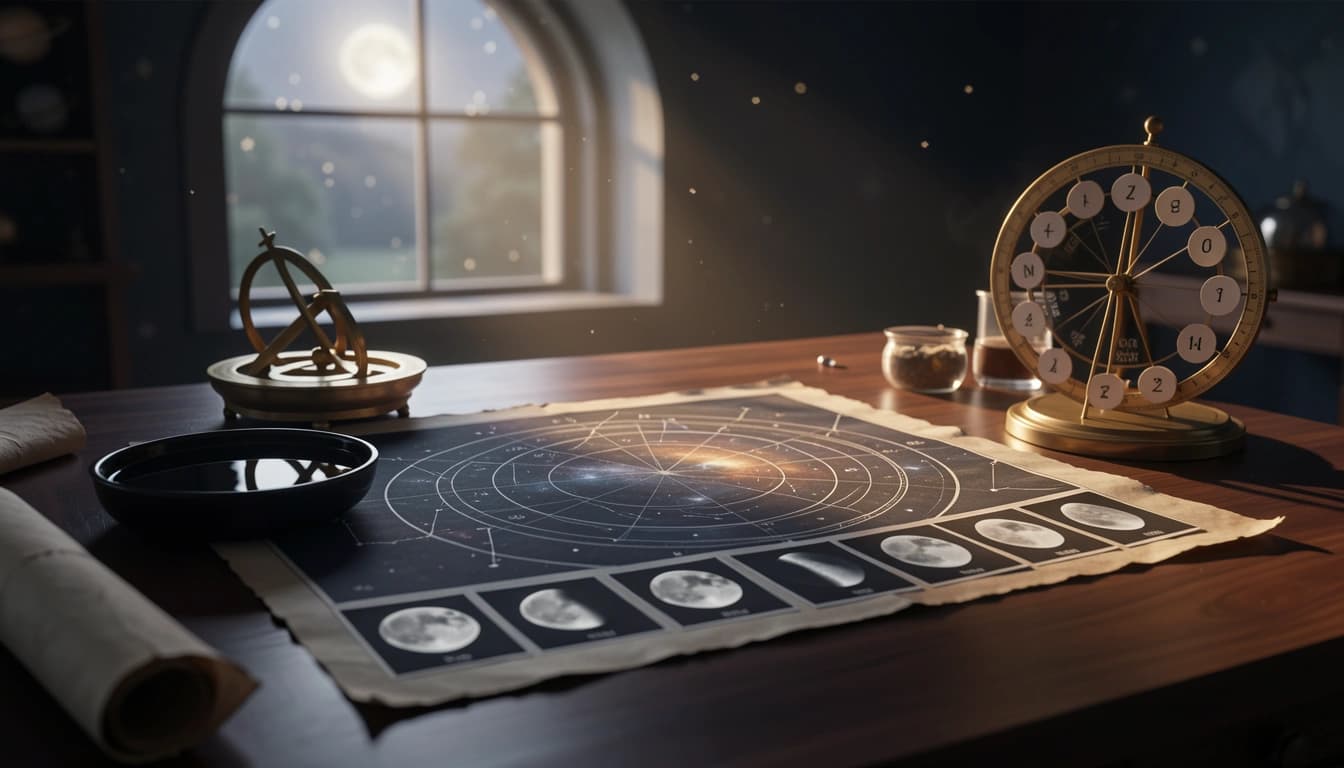
The progressed moon phase is determined by the angle between the progressed Sun and the progressed Moon in your progressions chart. Just like the monthly lunar cycle, the progressed moon goes through eight phases: New Moon (0° to 45° ahead of the Sun), Crescent (45° to 90°), First Quarter (90° to 135°), Gibbous (135° to 180°), Full Moon (180° to 225°), Disseminating (225° to 270°), Last Quarter (270° to 315°), and Balsamic (315° to 360°). Each phase lasts about 3.5 years in progressed time.
To calculate your progressed moon phase, the calculator compares the progressed Sun and progressed Moon positions. For example, if your progressed Moon is 90° ahead of your progressed Sun, you are in a progressed First Quarter Moon phase. This phase is associated with decision-making, tension, and action. A progressed Full Moon phase (180°) often coincides with heightened emotions, relationship milestones, and clarity.
Understanding your phase helps you understand the broader developmental arc of your life. The progressed New Moon starts a new emotional cycle, while the Balsamic phase calls for release and completion. This tool makes it easy to see which phase you are in and when it will transition. For a more comprehensive view, combine your progressed moon phase with your progressed moon sign and house.
Progressed Moon Phase Table
| Phase | Angle (Sun-Moon) | Duration | Theme |
|---|---|---|---|
| New Moon | 0°–45° | ~3.5 years | New beginnings, fresh emotional start |
| Crescent | 45°–90° | ~3.5 years | Building momentum, overcoming obstacles |
| First Quarter | 90°–135° | ~3.5 years | Action, crisis, decision |
| Gibbous | 135°–180° | ~3.5 years | Refinement, analysis, preparation |
| Full Moon | 180°–225° | ~3.5 years | Illumination, culmination, relationship focus |
| Disseminating | 225°–270° | ~3.5 years | Sharing, teaching, spreading |
| Last Quarter | 270°–315° | ~3.5 years | Reassessment, letting go |
| Balsamic | 315°–360° | ~3.5 years | Completion, surrender, spiritual preparation |
Secondary Progressed Moon Calendar and Dates
The secondary progressed moon calendar is a feature of the calculator that lists all significant progressed moon events in chronological order. It shows the exact date when your progressed Moon enters a new sign, a new house, or reaches a critical phase shift. This calendar is invaluable for planning life changes, as you can see, for example, that your progressed Moon will move into your 10th house in 2026, suggesting a career-oriented emotional focus.
The calendar covers your entire lifetime, from birth to age 90 or more. It is generated instantly based on your birth data. You can scroll through past years to see how your progressed moon has aligned with major life events. For instance, if you got married during a progressed Full Moon in Libra in the 7th house, the calendar would confirm that timing. This tool helps you recognize patterns and prepare for future transitions.
Each entry in the calendar includes the date, the new position (sign, degree, house), and the type of event (sign change, house ingress, phase change). You can also see the aspects formed between the progressed Moon and your natal planets at that time. The calendar is printable and can be used as a reference for journaling or therapy work. For a more detailed interpretation of each event, the premium report provides narrative descriptions.

How to Read Your Progressed Moon Cycle
Reading your progressed moon cycle involves three layers: sign, house, and phase. Start by identifying your current progressed moon sign. That tells you the emotional tone. Then look at the house it occupies in your progressed chart – that shows the life area where emotional growth is occurring. Finally, check the phase to understand the developmental stage of the cycle. For example, a progressed Moon in Taurus in the 2nd house during a Gibbous phase suggests you are refining your approach to finances and self-worth, preparing for a future breakthrough.
Next, consider the aspects your progressed Moon makes to your natal planets. These aspects are temporary but powerful. A progressed Moon conjunct your natal Venus can bring a period of heightened love and social engagement. A square to natal Saturn might indicate emotional challenges requiring discipline. The calculator includes these aspects in the output, showing the exact orb and date range.
Finally, look at the overall pattern. Are you in a series of progressed New Moons (fresh starts) or a series of progressed Full Moons (culminations)? The cycle of phases over decades tells a story of emotional evolution. The Free Secondary Progressed Moon Calendar & Phase Calculator provides this holistic view, making it easy to see the big picture. For a step-by-step guide, consider pairing this tool with the Free Birth Chart Calculator (Natal Chart) to understand how your progressed moon interacts with your natal foundation.
Step-by-Step Interpretation
- Identify the sign: What is the element and modality? Fire signs bring action, Water signs bring feeling, etc.
- Identify the house: Which life area is activated? 1st house = self, 4th = home, 7th = relationships, 10th = career.
- Identify the phase: New Moon = start, Full Moon = peak, Balsamic = end.
- Check aspects: Look for conjunctions, sextiles, squares, trines, and oppositions to natal planets.
- Synthesize: Combine all three layers into a coherent narrative.
Progressed Moon Signs and Emotional Development
Each progressed moon sign represents a 2.5-year chapter of emotional development. The energy of the sign colors your feelings, needs, and reactions. For example, when your progressed Moon moves through Aries, you learn to assert yourself and take emotional risks. In Taurus, you focus on stability and sensory comfort. In Gemini, communication and curiosity drive your emotional life. Cancer brings a need for nurturing and home, while Leo demands creative self-expression.
As the progressed Moon moves through Virgo, you become more analytical and health-conscious. Libra emphasizes relationships and fairness. Scorpio deepens emotional intensity and transformation. Sagittarius expands your horizons through travel and philosophy. Capricorn brings maturity and responsibility. Aquarius encourages individuality and community. Pisces dissolves boundaries and heightens intuition.
These sign changes are not random; they follow the natural order of the zodiac. Observing your progressed moon sign history can reveal a clear emotional development path. For instance, you might notice that after a progressed Moon in Libra (relationship focus), you entered Scorpio (intimacy and transformation), which then led to Sagittarius (freedom and growth). This sequence is a map of your soul’s journey.
Elemental Shifts
Notice when your progressed Moon changes element. A shift from Fire to Earth (e.g., from Leo to Virgo) marks a transition from enthusiastic self-expression to practical refinement. Water to Air (e.g., from Pisces to Aries) moves from emotional merging to independent action. These elemental shifts often coincide with major life changes, such as moving, changing careers, or ending relationships.

Progressed Moon Houses and Life Themes
The house that your progressed Moon occupies in your progressed chart indicates which area of life is most emotionally charged. A house ingress occurs when the progressed Moon moves from one house to another, typically every 2 to 3 years depending on house size. This shift often signals a change in life focus. For example, if your progressed Moon enters the 1st house, you may become more focused on self-image, identity, and personal initiatives. In the 7th house, relationships and partnerships take center stage.
House ingresses are especially significant because they often coincide with tangible events. A progressed Moon in the 4th house can bring a move, family changes, or deep inner work. In the 10th house, career achievements and public recognition become important. The calculator shows the exact date of house ingress, allowing you to anticipate these themes.
To interpret a house placement, consider the sign on the cusp and the ruler of that house. For instance, if your progressed Moon is in the 5th house with Leo on the cusp, creativity and romance are highlighted. If the house is intercepted, the energy may be more internal. The Free Secondary Progressed Moon Calendar & Phase Calculator uses your birth time to calculate houses accurately, so ensure your birth time is as precise as possible.
Example: Progressed Moon in the 4th House
When the progressed Moon enters the 4th house, emotional focus turns to home, family, and roots. You may feel a stronger need for security, nesting, or connecting with your past. This is a favorable time to resolve family issues, redecorate, or move to a place that feels like home. The shadow side can be emotional withdrawal or over-dependence on family.
What Does Your Progressed Moon Reveal?
Your progressed Moon reveals the emotional and psychological development you are undergoing at any age. It shows what you need to feel secure, how you express care, and where you are growing emotionally. Unlike transits, which reflect external events, the progressed Moon describes internal shifts. For example, a progressed Moon in the 12th house might indicate a period of introspection, dreams, and spiritual exploration, even if your external life appears quiet.
It also reveals the timing of emotional maturity. The progressed Moon’s journey through the houses mirrors the stages of life: in childhood, it moves through the lower houses (1-4), focusing on family and self; in adulthood, it moves through the upper houses (5-8), focusing on relationships and transformation; in later years, it moves through the 9-12 houses, emphasizing wisdom and spirituality. Your progressed moon position at any age tells you which developmental stage you are in.
Furthermore, the progressed Moon can reveal hidden patterns. For instance, if you have a recurring progressed Moon aspect to natal Saturn every 7 years, you may experience periodic tests of emotional resilience. The calculator helps you identify these cycles. For a comprehensive analysis that includes both progressed moon and other predictive techniques, the premium report offers a detailed narrative.

Progressed Moon Phases and Major Life Changes
Major life changes often coincide with significant progressed moon phase shifts. The progressed New Moon (0-45°) is a potent time for starting new emotional cycles – launching a relationship, beginning a new career path, or moving to a new city. The progressed Full Moon (180-225°) brings culmination, visibility, and often a relationship milestone or public acknowledgment. The progressed Last Quarter (270-315°) is a time of release and decision-making, often leading to endings.
These phases are not just symbolic; they are timed to your personal developmental rhythm. For example, if you are approaching a progressed Full Moon conjunct your natal Midheaven, you may receive a promotion or public recognition. A progressed New Moon in the 5th house could signal the start of a creative project or a new romance. The calculator highlights these phases, showing the exact date and house location.
To maximize the value of this information, keep a journal of major life events and compare them to your progressed moon phases. You will likely see a clear pattern. The Free Secondary Progressed Moon Calendar & Phase Calculator makes this comparison easy by providing a timeline you can reference. For those who want to deepen their understanding, the premium report includes interpretations for each phase in relation to your natal chart.
Progressed Moon Phase and Relationship Timing
Relationships are particularly sensitive to progressed moon phases. A progressed New Moon in the 7th house often coincides with the start of a significant partnership. A progressed Full Moon in the 7th house can bring a marriage proposal, a public commitment, or a relationship crisis that leads to clarity. The phase tells you whether the relationship is in a beginning, middle, or ending stage.
Progressed Moon Aspects to Your Natal Chart
When your progressed Moon forms an aspect to a natal planet, it activates that planet’s energy for a period of time. The most powerful aspects are conjunctions (0° orb, with a 1° orb for progressed moon), which can last up to 2 years. A progressed Moon conjunct natal Venus can bring a period of love, beauty, and social harmony. A progressed Moon square natal Saturn can bring emotional challenges, discipline, and lessons in responsibility.
Other aspects include sextiles (opportunities), trines (flow), quincunxes (adjustment), and oppositions (tension). The calculator lists all aspects within a 3° orb, showing the exact date of exact aspect and the duration. For example, if your progressed Moon forms a trine to your natal Jupiter, you may experience a period of expansion, optimism, and luck in emotional matters.
These aspects are temporary but can be very influential. They often coincide with specific events. For instance, a progressed Moon opposite natal Mars might trigger arguments or conflicts that force you to assert your needs. The calculator helps you prepare for these periods by showing them in advance. To see how these aspects interact with your overall chart, use the Free Birth Chart Calculator (Natal Chart) to have your natal chart handy.
Progressed Moon Conjunct Natal Sun
This is a major aspect that occurs every 27-28 years. It marks a time of emotional rebirth and alignment of your will and feelings. You feel more authentic and integrated. This is an excellent time to make life decisions that honor your true self. The aspect lasts about 2 years.

How Long Does Each Progressed Moon Phase Last?
The progressed Moon phase (New, Crescent, etc.) lasts approximately 3.5 years each, since the entire progressed lunar cycle is about 27.3 years. Each phase is divided into eight segments, each about 45° of the 360° cycle. The exact duration can vary slightly depending on the speed of the progressed Moon, which can be influenced by the Moon’s apogee and perigee in the ephemeris. On average, you can expect each phase to last between 3.3 and 3.7 years.
Sign changes occur more frequently, every 2.5 years on average. House ingresses depend on your house system and the size of your houses; in Placidus, houses can vary from 20° to 40°, so house ingresses can last from 1.5 to 3.5 years. The calculator provides precise dates for each transition, so you can plan accordingly.
These durations make the progressed Moon a valuable tool for timing medium-term life cycles. Unlike transits that last days or weeks, progressed moon phases last years, giving you a broad arc of development. For example, a progressed First Quarter Moon phase
Progressed Moon vs. Transiting Moon
Both the progressed Moon and the transiting Moon reveal emotional shifts, but they operate on completely different timelines. The transiting Moon changes signs every two and a half days, reflecting short-term moods, daily reactions, and passing feelings. The progressed Moon, by contrast, moves through a sign over roughly two and a half years, mapping out your inner emotional evolution across seasons of life.
Think of the transiting Moon as the weather—it shifts hour to hour, influencing how you feel right now. The progressed Moon is more like the climate of your emotional world, setting the tone for months or years at a stretch. When the transiting Moon triggers your progressed Moon through an aspect, you often feel a sudden surge of awareness about where you're headed emotionally—a mini epiphany tied to a larger cycle.
In practice, the transiting Moon might make you irritable for an afternoon, while the progressed Moon moving into a new sign can mark the start of a whole chapter where your priorities around home, relationships, or career fundamentally shift. Understanding both layers gives you a clearer picture: the transiting Moon handles the daily pulse, and the progressed Moon holds the deeper narrative of your personal growth.
Secondary Progressions vs. Primary Directions
Secondary progressions and primary directions are two different techniques for forecasting life themes, and they're often confused by newcomers. Secondary progressions use the 'day for a year' method: each day after your birth corresponds to one year of life. So, if you're 30 years old, your progressed chart is based on the planetary positions 30 days after your birth. This method is widely used in modern astrology because it's straightforward and yields meaningful insights about emotional and psychological development.
Primary directions, on the other hand, are far older and more mathematically complex. They calculate how the planets move by rotating the Earth on its axis after birth—essentially, they measure the motion of the sky as seen from your birthplace over time. Primary directions are precise to specific dates and often indicate major turning points, like career changes or pivotal relationships, but they require exact birth times and advanced calculation software.
For most personal readings, secondary progressions are the go-to tool for understanding inner growth and emotional patterns. Primary directions are reserved for pinpointing life-defining events. The progressed Moon is exclusively a feature of secondary progressions, making it accessible and practical for everyday astrology enthusiasts.