On this page
The Personal Transit Calendar & Exact Transit Finder is a precision astrological tool that scans a user-selected date range for exact major aspects between the current positions of the planets and the planets in your birth chart. Unlike a generic daily horoscope, this calendar produces a timeline of events unique to you - every transit is calculated against your exact natal degrees, houses, and aspect patterns. Each entry includes the local date and time of the exact aspect, the orb (how close to perfect the aspect is), the nature of the aspect (conjunction, sextile, square, trine, opposition, etc.), and the natal house being activated.
Whether you are a seasoned astrologer tracking a Saturn return or a curious beginner wanting to know when Venus will trine your Sun, this tool eliminates guesswork. It delivers a clear, chronological list of transit events, allowing you to plan, reflect, and prepare for astrological weather. The calendar focuses only on exact (or near-exact) aspects, which are the moments when transiting planets align most tightly with your natal chart - these are the windows of greatest potential for change, opportunity, or challenge.
In the sections below, we explain how the transit finder works, how to generate your personalized calendar, and how to interpret the results so you can make the most of every planetary alignment.
What Is a Personal Transit Calendar?
A personal transit calendar is a dynamic timeline that maps the current movements of the planets (transits) onto the fixed positions of your natal chart. Unlike a generic transit calendar that shows aspects to the current day's planet positions for everyone, a personal version filters events so that only transits making an exact aspect to one of your natal planets or sensitive points (Ascendant, Midheaven, Lunar Nodes) are listed. The result is a custom schedule of astrological events that are personally relevant to you.
The Personal Transit Calendar & Exact Transit Finder goes a step further by emphasizing exact aspects - those where the transiting planet's longitude matches your natal planet's longitude within an adjustable orb (usually 0° to 1° for the most precise hits). These are the peak moments of transit influence. For example, if transiting Jupiter is at 15° Aries and your natal Sun is at 15° Aries, that exact conjunction will appear in your calendar with the local time when the alignment is perfect.
This tool is invaluable for timing decisions, understanding recurring patterns, and preparing for major life events. It is commonly used in predictive astrology alongside progressions and solar arcs. Many astrologers consider transits to the natal chart as the primary trigger for unfolding destiny - they represent external circumstances meeting your internal blueprint.
Why Exact Aspects Matter
In transit astrology, the orb (the allowed deviation from perfect aspect) determines the strength and timing of an event. A transiting planet is said to be 'applying' as it approaches exactness and 'separating' as it moves away. The exact transit finder captures the moment when the energy is most concentrated. For fast-moving planets like the Moon, an exact aspect lasts only a few hours. For slow planets like Pluto, the exactness can stretch over days or even weeks due to retrograde motion. Understanding these windows helps you pinpoint when to take action or exercise caution.
For example, a transiting Mars square your natal Venus may last a few days, but the exact square might occur on a specific Tuesday evening. If you have the exact time, you can plan to avoid conflict during those hours. The calendar shows not only the date but the precise time in your local timezone, making it a practical tool for real-life planning.
How Does an Exact Transit Finder Work?
The Exact Transit Finder (the engine behind the Personal Transit Calendar) operates on astronomical and astrological principles. First, it calculates the current positions of all major planets (Sun, Moon, Mercury, Venus, Mars, Jupiter, Saturn, Uranus, Neptune, Pluto) plus the Lunar Nodes using ephemeris data. Then it compares these positions to the user's natal chart planets, houses, and angles. The search algorithm identifies when a transiting planet's longitude falls within a user-defined orb of an exact aspect to a natal point.
Most implementations allow you to set the date range (e.g., next 30 days, next year), choose which aspects to include (major aspects only or also minor ones), and adjust orbs. The default orb for exact transits is typically 0° to 1°, ensuring high precision. The tool then outputs a list sorted by date and time, showing the transiting planet, the aspect type, the natal planet or point involved, the orb, and the natal house being transited. Some advanced versions also include the house that the transiting planet is currently occupying in the natal chart.
Behind the scenes, the calculation respects time zones and daylight saving adjustments, so the times displayed are your local clock times. This makes the calendar immediately actionable - you know exactly when an aspect perfects in your local area.
Orb Tolerances and Precision
The concept of 'exact' in astrology is not absolute zero due to the nature of ephemeris calculations. A transit is considered exact when the angular difference is 0°00'00" ideally, but in practice the finder uses a tolerance of ±0°01' to ±1°00'. For the Personal Transit Calendar & Exact Transit Finder, the default is set to 0°30' (half a degree) for slower planets and 0°10' for the Moon, balancing precision with practical usability. You can often customize these settings if you prefer a tighter or wider lens.
Wider orbs (e.g., 2°) will include more events but may dilute the sense of 'exactness'. Tight orbs (0°10') yield fewer but more potent moments. For serious predictive work, many astrologers use a combination: tight orbs for the Moon and personal planets, wider orbs for generational planets. The tool's flexibility supports both approaches.
What Aspects Are Included?
The standard set includes the five major aspects: conjunction (0°), sextile (60°), square (90°), trine (120°), and opposition (180°). Some versions also include semi-sextile (30°), quincunx (150°), and the minor aspects (e.g., semi-square, sesquiquadrate). The Exact Transit Finder on YesAstrology includes all major aspects by default, with an option to add the quincunx and semi-sextile - both are important for health, adjustments, and subtle shifts.
Additionally, aspects to the Ascendant, Midheaven, North Node, and South Node can be included. These points are sensitive and often mark external events or karmic encounters. For example, a transit of Jupiter conjunct the natal Ascendant can signify a new chapter or a surge in personal confidence.

Generate Your Personal Transit Calendar
Creating your own Personal Transit Calendar is straightforward. You will need your birth date, exact birth time, and birth location to generate an accurate natal chart. If you do not have an exact birth time, you can still get a useful calendar, but house placements and Moon aspects may be less reliable. Many tools, including YesAstrology's Free Birth Chart Calculator (Natal Chart), can help you obtain your chart first.
Once your natal chart is saved, the transit finder uses it as the reference. You set a date range - commonly 30 days, 90 days, or a full year - and choose the level of precision. After hitting generate, the tool returns a list of exact transit events. Each entry shows:
- Date & Time (local) – when the aspect exactly perfects.
- Transiting Planet – the planet currently moving.
- Aspect – e.g., trine, square.
- Natal Planet/Point – the part of your chart being activated.
- Orb – angular difference at the moment.
- Natal House – the house where the natal planet resides.
You can then export the calendar or view it in a web interface. For a deeper analysis, the Personal Transit Calendar & Exact Transit Finder Premium Report adds interpretation text for each event, explaining what the transit means and how to work with it.
Step-by-Step Generation Process
- Enter Your Birth Data – Provide date, time, and location. Accurate time is crucial for correct house placement.
- Set Date Range – Choose start and end dates for the transit search. A 3-month window is a good starting point.
- Configure Aspect and Orb Preferences – Select which aspects to include and adjust orb sizes. Beginners can keep defaults.
- Generate Calendar – The tool processes the ephemeris and compares it to your natal chart. It may take a few seconds.
- Review Results – The events are displayed in chronological order. Click on any event for more details or interpretation.
You can regenerate the calendar with different parameters as often as you like. The premium report also provides a downloadable PDF with extended interpretation for each transit.
Common Mistakes to Avoid
- Ignoring the Moon – The Moon transits quickly (2-3 days per sign) and can be easily overlooked. However, lunar transits to your natal Sun, Moon, or Ascendant can trigger emotional reactions and are worth tracking.
- Using Too Wide Orbs – Expanding orbs to 2° or 3° can make the calendar noisy and dilute the 'exact' nature. Stick to 1° or less for clarity.
- Forgetting Retrograde Periods – A planet may station and cross the same natal degree multiple times. The calendar will show each pass. Treat the first pass as the initial activation, the station as the peak, and the final direct pass as the resolution.
- Not Adjusting for Your Timezone – Always verify that your device timezone is correctly set. The tool uses your local timezone based on IP or manual input.
Find Your Exact Planetary Transits
Once you have your calendar, the next step is interpretation. Each exact transit is a signal that the energy of the transiting planet is merging with the natal promise of the affected planet and house. For example, a transit of Jupiter over your natal Venus (exact conjunction) often coincides with love, financial gain, or artistic inspiration. An exact Saturn square to your natal Sun can signify a period of pressure, responsibility, or internal restructuring.
The Exact Transit Finder gives you the raw data - dates, times, aspects, houses. But the real value lies in understanding the story behind the aspects. A trine from Jupiter to your natal Moon suggests ease in emotional expression, while a square from Mars to your natal Mercury warns of hasty words or arguments. By combining the nature of the transiting planet (e.g., Jupiter expands, Saturn contracts), the aspect (trine flows, square challenges), and the natal house (what area of life), you can build a coherent narrative for the upcoming weeks.
For instance, if transiting Pluto is exactly opposite your natal Sun in the 10th house, expect power struggles related to career or reputation. The calendar will show the exact date of that opposition. This allows you to prepare mentally and strategically. Many users print out their calendar for the month and review it weekly, noting which transits are approaching and what actions they can take to align with the energy.
Interpreting Transit Timing in Multipass Events
When a planet goes retrograde, it will cross the same natal degree three times: first direct, then retrograde, then direct again. The Personal Transit Calendar will list each passage separately. The first direct hit is the initial encounter - the theme is introduced. The retrograde hit is often a review or revision phase. The final direct hit brings closure or integration. For example, a Saturn transit to your natal Mercury may first manifest as a communication block, then a period of introspection, and finally a clear understanding. Recognizing these phases helps you work with the transit rather than resist it.
For fast-moving planets like Mercury and Venus, retrogrades happen multiple times a year. Their exact transits can be frequent but short-lived. The calendar is especially useful for identifying Mercury retrograde exact squares to your natal planets, which are often the most frustrating days for travel and technology.
Using Transits for Timing Major Decisions
One of the primary uses of an exact transit calendar is electional astrology - choosing the best time to start a project, sign a contract, or get married. The Exact Transit Finder helps you avoid negative transits and align with positive ones. For example, you would avoid scheduling a business launch when Mars is square your natal Sun (risk of conflict or failure) and prefer a day with Venus trine your natal Jupiter (harmony and expansion).
Pairing the transit calendar with an Electional Astrology Calculator gives you a powerful combination: the transit calendar warns of difficult days, while electional tools help you pick the best time within a window. This is standard practice among professional astrologers.
Tracking Progress with the Calendar
Many people use the Personal Transit Calendar as a journaling tool. By noting what happened on each exact transit day, you can verify the predictive value of astrology for your own life. Over months, patterns emerge: you may notice that Jupiter transits to your 2nd house often coincide with unexpected income, or that Pluto transits to your 4th house correspond with home renovations. This experiential learning deepens your trust in astrology and refines your interpretation skills.
YesAstrology's premium report provides interpretation snippets, but you can always customize your own meanings. The calendar is a living document - update it weekly, cross-reference with your diary, and watch your understanding grow.
How to Read Your Personal Transit Calendar
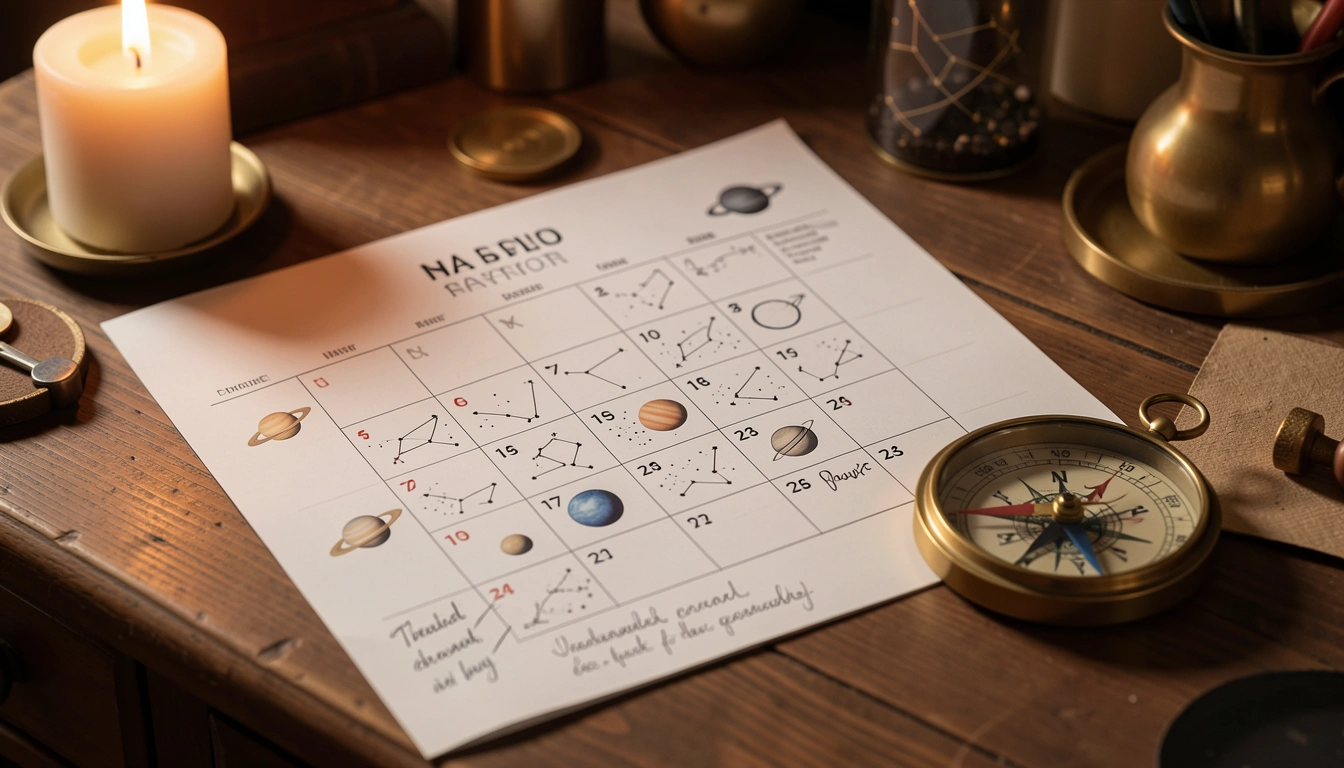
Your Personal Transit Calendar & Exact Transit Finder presents a clean, chronological list of every exact major aspect the current planets are making to your natal chart. Each row shows the transit date and local time, the aspect type (conjunction, sextile, square, trine, or opposition), the orb — how many degrees before or after exactness — and the natal house being activated. This layout lets you scan upcoming weeks or months at a glance, knowing exactly when a particular planetary alignment reaches its peak.
The calendar uses your birth data to calculate the precise moment a transiting planet forms an aspect to a natal planet or angle. For example, if transiting Mars squares your natal Mercury at 2° orb, the event appears with the date and time when the square is exact. The orb column tells you how close the aspect is: a smaller orb means a tighter, more powerful influence. You can adjust the date range to focus on a specific period, making the tool ideal for planning important decisions or simply anticipating energetic shifts.
To get the most out of the calendar, pay attention to the natal house listed for each transit. That house reveals the life area most likely to feel the transit's impact — career, relationships, home, or personal growth. Pair the house with the aspect's nature: a trine from Jupiter to your natal Sun in the 10th house suggests a smooth period of professional recognition, while a square from Saturn to your natal Moon in the 4th house might signal emotional weight around family matters. The calendar gives you both the when and the where so you can prepare mindfully.
Understanding Aspect Columns
Each transit row includes the aspect symbol (conjunction ☌, sextile ⚹, square □, trine △, opposition ☍) and the exact degree of the aspect. The orb is listed as a decimal value — typically within 1° to 2° for exact transits. A 0.5° orb indicates the transit is almost perfectly exact, while a 1.8° orb means the influence is still active but slightly looser. Use this column to prioritize the most potent alignments in your calendar.
Reading Orb and House Positions
The natal house number (1–12) next to each transit tells you which area of life the transit is activating. For instance, a transit through the 7th house often relates to partnerships, while the 6th house points to daily routines and health. Combine the house with the aspect's tone — a square in the 12th house may bring hidden tensions to the surface, whereas a trine in the 5th house can spark creative joy.
What Do Your Personal Transits Reveal?
Personal transits are the conversation between the sky as it moves now and the sky as it was at your birth. They reveal when certain energies become active, urging you to grow, confront, or embrace change. A transit does not cause an event by itself — it activates a potential already written in your natal chart. For example, when transiting Jupiter crosses your natal Ascendant, you may feel a surge of optimism and new opportunities for self-expression. The aspect's nature shapes how that energy flows: a trine brings ease, a square demands effort, and a conjunction merges the planet's force with your own.
The house system adds another layer. If transiting Saturn squares your natal Venus in the 10th house, you might face challenges in your professional relationships or public image. The same aspect in the 4th house could manifest as family responsibilities testing your sense of security. By reading the transit's house placement alongside the aspect, you gain a nuanced understanding of where life's spotlight will fall. The calendar's chronological order also shows the sequence of events — sometimes a series of transits builds a story over weeks.
Beyond the obvious, transits can reveal timing for inner shifts. A Neptune transit to your natal Mercury might cloud your thinking at first, but later bring intuitive insights. Pluto transits often strip away what no longer serves you, leaving room for transformation. The calendar gives you the exact dates so you can observe these processes with awareness rather than surprise. Over time, you'll notice patterns — certain transits recurring at pivotal moments — and learn to work with the cosmic rhythm.
Transit Aspects and Their Emotional Signatures
Each aspect carries a distinct emotional flavor. Conjunctions blend two planetary energies, often intensifying the natal planet's expression. Sextiles and trines are cooperative, bringing opportunities with less friction. Squares and oppositions create tension and confrontation, pushing you to resolve imbalances. The calendar shows the exact aspect type so you can anticipate whether a transit will feel supportive or challenging.
House Placements and Life Domains
The natal house activated by a transit is the stage where the drama unfolds. Transits through angular houses (1st, 4th, 7th, 10th) tend to be more noticeable, while cadent houses (3rd, 6th, 9th, 12th) influence mental and spiritual processes. Use the house number to focus your attention on the relevant area — a transit to the 2nd house may affect finances, while the 11th house touches friendships and long-term goals.

Transit Dates and Exact Timing
The Personal Transit Calendar & Exact Transit Finder calculates the precise moment when a transiting planet reaches an exact aspect to your natal chart. This is not a daily horoscope — it is a pinpoint timing tool. You can set a date window — for example, the next three months — and the calendar will list every exact major transit within that period, ordered by local date and time. This allows you to see not just that a transit is happening, but exactly when it peaks.
Why does exact timing matter? Because the influence of a transit is strongest at the moment of exact aspect, though its effects can be felt a few days before and after depending on the orb. For fast-moving planets like the Moon, the exact transit may last only a couple of hours. For slower planets like Saturn, the exact aspect can be felt for days. The calendar's time column shows the local time based on your birth location or current location — whichever you choose — so you can sync the transit with your daily schedule.
To use the calendar effectively, consider the context of the transit. A Mars square to your natal Sun at 3:15 PM might coincide with a tense meeting, while a Venus trine to your natal Moon at 8:00 PM could be perfect for a relaxing evening. You can also look for clusters — several transits happening on the same day — which often mark significant turning points. The tool gives you the raw data; your awareness turns it into wisdom.
Setting Your Transit Window
You can define the date range for the calendar — from a few days to a full year. The tool then scans for all exact major aspects within that window. Shorter windows (e.g., two weeks) are useful for detailed planning, while longer windows (e.g., six months) help you see the bigger picture of upcoming planetary activity.
Interpreting the Time of Day
The local time of each transit is calculated to the minute. This is especially helpful for lunar transits, which shift quickly. If a transit occurs during your sleep hours, its influence may manifest in dreams or subconscious processing. For transits during waking hours, you can consciously align your actions with the planetary energy.
Major Transits to Your Natal Chart
While every exact transit carries weight, some stand out as life markers. Saturn transits, especially the Saturn return (around ages 29–30 and again in your late 50s), are famous for restructuring your career, relationships, and sense of responsibility. Jupiter transits bring expansion, luck, and growth — a Jupiter trine to your natal Sun often coincides with a period of confidence and opportunity. Uranus transits shake things up, breaking old patterns to make way for freedom. Neptune transits dissolve boundaries, inspiring creativity but also confusion. Pluto transits transform from the ground up, often through intense challenges that lead to profound renewal.
The calendar will show these outer planet transits as they make exact aspects to your natal planets. For example, if Uranus is exactly opposing your natal Venus, you might experience sudden changes in relationships or values. If Neptune is exactly sextile your natal Mercury, your intuition and imagination can flow more freely. Because outer planets move slowly, their exact transits are rare — sometimes only once every several years — making them especially significant. The calendar ensures you don't miss these pivotal moments.
Beyond the outer planets, transits from Mars, Venus, and Mercury also have major impacts, especially when they aspect your personal planets (Sun, Moon, Mercury, Venus, Mars). A Mars transit to your natal Moon can stir emotions and drive action; a Venus transit to your natal Jupiter can bring social joy and generosity. The calendar treats all planets equally, listing each exact transit by its chronological order. By reviewing the full list, you can identify which transits are likely to be most noticeable — often those involving your ruling planet or planets in angular houses.
Saturn Transits and Life Structure
Saturn transits to your natal planets demand maturity and discipline. A Saturn square to your natal Mercury may require you to communicate more carefully or take on a serious study. Saturn opposite your natal Sun can feel like a test of your identity. The calendar's exact timing helps you prepare for these weighty periods.
Jupiter Transits and Expansion
Jupiter transits bring growth, optimism, and sometimes excess. A Jupiter trine to your natal Mars can boost your energy and drive, while a Jupiter square to your natal Venus might lead to overindulgence in pleasure. Knowing the exact date allows you to channel Jupiter's abundance wisely.
Uranus, Neptune, Pluto: Generational Waves
These slow-moving planets affect entire generations, but when they aspect your natal chart personally, the impact is deeply individual. Uranus transits can feel like lightning bolts of change; Neptune transits can blur reality and inspire art; Pluto transits can bring power struggles and rebirth. The calendar pinpoints these rare exact aspects so you can navigate them with awareness.

Planetary Transits Through Your Natal Houses
When a transiting planet moves through a house in your natal chart, it activates the themes associated with that area of life. The Personal Transit Calendar & Exact Transit Finder pinpoints the exact moment a planet crosses a house cusp, allowing you to see precisely when your career, relationships, home life, or personal growth will come into focus. Whether you use Placidus, Whole Sign, or another house system, the tool calculates the cusp positions from your birth data and tracks each transit with local date and time precision.
Each house governs a distinct domain: the first house shapes identity and appearance, the fourth roots you in family and home, the seventh governs partnerships, and the tenth speaks to public standing. As a planet like Jupiter transits your seventh house, you may encounter new opportunities in marriage or business collaborations. A Saturn transit through the fourth house often brings responsibilities related to parents or property. The calendar lists these events chronologically, so you can plan around the most intense periods.
For a deeper look at how your natal houses are configured, explore our Free Birth Chart Calculator to generate your full house system. Then use the transit calendar to see which planets are currently moving through those same houses. This layered approach reveals the timing of life’s major shifts with remarkable clarity.
The Role of House Cusps and Angles
House cusps act as thresholds. A planet exactly conjunct the Ascendant, IC, Descendant, or Midheaven can mark a turning point. The transit calendar records these exact crossings, noting the degree and minute when the transit becomes exact. For example, a Venus transit over your Descendant might precede a significant romantic encounter, while a Mars transit over the Midheaven could ignite a career move. Understanding these sensitive points adds another layer of precision to your reading.
Transit Aspects and Their Meaning
Transit aspects describe the angular relationships between moving planets and your natal chart points. The Personal Transit Calendar focuses on the five major Ptolemaic aspects: conjunction (0°), sextile (60°), square (90°), trine (120°), and opposition (180°). Each aspect carries a distinct energy. Conjunctions amplify and merge; sextiles bring ease and opportunity; squares create tension and drive; trines offer flow and support; oppositions highlight balance and confrontation.
Orb tolerance matters. For fast-moving planets like the Moon, an orb of 1–2 degrees is typical, while slower planets such as Saturn or Jupiter allow up to 6–8 degrees. The tool respects these standard orbs and lists only exact aspects within the defined window, showing the precise moment the aspect reaches perfection. This precision helps you identify the peak of an influence rather than the vague weeks-long period often described in generic horoscopes.
You can also examine how multiple transits form patterns. A T-square between transiting Saturn, Uranus, and your natal Sun, for instance, can signal a period of abrupt restructuring. The calendar’s chronological layout makes it easy to spot clusters of aspects. For a broader view of current planetary positions, use the Free Transit Chart Calculator to see the full sky at a glance.
Orb Tolerances and Aspect Precision
Not all astrologers agree on exact orb limits. The Personal Transit Calendar uses widely accepted ranges: 8° for Sun and Moon aspects to personal planets, 6° for aspects to outer planets, and 2° for Moon transits. You can adjust these settings in the tool to match your preferred style. The calendar then returns only those aspects that fall within your chosen orb, filtering out noise and highlighting the most potent alignments.

Saturn, Jupiter and Outer Planet Transits
The slow-moving outer planets — Saturn, Jupiter, Uranus, Neptune, and Pluto — shape the long arc of your life. Saturn transits demand accountability and structure, often coinciding with career milestones, relationship tests, or health discipline. Jupiter transits expand whatever they touch, bringing growth, luck, and sometimes excess. Uranus transits shake up routines, Neptune dissolves boundaries, and Pluto transforms through power and rebirth.
Saturn’s return around ages 27–30 and again at 57–60 is one of the most significant astrological rites of passage. The Personal Transit Calendar can pinpoint the exact dates of your Saturn return, showing when it hits your natal Saturn and which house it activates. Similarly, Jupiter’s annual transit through each house offers a 12-month cycle of opportunity in a different life area. Use the Free Saturn Return Calculator to get a dedicated report, then layer in the transit calendar for daily precision.
Transits from Uranus, Neptune, and Pluto last years and often coincide with generational shifts. When these planets aspect a personal planet or angle in your chart, the effects are profound but gradual. The calendar helps you identify when these slow-burning transits become exact, allowing you to prepare for breakthroughs, illusions, or deep transformations. For a complete timeline of all planetary returns, explore the Planetary Return Finder.
Timing Your Saturn Return with Precision
Saturn returns are not a single event — Saturn will go retrograde and direct over your natal Saturn degree multiple times. The Personal Transit Calendar lists each exact pass, including the first hit, the retrograde revisit, and the final direct pass. This three-phase pattern often mirrors the gradual unfolding of a life lesson. Knowing the dates of each exact transit helps you track your progress through the Saturn return cycle.
Mercury, Venus and Mars Transits
The inner planets — Mercury, Venus, and Mars — move quickly through the zodiac, creating short but noticeable shifts in your day-to-day life. Mercury transits influence communication, travel, and mental processes. When Mercury transits your natal Mercury or an important angle, expect a flurry of conversations, decisions, or technical issues. Venus transits affect love, money, beauty, and social harmony. Mars transits bring energy, assertiveness, and sometimes conflict, depending on the aspect.
Retrograde periods for these planets are especially potent. Mercury retrograde transits often cause miscommunications and delays, but they also offer a chance to revisit unfinished business. Venus retrograde can stir up past relationships or shift your values. Mars retrograde slows down your drive and can lead to frustration if you push too hard. The Personal Transit Calendar marks all retrograde stations and the exact dates when these planets form aspects to your natal chart, so you can navigate these cycles with awareness.
Because these transits are brief — often lasting only a few days to a couple of weeks — the calendar’s chronological format is ideal for planning. You can see, for example, that Venus will trine your natal Moon next Tuesday, making it a great day for emotional connection, or that Mars will square your natal Mercury, suggesting you avoid signing contracts that day. For a deeper dive into how your progressed Moon interacts with these transits, check the Free Secondary Progressed Moon Calendar & Phase Calculator.
Working with Mercury Retrograde Transits
During Mercury retrograde, the planet repeats degrees it already crossed, creating three exact aspects to your natal chart instead of one. The Personal Transit Calendar captures all three passes: the pre-retrograde shadow, the retrograde exact hit, and the post-retrograde shadow. This allows you to see the full arc of the transit. For example, a Mercury retrograde square to your natal Venus might begin with a misunderstanding in a relationship, lead to a heartfelt conversation during the retrograde, and culminate in a clearer commitment after the shadow ends.

Personal Transits for Love and Relationships
When the current planets make exact aspects to your natal Venus, Mars, Moon, or the ruler of your 7th house, the sky is writing a love letter just for you. The Personal Transit Calendar & Exact Transit Finder pinpoints these moments down to the local hour, revealing when a Venus transit to your natal Venus might stir a renewed sense of romance, or when a Mars transit to your natal Moon could ignite a passionate but potentially volatile encounter. By tracking the exact orb and aspect type—whether a harmonious trine or a challenging square—you can prepare for the emotional weather ahead.
For those in committed relationships, transits from Jupiter or Saturn to the 7th house cusp or its ruler often mark significant milestones. Jupiter can expand the bond, sometimes through travel or shared beliefs, while Saturn may demand a serious conversation about boundaries or long-term commitment. The calendar's chronological ordering lets you see how these transits unfold over weeks or months, so you can plan important conversations or decide when to take a relationship to the next level. Even a fleeting transit of Mercury to your natal Venus, lasting only a day or two, can be the perfect window for a heartfelt note or a crucial dialogue.
Understanding the house placement of the transiting planet adds another layer of nuance. A Venus transit through your 5th house might spark creativity and flirtation, while the same transit through the 7th house emphasizes partnership harmony. The tool's preservation of the active natal house means you never have to guess which area of life is being activated. Whether you're single and seeking or partnered and deepening, knowing the exact timing of these personal transits gives you a practical edge in navigating the heart's most mysterious rhythms.
Key Planetary Players in Love Transits
Venus rules attraction and affection, Mars governs passion and pursuit, and the Moon reflects emotional needs. Jupiter expands love, Saturn tests commitment, and Uranus can bring sudden changes or independence. The outer planets—Neptune and Pluto—work on a generational level but can still trigger profound shifts when they aspect personal planets. The Personal Transit Calendar defaults to major aspects (conjunction, sextile, square, trine, opposition) with an orb of 1° for faster planets and 2° for slower ones, though you can adjust these settings to match your preferred sensitivity.
Personal Transits for Career and Major Life Changes
Your career path and major life transitions are often written in the transits of Saturn, Jupiter, and Pluto to the angles of your chart—especially the Midheaven (MC) and the 10th house. When Saturn transits your MC, you may face a professional reckoning: a promotion, a layoff, or a sobering realization about your true ambitions. The Personal Transit Calendar & Exact Transit Finder shows you exactly when Saturn will form an exact conjunction, square, or opposition to your natal MC, so you can prepare for that pivotal moment rather than be blindsided by it.
Jupiter's transit through the 10th house is a classic period of career expansion and recognition. It might coincide with a job offer, a successful launch, or a surge in public visibility. But not all transits are smooth: a square from Uranus to your natal Sun can disrupt your identity or career direction unexpectedly. The calendar's chronological listing by local date and time helps you identify windows of opportunity (sextiles and trines) and periods of tension (squares and oppositions) so you can plan job interviews, negotiations, or major announcements accordingly.
Pluto transits to the MC or the ruler of the 10th house often signal deep transformations in your professional identity—a complete career change, the end of a long-standing role, or the emergence of a new calling. These transits unfold slowly, but the exact aspect dates are critical moments of decision or revelation. By combining the transit calendar with your natal chart, you can see which house system amplifies the effect. The tool's default use of the Placidus house system offers a nuanced view, but you can also explore whole sign houses for a different perspective on career timing.
Saturn Returns and Career Crossroads
A Saturn return—occurring around ages 28–30, 58–60, and 88–90—is one of the most significant career transits. The Personal Transit Calendar can track the exact moments when Saturn returns to its natal position, which happens three times over about two years (the first exact hit, the retrograde revisit, and the final direct hit). Each of these dates can mark a major career decision or restructuring. Use the Saturn Return Calculator to complement the transit calendar for a deeper understanding of this life cycle.

How Long Do Personal Transits Last?
The duration of a personal transit depends on the speed of the transiting planet, the orb you set, and whether the planet turns retrograde. The Moon moves through a sign in about 2.5 days, so a Moon transit to a natal planet may last only a few hours if you use a tight 1° orb. Mercury and Venus typically transit a single degree in a day or two, making their exact aspects last roughly 24–48 hours. The Sun, moving about 1° per day, delivers a transit window of about two days. For these faster bodies, the calendar's precision down to the local time is invaluable—you can schedule a meeting or a creative session right when the aspect becomes exact.
Mars takes about two days to traverse one degree, so its exact aspects last around 48 hours, but the influence can be felt a few days before and after depending on the aspect's nature. Jupiter, Saturn, Uranus, Neptune, and Pluto move much more slowly. A Jupiter transit may stay within 1° orb for about a week, while Saturn can linger for two to three weeks. The outer planets—Uranus, Neptune, and Pluto—can hold an exact aspect to a natal point for a month or more, especially when they station retrograde or direct. The Personal Transit Calendar automatically accounts for retrograde periods, so you'll see multiple exact hits for the same transit, which effectively extends the overall influence.
Orb tolerance is another factor you control. The tool defaults to 1° for inner planets and 2° for outer planets, but you can tighten or widen these values. A wider orb (e.g., 3° for Jupiter) will make the transit appear to last longer, but the intensity is strongest at the exact moment. The calendar displays the orb for each event, so you can see how close the transit is to perfection. This is especially useful for tracking the approach of a major transit like a Saturn return or a Pluto square, where the exact hit is just one peak in a longer process of transformation.
Retrograde Seasons and Extended Effects
When a planet turns retrograde, it will transit the same degree of the zodiac three times: once direct, once retrograde, and once direct again. For example, a Jupiter transit to your natal Sun might first be exact in January, then again in April (retrograde), and finally in June (direct). The Personal Transit Calendar lists all three exact dates, showing you how the transit ebbs and flows. The period between the first and last exact hit can last several months, especially for outer planets, making the entire season feel charged with that planet's energy.
Transit Calendar vs. Natal Chart
Your natal chart is a snapshot of the sky at the moment of your birth—a fixed blueprint of your potential, strengths, and challenges. The transit calendar, by contrast, is a dynamic map of how the current planetary movements interact with that fixed blueprint. While the natal chart remains static, transits are constantly shifting, activating different parts of your chart over time. The Personal Transit Calendar & Exact Transit Finder bridges the two: it takes your natal chart as the foundation and overlays the current (or future) planetary positions to show you exactly when and where aspects will form.
A natal chart alone tells you that you have Venus in Libra in the 10th house, suggesting a natural charm in your career. But without transits, you won't know when that Venus will be activated by a passing Jupiter for a wave of professional popularity, or by a challenging Saturn to test your professional relationships. The transit calendar provides the timing. It organizes events chronologically, so you can see that on March 15th at 2:34 PM local time, Jupiter will exactly trine your natal Venus. That's a date you can mark for a pitch, a public appearance, or a networking event.
Moreover, the transit calendar includes the orb and the active natal house, which the natal chart alone cannot show in a temporal context. For example, your natal chart may show Saturn in the 4th house, but a transit from Saturn to your IC will only happen once every 29 years. The calendar lets you prepare for that rare event. While the natal chart is your astrological DNA, the transit calendar is your daily weather forecast—and for serious planning, you need both. Use the Transit Chart Calculator to see the full transit chart for any moment, and the Personal Transit Calendar to focus on exact aspects to your birth chart alone.
How to Use Both Tools Together
Start with your natal chart to understand your core placements. Then open the Personal Transit Calendar and set your date range—perhaps the next 30 days or the next 6 months. Scan the list for transits to your personal planets (Sun, Moon, Mercury, Venus, Mars) and angles. Note the exact times and aspects. Cross-reference with the house positions: a transit to the 7th house ruler is relationship-oriented, while one to the 10th house ruler is career-focused. This combined approach transforms static knowledge into actionable timing.