On this page
The Free Human Design Chart Calculator is your gateway to understanding the unique energetic blueprint you brought into this world. Human Design blends elements of astrology, the I Ching, the Kabbalah, and the chakra system into a single, practical map of your nature. By entering your birth date, exact time, and location, this tool instantly generates your BodyGraph - a visual representation of how your energy flows, where you are consistent, and where you are open to influence.
Unlike a traditional astrology chart that focuses on planetary positions, a Human Design chart reveals your Type (how you best interact with the world), your Strategy (the most effective way to make decisions), and your Inner Authority (your personal compass for choices). It also shows your defined and undefined Centers, which indicate where you have reliable energy and where you are sensitive to others. The calculator also identifies your Profile, your Incarnation Cross, and the specific Gates and Channels active in your design.
Whether you are new to Human Design or a seasoned practitioner, this free tool provides a complete, accurate foundation for self-discovery. No sign-up required - just your birth data and a few seconds. Use the results to align your decisions, understand your relationships, and live more authentically.
What Is a Human Design Chart?
A Human Design chart, also called a BodyGraph, is a detailed energetic map calculated from your birth date, time, and location. It combines principles from four ancient wisdom traditions: the Chinese I Ching (64 hexagrams), the Western zodiac (astrology), the Hindu chakra system, and the Kabbalistic Tree of Life. The system was synthesized by Ra Uru Hu in 1987 after a mystical encounter, and it has since become a popular tool for personal development and decision-making.
The chart shows nine geometric Centers (similar to chakras) connected by Channels and Gates. Each Gate corresponds to one of the 64 hexagrams, and the Channels represent specific energetic pathways. The positions of the planets at your birth determine which Gates are activated, and the configuration of defined (colored) and undefined (white) Centers reveals your unique design. Unlike a horoscope that describes personality traits, Human Design focuses on how your energy operates consistently versus where you are open to conditioning from others.
Your chart also includes your Type (Manifestor, Generator, Manifesting Generator, Projector, or Reflector), your Strategy (how to interact with the world effectively), and your Inner Authority (your reliable decision-making mechanism). Together these elements form a practical guide for living in alignment with your true nature. The calculator on this page produces all of these components instantly, giving you a full report you can explore section by section.
The Origins of Human Design
Human Design was channeled by Ra Uru Hu (born Robert Allan Krakower) in 1987 on the island of Ibiza. He claimed to receive a download of information from a voice he called 'the Voice.' The system he taught combines four esoteric traditions into a coherent, testable framework. Over the past three decades, thousands of analysts and practitioners have expanded and taught the system worldwide.
While some critics question its mystical origins, many users report that their BodyGraph accurately describes their decision-making patterns, energy levels, and relationship dynamics. The system is not a belief system but an empirical tool - you are encouraged to experiment with your Strategy and Authority to see if they improve your life.
How Does a Human Design Calculator Work?
A Human Design calculator uses your birth date, exact time, and location to compute the positions of the Sun, Moon, planets, and the lunar nodes at the moment of your birth. It then maps these positions onto the 64 Gates of the I Ching, which are arranged in a circular wheel similar to an astrological chart. The calculator determines which Gates are activated (colored in) and which are dormant, based on the planetary degrees and the specific algorithm designed by Ra Uru Hu.
The process involves several steps: first, the calculator calculates the sidereal zodiac positions (using a 23-degree offset from the tropical zodiac) to align with the fixed stars. Then it applies the Human Design 'neutrino' calculations that map planetary positions to the 64 Gates. Next, it determines the Centers by checking which Gates are connected via the predefined Channels. A Center is defined (colored) if it has at least one Gate connected to it; otherwise it remains undefined (white).
Finally, the calculator derives your Type based on which Centers are defined (specifically the Ajna, Throat, and Root Centers), your Authority based on the defined Centers (e.g., Sacral, Emotional Solar Plexus, Splenic), and your Profile from the positions of the Sun and Earth in the Gates. The entire calculation takes less than a second. The free tool on this page performs all these steps accurately and presents the results in an easy-to-read BodyGraph with explanatory text.
The Role of Birth Time Accuracy
Your birth time is critical for an accurate Human Design chart. A difference of even a few minutes can change the Gate positions of the Sun and Earth, which determine your Profile and Incarnation Cross. If you do not know your exact birth time, the calculator can still produce a chart based on the day, but many elements will be approximate. For the most reliable results, use the best available time from your birth certificate or hospital records.
If your birth time is uncertain, you can explore the free Birth Chart Without Accurate Time tool for astrology, but for Human Design we recommend obtaining your official time. Some users later use Birth Time Rectification services to refine it.

Generate Your Free Human Design Chart
To generate your free Human Design chart, simply enter your birth date, exact birth time, and birth location into the calculator on this page. The tool processes your data instantly and displays your BodyGraph with all major components: Type, Strategy, Authority, Profile, Centers, Gates, Channels, and Incarnation Cross. No account creation or payment is required.
Once generated, you can explore each element interactively. Hover over a Center to see its definition status and associated Gates. Click on a Gate to read its hexagram description and planetary influence. The chart also includes a summary of your Type and Authority with practical guidance for applying them in daily life. For a deeper dive, consider the Human Design Chart Premium Analysis Report, which provides an extended interpretation of your entire design.
The calculator is designed for both beginners and advanced students. Beginners will appreciate the clear labels and concise explanations. Advanced users can access the raw planetary positions and Gate numbers for further analysis. The chart can be saved as an image or printed for reference.
Privacy and Data Handling
Your birth data is processed securely and is not stored on our servers unless you choose to create an account. The calculation happens in real time, and the resulting chart is displayed only to you. We do not share your personal information with third parties. For more details, see our privacy policy.
How to Read Your Human Design BodyGraph
Your BodyGraph is a diagram with nine geometric shapes (Centers) connected by lines (Channels). The Centers that are colored in are 'defined' - they represent consistent, reliable energy in your design. White Centers are 'undefined' - they are open to influence and conditioning from others. The first step in reading your chart is to notice which Centers are defined and which are undefined, as this reveals where you have fixed energy and where you are sensitive.
Next, look at the Throat Center. If it is connected to any other Center, you have a defined Throat, meaning you have a consistent way of communicating and manifesting. If it is undefined, your communication style varies depending on your environment. Then check the Sacral Center: if defined, you are a Generator or Manifesting Generator; if undefined, you are a Projector, Manifestor, or Reflector. This leads directly to your Type.
Your Authority is determined by the defined Centers in a specific hierarchy. If the Sacral is defined, your Authority is Sacral (gut response). If the Solar Plexus is defined, your Authority is Emotional (clarity over time). If the Spleen is defined, your Authority is Splenic (intuitive in the moment). If only the Ajna or Crown is defined, your Authority is Self-Projected (speaking out loud). Finally, your Profile is a two-number combination (e.g., 1/3, 2/4, 6/2) derived from the Sun and Earth Gates, describing your personality archetype.
Step-by-Step Chart Reading
- Identify defined (colored) Centers. Count them.
- Determine your Type from the combination of defined Centers (see next section).
- Find your Authority by checking the highest-priority defined Center: Sacral > Solar Plexus > Spleen > Ajna > Crown.
- Read your Profile numbers from the chart (two numbers separated by a slash).
- Note any Channels that connect two defined Centers - these are your consistent energetic themes.
- Finally, look at your Incarnation Cross (the four Gates around the Sun/Earth positions) for your life purpose.
The Five Human Design Types Explained
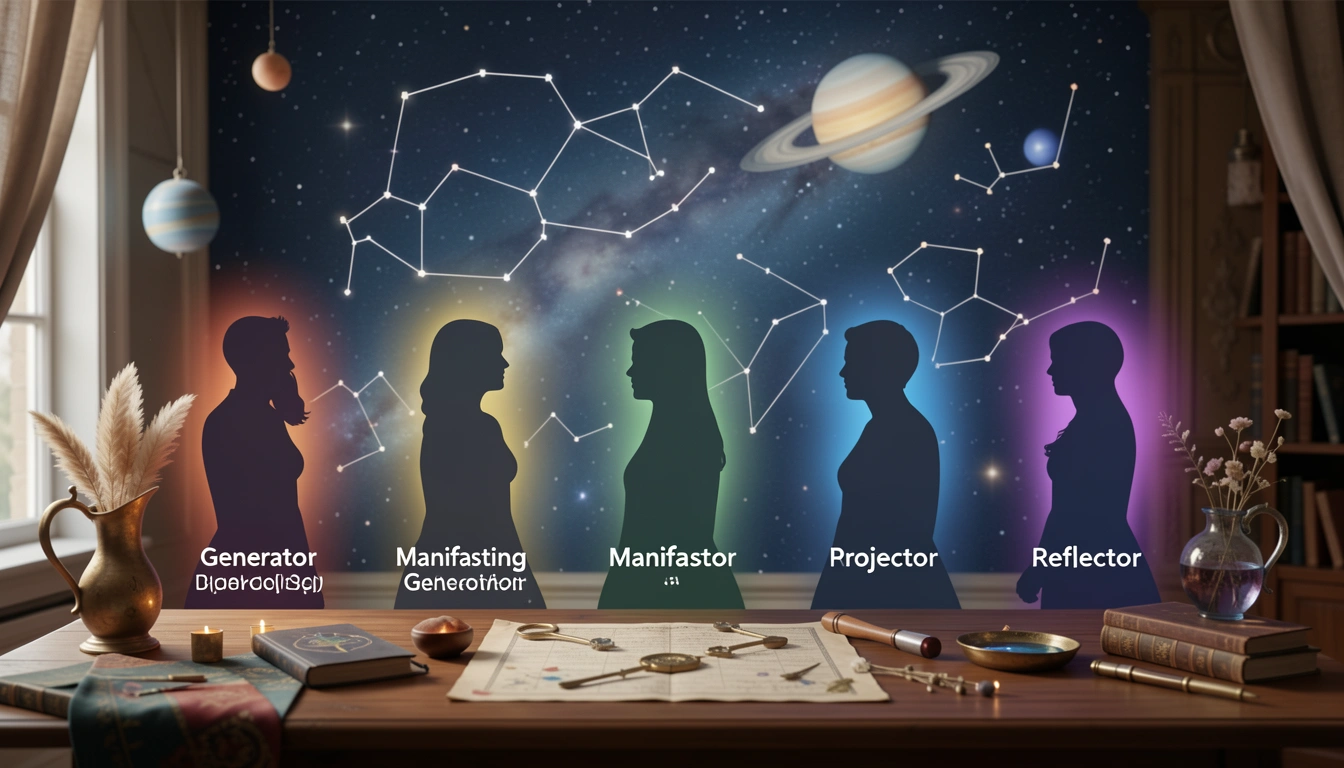
Human Design defines five Types based on the configuration of your defined Centers. Your Type describes your natural energetic aura and the most effective way to interact with the world. Each Type has a specific Strategy and Authority that, when followed, leads to a life of less resistance and more fulfillment.
Generators (about 37% of the population) have a defined Sacral Center. They are the workhorses of the world, with sustainable energy for work they love. Their Strategy is 'to respond' - they should wait to be asked or to have something land in their field before acting. Their Authority is Sacral, a gut yes/no response.
Manifesting Generators (about 33%) also have a defined Sacral Center but with a defined Throat connected to the Sacral. They are multi-passionate and fast. Their Strategy is also 'to respond,' but they can initiate once they respond. Their Authority is Sacral.
Manifestors (about 8%) have at least one motor Center (Sacral, Solar Plexus, Root) connected to the Throat, but no defined Sacral. They are initiators who can start things independently. Their Strategy is 'to inform' - they must tell others what they intend to do. Their Authority can be Emotional, Splenic, or Self-Projected.
Projectors (about 21%) have no defined Sacral and no motor connected to the Throat. They are natural guides and managers of energy. Their Strategy is 'to wait for the invitation' - recognition and invitation are key. Their Authority varies.
Reflectors (about 1%) have no defined Centers at all. They are mirrors of their environment, highly sensitive and lunar in nature. Their Strategy is 'to wait a lunar cycle' (28 days) before making major decisions. Their Authority is lunar, relying on the moon's transit.
How to Determine Your Type from the Calculator
Your Type is automatically displayed at the top of your chart. The calculator uses the following rules: if Sacral is defined and Throat is not connected to Sacral, you are a Generator. If Sacral is defined and Throat is connected to Sacral, you are a Manifesting Generator. If no Sacral definition but a motor Center connects to Throat, you are a Manifestor. If no Sacral and no motor-Throat connection, you are a Projector. If no Centers defined, you are a Reflector.
Strategy and Authority in Human Design
Strategy and Authority are the two most practical tools Human Design offers. Strategy is the external way you interact with the world - how you initiate, respond, or wait. Authority is your internal decision-making mechanism - how you know what is right for you. Together they form a reliable system for living in alignment.
Each Type has a specific Strategy: Manifestors inform, Generators and Manifesting Generators respond, Projectors wait for the invitation, and Reflectors wait a lunar cycle. Following your Strategy reduces resistance in your life. For example, a Projector who pushes their advice on others will often feel bitter, while one who waits for recognition thrives.
Authority is more personal. There are seven main Authorities: Sacral (gut response), Emotional (clarity over time), Splenic (intuitive in the moment), Ego (willpower), Self-Projected (speaking out loud), External (no inner authority, rely on others), and Lunar (for Reflectors). Your chart shows your Authority based on the highest-priority defined Center. To use your Authority, you must practice noticing its signals - a gut sound, a wave of emotion that settles, a sudden knowing, or a spoken statement that feels true.
Experimenting with Your Strategy and Authority
Human Design is an experiment. The system encourages you to try living according to your Strategy and Authority for a few months and observe the results. Many users report less frustration, better decisions, and more satisfying relationships. The key is to trust the process and not force outcomes.
What Are Human Design Centers?
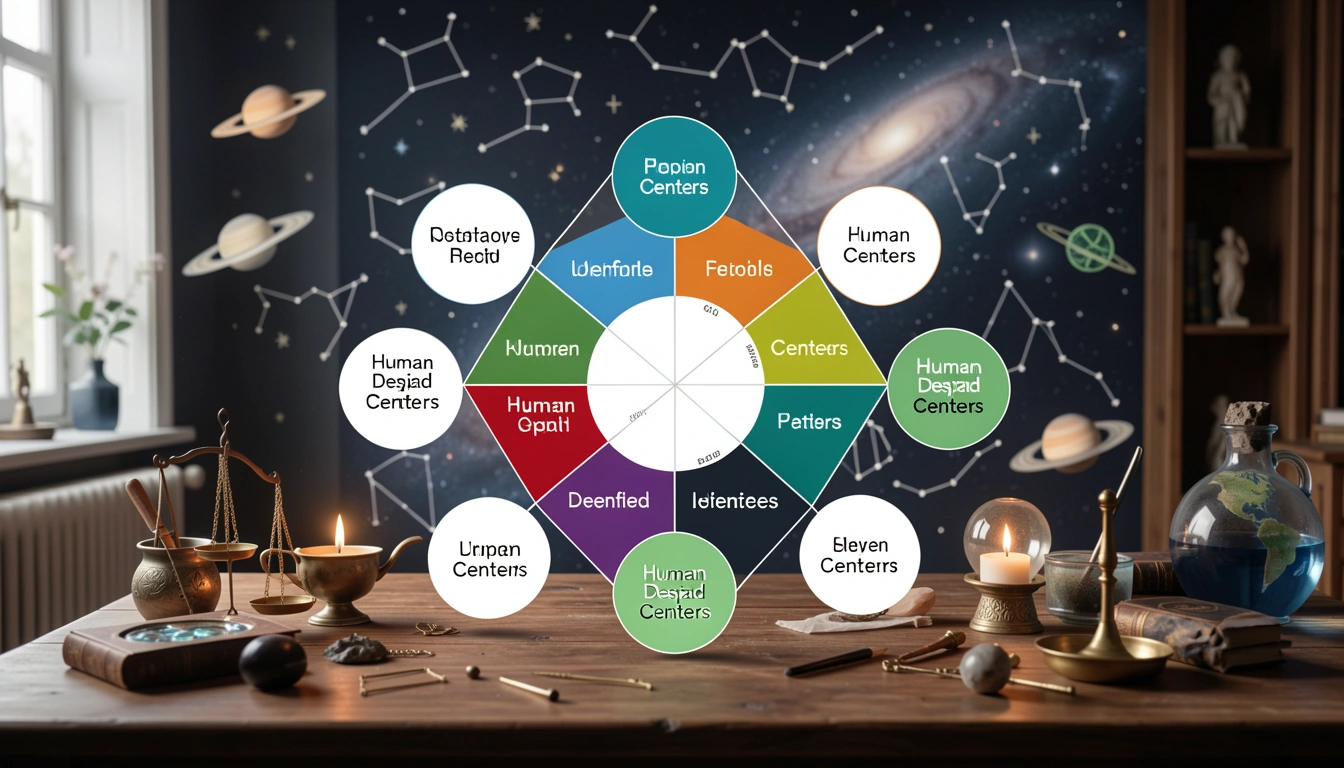
Human Design has nine Centers, each corresponding to a specific aspect of human experience. They are derived from the chakra system but with modifications. The Centers are: Crown (head), Ajna (mind), Throat (communication), G-Center (identity and direction), Heart/Ego (willpower and self-worth), Solar Plexus (emotions), Sacral (life force and sexuality), Spleen (intuition and health), and Root (stress and drive).
Each Center can be defined (colored) or undefined (white). A defined Center is a fixed source of energy or awareness in your design. You consistently experience that Center's theme. An undefined Center is open and sensitive - you take in energy from others and amplify it, but you do not have a consistent experience of that Center. For example, someone with an undefined Solar Plexus may absorb the emotions of those around them, feeling intense highs and lows that are not their own.
Defined Centers are also pressure points. They can be a source of wisdom or a source of conditioning if you are not aware. Understanding which Centers are defined and which are undefined is essential for self-awareness and healthy relationships. The free calculator clearly highlights your defined Centers in color and lists them in the summary.
The Nine Centers and Their Meanings
- Crown – Inspiration and mental pressure. Defined: consistent inspiration. Undefined: open to others' ideas.
- Ajna – Conceptualization and certainty. Defined: fixed ways of thinking. Undefined: flexible, open-minded.
- Throat – Communication and manifestation. Defined: consistent expression. Undefined: varies with environment.
- G-Center – Identity and direction. Defined: stable sense of self. Undefined: chameleon-like, seeks identity.
- Heart/Ego – Willpower and value. Defined: reliable will. Undefined: may struggle with self-worth.
- Solar Plexus – Emotions and sensitivity. Defined: consistent emotional wave. Undefined: absorbs others' emotions.
- Sacral – Life force and work. Defined: sustainable energy. Undefined: not a Generator.
- Spleen – Intuition and survival. Defined: reliable gut instincts. Undefined: intuitive but inconsistent.
- Root – Stress and drive. Defined: consistent pressure to act. Undefined: amplifies others' stress.
Human Design Gates, Channels and Profiles
Gates are the 64 hexagrams of the I Ching, each representing a specific archetypal energy or theme. They are located within the Centers. When a Gate is activated by a planetary position, it becomes part of your design. Gates can be conscious (Sun/Earth) or unconscious (design crystals), and they influence your personality and life themes. For example, Gate 1 (Creativity) in the Crown Center brings inspiration, while Gate 51 (Shock) in the Heart Center brings a need for awakening.
Channels are connections between two Gates in different Centers. When both Gates are defined (colored), the Channel is fully defined, creating a consistent energetic pathway between those Centers. Channels represent your most reliable talents and themes. For instance, the 57-20 Channel (through the Spleen and Throat) gives intuitive awareness and the ability to articulate it in the moment. A fully defined Channel is a source of strength in your design.
Your Profile is a two-number code (e.g., 1/3, 2/4, 6/2) that describes your personality archetype and how you interact with others. The first number is your conscious personality (your Sun Gate), and the second is your unconscious personality (your Earth Gate). Each number from 1 to 6 has a specific role: 1 is investigative, 2 is hermit, 3 is experimenter, 4 is opportunist, 5 is heretic, and 6 is role model. The combination creates a unique life theme. The calculator displays your Profile prominently.
How Gates Are Activated by Planets
Each Gate corresponds to a specific degree range in the zodiac. The Sun, Moon, planets, and lunar nodes at your birth fall into these ranges, activating the corresponding Gates. The Sun activates your conscious personality Gate, and the Earth activates your unconscious personality Gate. Other planets add nuance. The calculator computes all these positions.

What Does Your Human Design Profile Mean?
Your Profile is one of the most recognizable parts of your Human Design chart. It consists of two numbers from 1 to 6, written as a fraction (e.g., 1/3, 2/4, 6/2). The first number is your conscious personality - how you see yourself and what you are aware of. The second number is your unconscious personality - how others perceive you and what drives you beneath awareness. Together they form a life theme that influences your relationships and career.
There are 12 possible Profiles (since numbers 1-6 combine in specific ways). A 1/3 Profile is the Investigator/Experimenter: you need to research deeply and learn through trial and error. A 2/4 Profile is the Hermit/Opportunist: you need alone time but also networking. A 3/5 Profile is the Experimenter/Heretic: you try everything and challenge the status quo. A 4/6 Profile is the Opportunist/Role Model: you build connections and eventually become a wise guide. A 5/1 Profile is the Heretic/Investigator: you bring practical solutions and need deep foundations. A 6/2 Profile is the Role Model/Hermit: you have a three-part life of trial, retreat, and leadership.
Your Profile also interacts with your Type. For example, a Projector with a 2/4 Profile may find that their hermit nature conflicts with the need to wait for invitations, but the opportunist aspect helps them connect. Understanding your Profile helps you make sense of your life patterns and relationships.
Profile Lines Explained
- Line 1 – The Investigator: needs to research and understand deeply before acting.
- Line 2 – The Hermit: naturally talented but needs solitude; others see their gifts.
- Line 3 – The Experimenter: learns through trial and error; resilient and adaptable.
- Line 4 – The Opportunist: thrives through networks and friendships.
- Line 5 – The Heretic: brings universal solutions; often projected upon.
- Line 6 – The Role Model: lives in three stages; eventually becomes a wise guide.
Defined vs. Undefined Centers Explained
One of the most profound insights from Human Design is the distinction between defined and undefined Centers. A defined Center is colored in your BodyGraph and represents a fixed, consistent energy within you. You have reliable access to that Center's qualities. An undefined Center is white, meaning you are open and sensitive to that energy from others. You experience the energy of that Center but inconsistently, because you amplify what you pick up from your environment.
For example, if your Solar Plexus Center is defined, you have a consistent emotional wave that you can learn to ride. If it is undefined, you absorb the emotions of people around you and may feel confused about whether the feelings are yours. The same applies to the Root Center (stress), the Splenic Center (intuition), and others. Undefined Centers are not weaknesses - they are sources of potential wisdom and flexibility, but they require awareness to avoid conditioning.
When two people interact, their defined Centers can 'condition' each other's undefined Centers. This is neither good nor bad - it is simply how energy exchange works. Understanding your defined and undefined Centers helps you navigate relationships, work, and daily life with less confusion. The calculator clearly marks each Center's status.
The Wisdom of Undefined Centers
Undefined Centers give you the ability to experience and understand a wide range of human experience. Someone with an undefined Ajna can see many perspectives. Someone with an undefined G-Center can adapt to different identities and settings. The key is to not identify with the energy you pick up - recognize it as not your own. This awareness turns openness into wisdom.

Human Design Incarnation Cross Explained
Your Incarnation Cross is the overarching theme or purpose of your life in Human Design. It is derived from the positions of the Sun and Earth at your birth, plus the positions of the Sun and Earth 88 degrees ahead (the 'conscious' and 'unconscious' crosses). There are four main types of Incarnation Crosses: Right Angle Cross (personal destiny), Left Angle Cross (transpersonal destiny), Juxtaposition Cross (fixed destiny), and the rare None (for Reflectors).
Your Incarnation Cross is named after the four Gates involved. For example, the Right Angle Cross of Planning (9, 16, 40, 37) indicates a life focused on organizing and creating structures for community. The Left Angle Cross of Demands (30, 29, 28, 27) suggests a life of emotional intensity and service. The calculator displays your Incarnation Cross name and the four Gates.
Understanding your Incarnation Cross gives you a sense of direction. It is not a rigid fate but a trajectory that, when followed, leads to fulfillment. You can explore your cross through the prism of your Type and Authority. For instance, a Generator with the Right Angle Cross of Eden (64, 47, 4, 63) may find purpose in creatively processing chaos into clarity. The cross is a lifelong theme that unfolds over time.
How to Work with Your Incarnation Cross
To work with your Incarnation Cross, study the four Gates involved. Read the I Ching hexagrams for each Gate and notice how they show up in your life. Then look at how the cross interacts with your Type and Authority. For example, a Manifestor with a cross that includes Gate 21 (the Hunter) may need to assert leadership. Experiment with living the theme consciously.
How Your Birth Data Shapes Your Human Design Chart
Your Human Design chart is entirely dependent on your birth data: date, exact time, and location. The time determines the positions of the Sun and Earth to the exact degree, which sets your Profile and Incarnation Cross. The location (latitude and longitude) affects the house system used in the calculation (Human Design uses the Equal House system). Even a four-minute difference in birth time can shift the Sun by about 1 degree, potentially changing your Gate and thus your Profile line.
The planetary positions also determine which Gates are activated in each Center. For example, if Venus was in a particular Gate at your birth, that Gate becomes part of your design, influencing your values and relationships. The lunar nodes (North and South Nodes) also activate specific Gates that indicate karmic direction. The calculator uses the same ephemeris data as professional astrology software to ensure accuracy.
If your birth time is unknown, the calculator can still generate a chart using the default time of noon, but the results will be less precise. Many elements will still be valid (your Type may still be correct if it depends on Centers rather than exact Gates), but your Profile and Incarnation Cross will be approximate. For a more accurate reading, use the best available birth time or consider Birth Time Rectification.
What If I Don't Know My Birth Time?
If you do not know your birth time, you can still get value from a Human Design chart. The calculator will use a default time (often noon) and show you the resulting chart. Your Type may still be accurate because Type depends on Centers that are less sensitive to time changes. However, your Profile, Incarnation Cross, and many Gate activations will be uncertain. Some practitioners recommend using the chart as a starting point and later refining it with a known time.

Human Design Chart vs. Astrology Birth Chart
While both Human Design and astrology use your birth data to create a chart, they are fundamentally different systems. An astrology birth chart (natal chart) maps the planets in the tropical zodiac and divides them into houses using a house system like Placidus or Whole Sign. It focuses on planetary aspects, signs, and houses to describe personality, strengths, challenges, and life themes. Astrology is thousands of years old and has many branches (Western, Vedic, Hellenistic, etc.).
Human Design, by contrast, uses a sidereal zodiac with a fixed offset and maps planetary positions onto the 64 Gates of the I Ching. It does not use signs or houses in the traditional sense. Instead, it uses nine Centers, Channels, and Gates to describe energy dynamics. Human Design is primarily concerned with how you make decisions and interact with the world (Type, Strategy, Authority) rather than personality traits. It also includes elements like the Incarnation Cross (life purpose) and Profile (archetype) that have no direct astrology equivalent.
Both systems can complement each other. Many people use astrology for psychological insight and timing (transits, progressions) and Human Design for practical decision-making and energetic awareness. For example, your Sun sign in astrology might describe your core identity, while your Human Design Type tells you how to best express that identity. The Free Birth Chart Calculator on this site can generate your astrology chart, and you can compare it with your Human Design chart for a richer understanding.
Key Differences at a Glance
| Aspect | Astrology Birth Chart | Human Design Chart |
|---|---|---|
| Zodiac | Tropical (seasonal) | Sidereal with 23° offset |
| Primary structure | 12 signs, 12 houses, aspects | 9 Centers, 64 Gates, Channels |