On this page
The Free Davison Relationship Chart Calculator from YesAstrology generates a single chart that represents the relationship itself—not the individuals, but the space between them. By calculating the exact time-space midpoint of two birth charts, this tool reveals the core identity, purpose, and developmental arc of a partnership. Unlike synastry, which compares two charts, or composite charts, which average planetary positions, the Davison chart is a true midpoint chart with its own ascendant, houses, and planetary placements.
This calculator is designed for anyone serious about relationship astrology. Whether you are exploring a romantic partnership, a business collaboration, or a deep friendship, the Davison chart offers a third entity: the soul of the relationship itself. Use the form below to enter two birth dates, times, and locations. The tool instantly computes the midpoint and draws a full natal-style chart with house cusps, aspects, and planetary dignities.
You can also pair this chart with a Davison Relationship Chart Premium Analysis Report for a detailed interpretation of every placement and aspect. For a broader view of relationship astrology, explore our Chart Calculators hub.
What Is a Davison Relationship Chart?
The Davison Relationship Chart, named after astrologer Ronald Davison, is a midpoint-based chart that represents the relationship as a distinct entity. It is calculated by finding the geographic midpoint between two birth locations and the temporal midpoint between two birth times, then casting a chart for that exact moment and place. The result is a unique chart that has its own ascendant, planets, houses, and aspects.
This chart is particularly valued in relationship astrology because it reveals the relationship's purpose, strengths, and challenges independently of the individuals involved. While synastry shows how two people interact, the Davison chart shows what the relationship itself is becoming. It answers questions like: What is this relationship meant to teach? What is its core identity? How does it evolve over time?
Astrologers often use the Davison chart for long-term couples, families, and business partnerships. Because it requires accurate birth times and locations, it is most reliable when both data sets are precise. The chart is considered a "natal chart of the relationship" and can be interpreted using standard natal astrology techniques.
Origins of the Davison Chart
Ronald Davison introduced this technique in his 1977 book "Synastry: Understanding Human Relationships Through Astrology." He proposed that the relationship itself has a birth moment defined by the midpoint of two individuals' birth coordinates. This concept was a departure from the composite chart, which averages planetary positions. Davison argued that the midpoint chart more accurately reflects the relationship's unique energy field.
How Does a Davison Chart Calculator Work?
The Free Davison Relationship Chart Calculator performs three key calculations: it finds the midpoint of the two birth locations (latitude and longitude), the midpoint of the two birth times (adjusted for time zones and daylight saving), and then casts a full natal chart for that synthetic birth moment. The result is a chart with a unique ascendant, house cusps, and planetary positions.
Because the midpoint time and location may fall anywhere on Earth, the calculator uses the same astronomical ephemeris data as a standard natal chart. It calculates planetary positions for that exact moment, plus house cusps using the Placidus house system by default (users can switch to Whole Sign, Koch, or Equal if desired). The tool also computes aspects with orbs: 0-1° for exact conjunctions, 1-3° for tight aspects, and up to 5-8° for wide aspects.
All calculations are done server-side using the Swiss Ephemeris for precision. The tool is free to use with no registration required. You can generate unlimited Davison charts for any pair of individuals.
Generate Your Free Davison Relationship Chart
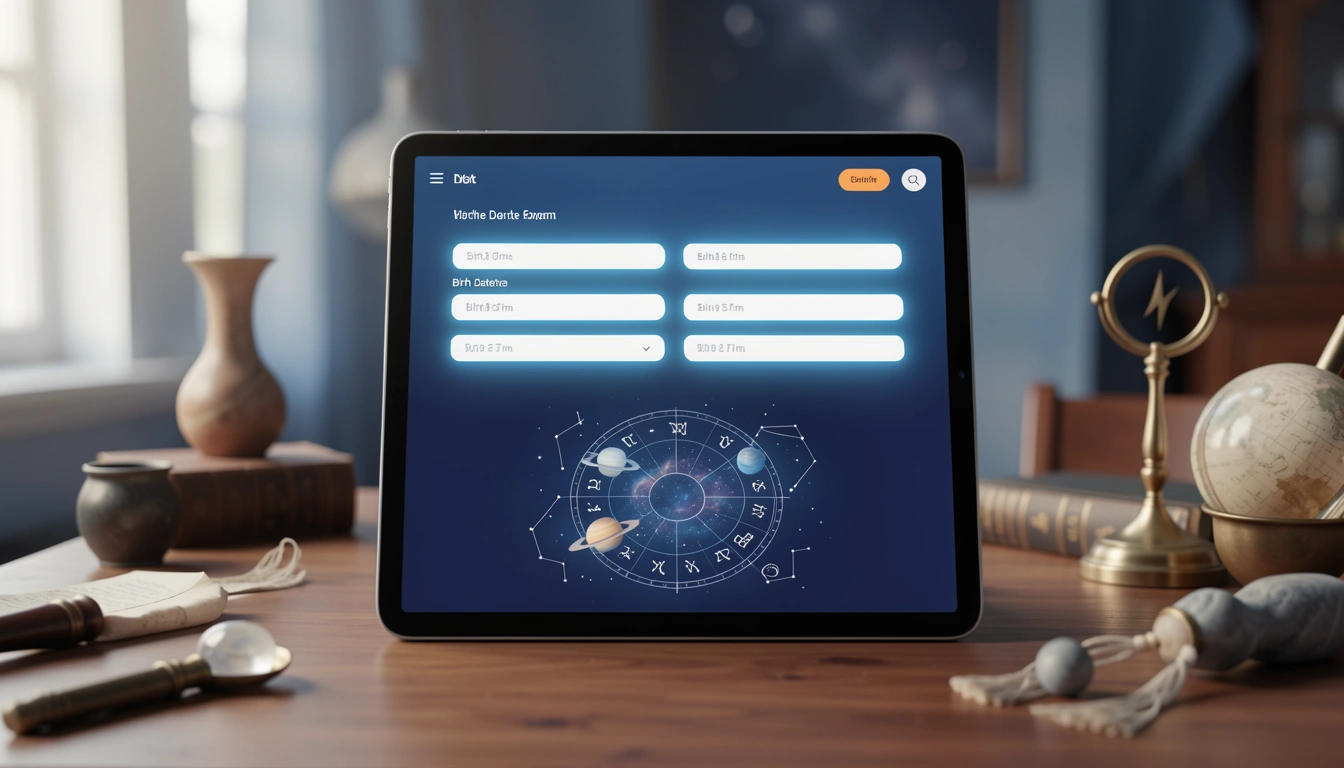
To generate your chart, you need the birth date, exact birth time, and birth location for both people. Even a small error in time can shift the ascendant significantly, so use the most accurate data available. If you do not know the exact birth time, you can still generate a chart, but the house cusps and ascendant will be less reliable.
Enter the data in the form below. The tool supports all time zones and automatically adjusts for daylight saving time where applicable. After submission, the chart will display the midpoint ascendant, planetary positions, house cusps, and a list of aspects with orb values. You can download the chart as a PDF or share it via a unique link.
For a deeper interpretation, consider pairing the chart with the Davison Relationship Chart Premium Report, which provides a professional analysis of every placement, aspect, and house theme.
Data Requirements and Accuracy
Birth time accuracy within 15 minutes is recommended for reliable house placement. If both birth times are unknown, the calculator will default to 12:00 PM noon and warn you of reduced accuracy. For the most precise results, use birth times from official records or family sources.
How Is a Davison Chart Calculated?
The calculation involves three steps. First, the geographic midpoint: average the latitude and longitude of both birth locations. If the two locations are on opposite sides of the prime meridian, the calculation adjusts for the shortest arc. Second, the temporal midpoint: convert both birth times to UTC, average them, and convert back to the local time of the midpoint location. Third, cast a natal chart for that combined time and place using standard ephemeris data.
This method differs from the composite chart, which averages the planetary positions themselves. The Davison chart creates a completely new birth moment, which means the planets can fall in different signs and houses than either individual's chart. This is why the Davison chart often feels surprisingly accurate: it represents a genuine third entity, not a mathematical blend.
House systems affect the chart significantly. By default, the calculator uses Placidus, but you can change to Whole Sign, Koch, or Equal in the advanced settings. The aspects are calculated using the same orbs as a natal chart: 0-1° for exact, 1-3° for tight, 5-8° for wide. Retrogrades are noted but do not change the interpretation significantly in a Davison chart.
Technical Details of the Midpoint Calculation
When averaging birth times, the calculator accounts for dates that cross midnight. For example, if one person was born at 23:00 UTC and the other at 01:00 UTC the next day, the midpoint is 00:00 UTC of the overlapping date. The geographic midpoint may fall in the middle of an ocean, which is mathematically valid—the chart is still cast for that location.

What Does a Davison Chart Reveal About a Relationship?
The Davison chart reveals the relationship's core identity, purpose, and developmental path. The ascendant and its ruler show how the relationship appears to the outside world. The Sun sign indicates the relationship's central purpose, while the Moon sign reveals its emotional needs and habitual responses. Venus shows how the relationship expresses love and values, and Mars indicates its drive and conflict style.
Houses in the Davison chart are read as relationship themes. For example, the 7th house in the Davison chart does not represent the other person (as it does in a natal chart) but rather how the relationship interacts with others or with committed partnerships. The 4th house shows the relationship's inner emotional foundation, and the 10th house reveals its public reputation and achievements.
Aspects between planets in the Davison chart describe the relationship's internal dynamics. A Sun-Moon conjunction suggests a harmoniously integrated purpose and emotion. A Mars-Saturn square may indicate frustration or blocked energy. The chart can also be progressed and transited to see how the relationship evolves over time.
Key Placements to Examine First
Start with the ascendant and its ruler to understand the relationship's outward style. Then look at the Sun and Moon for purpose and emotional bond. Venus and Mars for love and conflict patterns. Finally, examine the 1st, 4th, 7th, and 10th houses for the relationship's identity, foundation, partnerships, and public image.
How to Read the Sun, Moon and Venus in a Davison Chart
The Sun in a Davison chart represents the relationship's core purpose and identity. It shows what the relationship is meant to become and what drives it forward. For example, a Sun in Leo suggests a relationship that thrives on creative expression, recognition, and warmth. A Sun in Capricorn indicates a relationship built on responsibility, structure, and long-term goals.
The Moon reveals the relationship's emotional needs, instinctive reactions, and nurturing style. A Moon in Cancer suggests a deeply protective, family-oriented bond. A Moon in Aquarius may indicate a need for freedom and intellectual connection. The Moon's aspects show how the relationship handles emotional stress and comfort.
Venus is the planet of love, values, and harmony. In a Davison chart, Venus shows how the relationship expresses affection, what it values, and what brings it pleasure. A Venus in Libra suggests a relationship focused on beauty and balance. Venus in Scorpio indicates intense, transformative bonding. Aspects to Venus reveal how the relationship handles money, aesthetics, and social connections.
Example: Sun in Taurus, Moon in Virgo, Venus in Gemini
This combination suggests a relationship built on stability and practicality (Sun Taurus), with a critical but caring emotional style (Moon Virgo), and a love of variety and communication (Venus Gemini). The relationship may struggle between a desire for routine and a need for novelty.

Davison Chart Houses and Relationship Themes
Each house in the Davison chart corresponds to a specific area of the relationship's life. The 1st house shows the relationship's identity and how it presents itself. The 2nd house covers shared resources, values, and financial dynamics. The 3rd house reveals communication patterns and intellectual connection. The 4th house is the emotional foundation and home life.
The 5th house indicates romance, creativity, and fun activities as a couple. The 6th house covers daily routines, health, and service to each other. The 7th house shows how the relationship interacts with external partners or other relationships. The 8th house deals with transformation, shared finances, and intimacy. The 9th house represents shared beliefs, travel, and higher learning.
The 10th house shows the relationship's public reputation and career achievements. The 11th house covers friendships, social networks, and group involvement. The 12th house reveals hidden dynamics, subconscious patterns, and spiritual dimensions. Planets in each house add specific themes. For example, Saturn in the 4th house may indicate a relationship with heavy responsibilities at home.
Interpreting House Rulers and Planets
Look at the ruler of each house and any planets placed there. For instance, if the 7th house cusp is in Libra and Venus (ruler) is in the 10th house, the relationship's approach to external partnerships is linked to its public image. This can indicate a relationship that is often seen as a model couple.
Davison Chart Aspects and Relationship Dynamics
Aspects in the Davison chart describe the internal dynamics of the relationship. Conjunctions (0°) merge planetary energies. Sextiles (60°) and trines (120°) indicate harmony and ease. Squares (90°) and oppositions (180°) reveal tension and growth areas. Quincunxes (150°) show adjustments needed.
Pay special attention to aspects involving the Sun, Moon, and ascendant ruler. A Sun-Moon square may indicate a conflict between the relationship's purpose and its emotional needs. A Venus-Mars trine suggests natural romantic and sexual harmony. A Saturn-Pluto square could indicate power struggles or deep transformation through hardship.
Orb tolerances matter. Use tight orbs (1-3°) for major aspects, and wider orbs (5-8°) for minor aspects. The calculator defaults to 1° for conjunctions, 3° for major aspects, and 5° for minor aspects. You can adjust these in the advanced settings.
Creating an Aspect Table for Your Chart
After generating your chart, look at the aspect list. Identify the strongest aspects (tight orbs) and interpret them first. For example, a Moon-Mars square (orb 0.5°) indicates emotional reactivity and potential arguments. A Venus-Jupiter conjunction (orb 1.2°) suggests generosity and joy in the relationship.
Davison vs. Composite Chart: What Is the Difference?
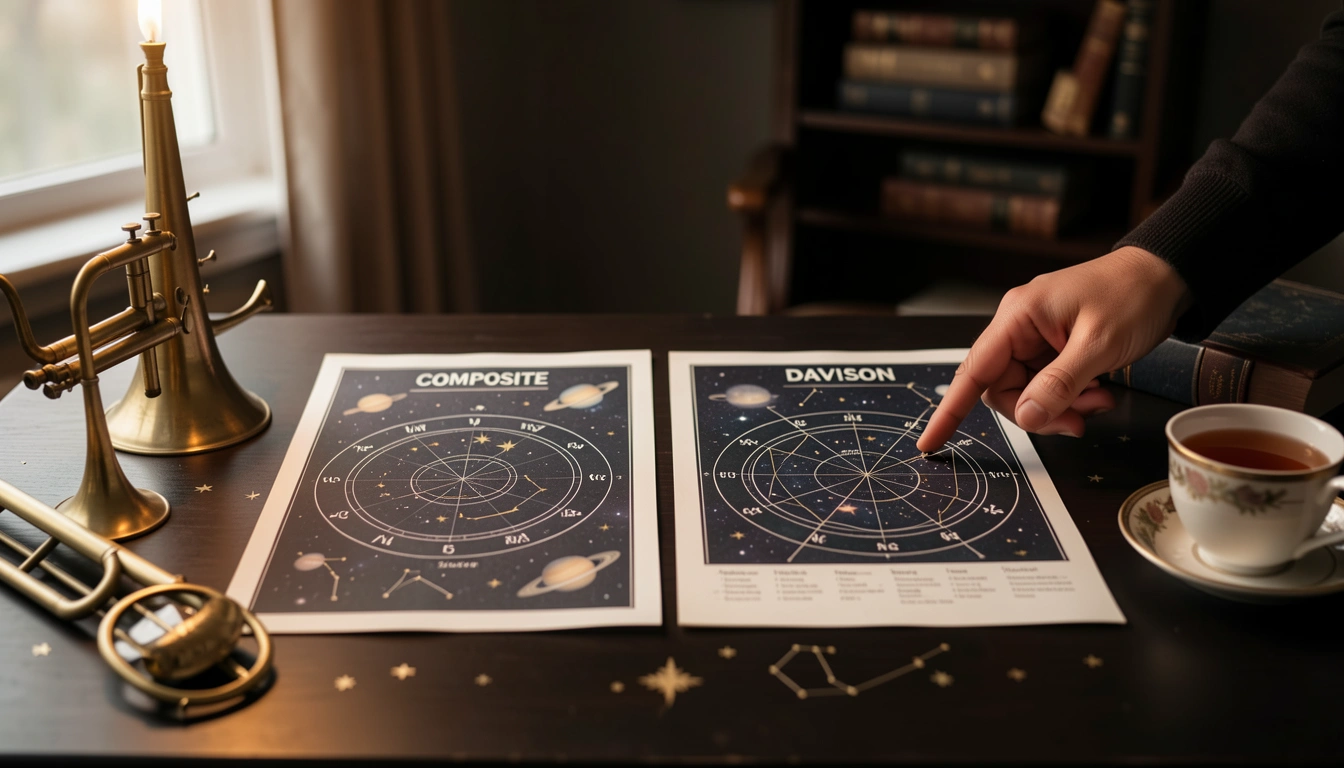
The Davison chart and the composite chart are both used to represent a relationship, but they are calculated differently and answer different questions. The composite chart averages the positions of the planets in two individual charts. For example, if one person's Sun is at 10° Aries and the other's at 20° Aries, the composite Sun is at 15° Aries. The Davison chart, on the other hand, calculates a midpoint in time and space and casts a new chart entirely.
This difference leads to significant practical implications. The composite chart often feels like a blend of the two individuals, while the Davison chart feels like a separate third entity. Astrologers use the composite chart for understanding the relationship's "personality" as a blend of the two, and the Davison chart for understanding the relationship's "soul" or independent purpose.
Which one is more accurate? Many practitioners find the Davison chart more revealing for long-term relationships because it has its own ascendant and house system, which can differ dramatically from either individual's chart. The composite chart is simpler and works well when birth times are unknown. For a complete relationship analysis, reading both charts together is recommended.
When to Use Each Chart
Use the composite chart for a quick overview of the relationship's blend of energies. Use the Davison chart for deep analysis of the relationship's identity, especially when precise birth times are available. For a full picture, generate both and compare the ascendants, Sun, Moon, and Venus placements.
Davison Chart vs. Synastry: Which Should You Use?
Synastry is the comparison of two birth charts by overlaying one person's planets on the other's houses and aspects. It answers the question: "How do we interact?" The Davison chart answers: "What is this relationship becoming?" These are complementary, not competing, techniques. Synastry shows the dynamic between two individuals; the Davison chart shows the relationship as a separate entity.
For example, synastry might reveal that one person's Mars squares the other's Saturn, indicating frustration in action. The Davison chart might show a Mars in Pisces, suggesting the relationship itself has a diffuse, compassionate energy. The two perspectives together give a fuller picture.
Start with synastry to understand the chemistry and challenges, then use the Davison chart to see the relationship's purpose and evolution. If you are short on time, the Davison chart alone can provide deep insight, especially for established relationships. For new relationships, synastry may be more immediately useful.
A Combined Approach
Use the Free Synastry Chart Calculator to generate a synastry report, then combine with the Davison chart. Compare the two ascendants and the Moon/Venus placements. This gives you both the interpersonal dynamics and the relationship's identity.

Can You Use Transits With a Davison Chart?
Yes, transits to the Davison chart work the same way as transits to a natal chart. When a transiting planet makes an aspect to a planet or angle in the Davison chart, it triggers events in the relationship's life. For example, a transit of Jupiter over the Davison Sun may bring expansion and joy to the relationship. A transit of Saturn over the Davison Moon may bring emotional challenges or a need for restructuring.
Similarly, progressions and solar arcs can be applied to the Davison chart to see the relationship's internal development over time. This is especially useful for long-term couples who have been together for years. The Davison chart's progressions can show major turning points, such as a progressed Moon changing signs or a progressed Sun aspecting a natal planet.
To use transits effectively, generate the Davison chart once and then apply current transits manually or using a transit calculator. The Free Transit Chart Calculator can be used with the Davison chart's time and location as the natal chart.
Example: Saturn Transit Over Davison Descendant
If transiting Saturn crosses the Davison descendant (7th house cusp), the relationship may face a serious test in its interactions with others, such as legal issues, partnership reevaluation, or a need to take responsibility for the relationship's public image.
How Accurate Is a Davison Relationship Chart?
The accuracy of a Davison chart depends entirely on the accuracy of the birth data. If both birth times are known within 15 minutes, the chart is highly reliable for house placement and ascendant. If one or both birth times are unknown, the chart's ascendant and house cusps may be off by several degrees, reducing the usefulness of house interpretations.
Even with exact times, the Davison chart is a tool for insight, not a deterministic prediction. It reveals themes and potentials, not fixed outcomes. The relationship's free will and choices shape how the chart's energies manifest. For example, a challenging Mars-Saturn aspect can be expressed as constructive discipline or destructive frustration.
Most astrologers report that the Davison chart feels remarkably accurate for couples who have been together for at least a year. For new relationships, the chart may reflect potential rather than current reality. Use it as a guide for understanding the relationship's direction, not as a final verdict.
Known Limitations
If both birth locations are very far apart (e.g., opposite hemispheres), the geographic midpoint may fall in an ocean, which is mathematically valid. Some astrologers prefer to use the midpoint of the two birth locations as a reference point, but the chart is still cast for that location. Also, if both birth times are exactly 12 hours apart, the temporal midpoint may fall at a time that is not representative—use caution in such cases.