On this page
What is astrology? At its core, astrology is a symbolic framework that maps the positions of celestial bodies at a specific moment and interprets their correlations with human experience. Practitioners and enthusiasts use it to gain insight into personality, relationships, life cycles, and timing. Unlike astronomy, which studies the physical universe, astrology focuses on meaning and pattern recognition. It draws on thousands of years of observation, mythology, and mathematics to create a language of archetypes that can be applied to individual birth charts, current events, and even questions about the future.
Understanding what is astrology begins with the birth chart, a circular diagram of the sky at the exact moment and location of a person's birth. This chart maps the Sun, Moon, planets, and other points onto twelve zodiac signs and twelve astrological houses, with angles and aspects connecting them. Each element adds a layer of meaning: the signs express qualities, the houses show life areas, and the aspects reveal how these energies interact. A skilled astrologer synthesizes these layers into a coherent narrative that can illuminate strengths, challenges, and growth opportunities.
Astrology is not a predictive science in the laboratory sense, but it offers a structured lens for self-reflection and timing. Many people use it for personal development, relationship compatibility, career guidance, and understanding recurring life patterns. The following sections break down each component of astrological practice, from the history and calculation methods to the interpretive logic that makes it useful for millions worldwide.
For further reading, you can also explore Home.
What Is Astrology and How Does It Work?
Astrology works on the principle of correspondence: the macrocosm of the heavens reflects the microcosm of individual life. By calculating the precise positions of the Sun, Moon, planets, and other celestial points at a given moment, an astrologer creates a map of potential energies. These positions are measured in degrees along the ecliptic, the apparent path of the Sun through the sky. The map is divided into twelve zodiac signs, each representing a distinct quality or archetype, and twelve houses, each governing a specific area of life such as identity, resources, communication, home, relationships, career, and spirituality.
The system relies on two main zodiac frameworks: tropical and sidereal. The tropical zodiac, used in Western astrology, is based on the seasons and the vernal equinox. The sidereal zodiac, used in Vedic astrology, aligns with the fixed stars and uses ayanamsa offsets such as Lahiri (23°15') or Raman (22°46'). Both systems produce valid interpretations, but they assign different sign positions to the same birth date. For example, someone born on March 25 is an Aries in the tropical system but may be a Pisces in the sidereal system depending on the ayanamsa used.
To interpret a chart, astrologers examine planetary placements by sign, house, and aspect. They also consider essential dignities: a planet in its own sign (domicile) or exaltation is strong and comfortable, while a planet in detriment or fall is challenged. Accidental dignities, such as angular house placement or direct motion, add further nuance. The combination of these factors creates a rich interpretive tapestry that can be read for personality analysis, predictive timing, or relational compatibility.
The Core Components of an Astrological Reading
A complete astrological reading synthesizes five main components: the planets (including the Sun and Moon as luminaries), the zodiac signs, the houses, the aspects (angular relationships between planets), and the angles (Ascendant, Midheaven, Descendant, and Imum Coeli). Each planet represents a core psychological drive: for example, Mercury governs communication, Venus rules love and values, Mars relates to action and desire, Jupiter expands, Saturn restricts, Uranus innovates, Neptune dissolves, and Pluto transforms. The sign a planet occupies colors how that drive expresses, and the house shows where in life it manifests.
Aspects describe the geometric angles between planets, measured in degrees along the ecliptic. The most commonly used aspects are the conjunction (0°), sextile (60°), square (90°), trine (120°), and opposition (180°). Each aspect has an orb, or allowable range of degrees, within which the aspect is considered active. Tight orbs (0° to 3°) create intense, focused energy, while wide orbs (5° to 8°) produce more diffuse effects. Astrologers also consider minor aspects like the quincunx (150°) and semisextile (30°) for additional detail.
The Origins and History of Astrology
Astrology is one of the oldest systems of symbolic thought, with roots stretching back to ancient Mesopotamia around the 3rd millennium BCE. The Babylonians were among the first to systematically observe the sky, recording planetary movements and correlating them with events like harvests, wars, and royal successions. They developed the zodiac as a band of constellations along the ecliptic and divided it into twelve equal sections, laying the groundwork for the signs we use today. Their omen-based astrology focused on collective affairs rather than individual birth charts.
The Greeks transformed astrology into a more personal and philosophical practice. By the 2nd century CE, Claudius Ptolemy had codified the principles of Western astrology in his work the Tetrabiblos, which remains influential. Ptolemy introduced the tropical zodiac, the system of essential dignities, and the interpretive logic of houses and aspects. Hellenistic astrology also integrated Egyptian decans and Mesopotamian omens, creating a sophisticated synthesis that spread across the Roman Empire, into the Islamic world, and later to medieval Europe. During the Renaissance, astrology was taught alongside astronomy, medicine, and philosophy.
In the 20th century, astrology experienced a revival through psychological astrology, popularized by figures like Dane Rudhyar and Liz Greene. This approach shifted the focus from prediction to self-understanding, aligning astrology with Jungian archetypes and depth psychology. Today, astrology is practiced in many forms: natal, horary, electional, mundane, and more. Digital tools and online calculators have made birth chart generation accessible to anyone, fueling a global resurgence in astrological literacy.
Key Historical Milestones in Astrology
Key milestones include the Babylonian creation of the zodiac (c. 500 BCE), Ptolemy's Tetrabiblos (c. 150 CE), the translation of astrological texts into Arabic during the Islamic Golden Age (8th–13th centuries), the reintroduction of Hellenistic texts to Europe via Spain and Sicily, and the development of modern psychological astrology in the early 1900s. Each era added layers of technique and interpretation, from the use of lots and prorogations in Hellenistic astrology to the refined house systems of Placidus, Koch, and Equal in modern practice. The availability of ephemerides and now digital APIs has further democratized the field.

How Astrology Uses Birth Dates, Times and Locations
To construct an accurate birth chart, an astrologer needs three pieces of information: the date, the exact time, and the location of birth. The date determines the Sun's position along the ecliptic, which is the foundation of the Sun sign. The time determines the Ascendant, or rising sign, which changes approximately every two hours. The Ascendant sets the entire house system and the angles, making it one of the most sensitive variables in the chart. An error of even a few minutes can shift the Ascendant by a degree or more, especially at higher latitudes.
The location provides the geographic coordinates that define the local horizon and meridian. These coordinates are used to calculate the house cusps and the Midheaven (MC). Without a precise birth time, an astrologer cannot reliably assign houses or the Ascendant. In such cases, some astrologers use a sunrise chart (setting the time to sunrise) or a noon chart as a workaround, but these methods lose the house-specific detail. Tools like rectification, which uses major life events to reverse-engineer the birth time, can sometimes recover an approximate time.
Modern astrology relies on ephemerides and astronomical algorithms to compute planetary positions. The Swiss Ephemeris, developed by YesAstrology.com, is the industry standard for accuracy. Online calculators, such as the Free Birth Chart Calculator on YesAstrology, use these algorithms to generate charts instantly. Users enter their birth data, and the calculator outputs a full chart with planets, signs, houses, aspects, and often a brief interpretation.
Why Birth Time Matters for House Placement
The birth time directly influences the house cusps. For example, if you were born at 6:00 AM, the Ascendant may be near your Sun sign, while a 6:00 PM birth places the Descendant near that sign. The house system also matters: Placidus houses, the most common in Western astrology, produce uneven house sizes, while Whole Sign houses assign each sign to an entire house regardless of degree. Placidus is more sensitive to time and latitude, while Whole Sign is simpler and older. Both systems have strong advocates, and many astrologers switch between them depending on the question.
What Is a Birth Chart in Astrology?
A birth chart, also called a natal chart, is a circular diagram that maps the positions of the Sun, Moon, planets, and other celestial points at the exact moment and place of a person's birth. It is the foundational tool of natal astrology. The chart is divided into twelve segments, each representing a zodiac sign, and overlaid with twelve houses, which start from the Ascendant and proceed counterclockwise. The planets are plotted within these segments and houses, and the angles between them are calculated as aspects.
The birth chart is not a static picture of destiny but a symbolic map of potential. It shows where your natural strengths lie, what challenges you may face, and what life themes are likely to recur. For example, Venus in the 10th house might indicate a career involving beauty, art, or diplomacy, while Saturn in the 4th house could point to early family responsibilities or a need for emotional structure. The chart's complexity arises from the interplay of all its elements: no single placement tells the whole story.
To read a birth chart, start with the Sun, Moon, and Ascendant, then move to the personal planets (Mercury, Venus, Mars), then to the social planets (Jupiter, Saturn), and finally to the outer planets (Uranus, Neptune, Pluto). Note the signs and houses of each, and then examine the aspects. Look for clusters of planets (stelliums) in a sign or house, which indicate concentrated energy. Also note any planets in mutual reception, where each planet is in the other's sign of dignity, creating a supportive exchange. The chart's overall pattern, such as a bowl, splash, or bundle shape, adds another interpretive layer.
How to Read a Birth Chart Step by Step
Begin by identifying the Ascendant and its ruler, which sets the tone for the entire chart. Then locate the Sun and Moon to understand your core identity and emotional nature. Next, scan the planets by house to see which life areas are most activated. Finally, look at the aspects: a grand trine (three planets in 120° aspect) suggests ease and talent, while a T-square (two planets in opposition, both square a third) indicates tension and motivation. Use the chart's angles (Ascendant, MC, Descendant, IC) as anchor points for life direction and relationships.
The Meaning of the Sun, Moon and Rising Signs
The Sun sign represents your core identity, ego, and conscious will. It is the sign the Sun occupied at your birth and is the most widely known astrological placement. The Sun sign shows your fundamental character, your creative drive, and the qualities you are developing in this lifetime. For example, a Sun in Leo seeks recognition and self-expression, while a Sun in Virgo strives for precision and service. The Sun's house placement reveals where you shine and seek validation.
The Moon sign governs your emotions, instincts, and subconscious patterns. It reflects how you react emotionally, what you need to feel secure, and your habitual responses to nurturing. The Moon changes signs every two to three days, so it is more personal and less generalized than the Sun sign. A Moon in Cancer craves emotional safety and family connection, while a Moon in Aquarius values intellectual detachment and community. The Moon's aspects to other planets indicate emotional strengths and challenges.
The Rising sign, or Ascendant, is the sign that was rising on the eastern horizon at your birth. It changes approximately every two hours and determines the layout of your entire chart. The Ascendant represents your outward personality, first impressions, and the mask you wear in public. It is often described as the filter through which your Sun and Moon express themselves. For instance, a Sun in Scorpio with a Libra rising may appear diplomatic and charming before revealing their intense depth. The ruler of the Ascendant (the chart ruler) is a key planet in the overall interpretation.
How the Big Three Work Together
The Sun, Moon, and Rising form the core triad of any birth chart. The Sun is your essence, the Moon is your emotional foundation, and the Rising is your interface with the world. When they are in harmonious aspect (trine or sextile), your personality feels integrated. When they are in challenging aspect (square or opposition), you may experience internal conflict or a gap between your inner self and outer presentation. Understanding this triad is the first step in any astrological self-awareness practice.
The Role of Planets in Astrology
In astrology, the planets are the primary actors in the birth chart. Each planet represents a distinct psychological function or life domain. The Sun and Moon, called luminaries, are treated as planets for interpretive purposes. The personal planets (Mercury, Venus, Mars) move quickly and relate to daily life, while the social planets (Jupiter, Saturn) move more slowly and reflect generational and societal patterns. The outer planets (Uranus, Neptune, Pluto) move very slowly and influence entire generations, but their house placement and aspects are highly personal.
Mercury rules communication, intellect, and transportation. Venus governs love, beauty, values, and money. Mars rules action, desire, anger, and physical energy. Jupiter expands, brings luck, and represents wisdom and growth. Saturn contracts, brings discipline, responsibility, and limitations. Uranus rules innovation, rebellion, and sudden change. Neptune governs dreams, intuition, illusion, and spirituality. Pluto rules transformation, power, and the subconscious. Each planet also has a sign of rulership (domicile) and exaltation, as well as detriment and fall.
Essential dignity is a key concept for evaluating planetary strength. A planet in its domicile (e.g., Mars in Aries) is comfortable and powerful. A planet in exaltation (e.g., Sun in Aries) is honored and expresses its highest potential. A planet in detriment (e.g., Mars in Libra) is in the opposite sign of its domicile and struggles. A planet in fall (e.g., Sun in Libra) is in the opposite sign of its exaltation and is weakened. These dignities affect how the planet's energy manifests in the chart.
Planetary Speeds, Retrogrades and Stations
Planets move at different speeds. The Moon moves fastest, about 13° per day, while Pluto moves less than 1° per year. When a planet appears to move backward from Earth's perspective, it is said to be retrograde. Retrograde planets turn inward, often causing delays or requiring re-evaluation in the areas they rule. A planet stationing direct or retrograde (slowing to change direction) is considered particularly powerful. Mercury retrograde, which occurs three times a year for about three weeks, is the most famous example, associated with communication breakdowns and technological glitches.
What Do the Twelve Zodiac Signs Represent?
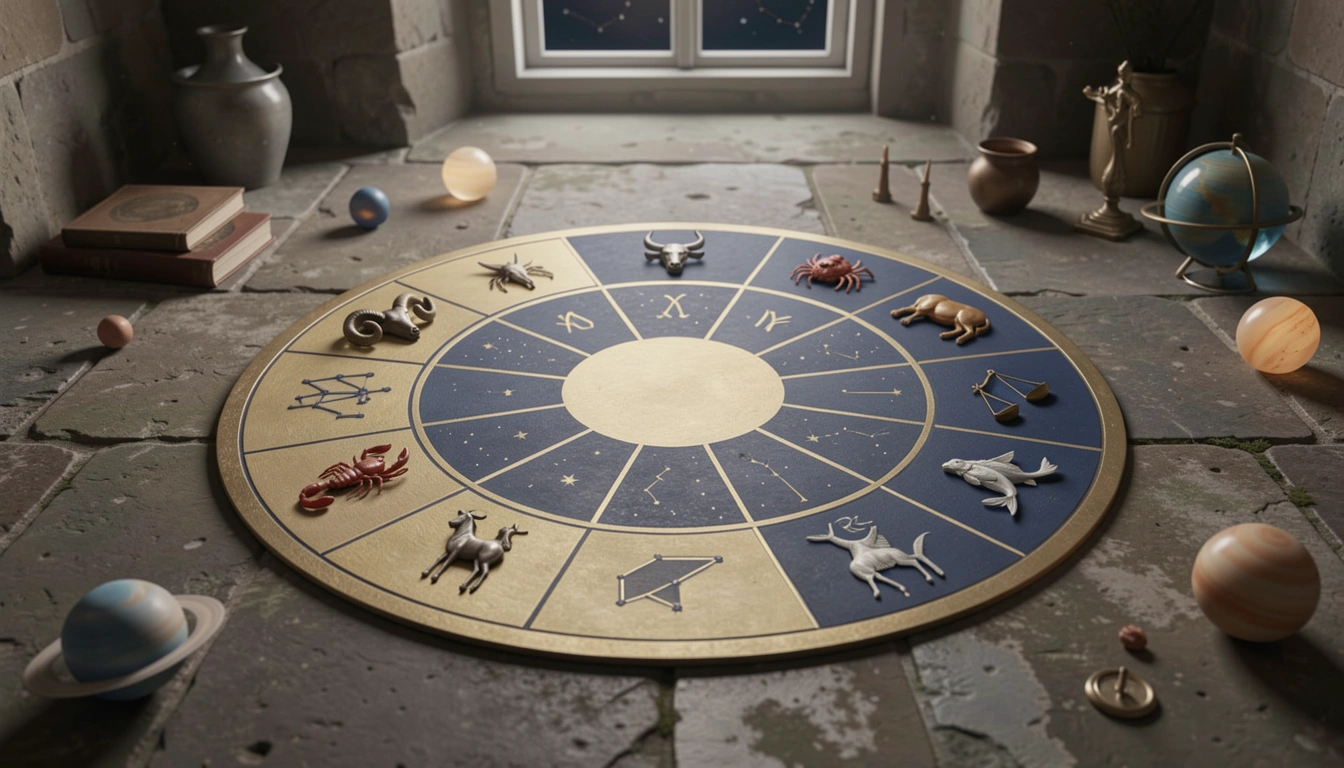
The twelve zodiac signs are archetypal patterns that describe different modes of being. They are divided into four elements (Fire, Earth, Air, Water) and three modalities (Cardinal, Fixed, Mutable). Each sign has a ruling planet, a set of keywords, and a range of expression from healthy to shadow. Understanding the signs is essential for interpreting planetary placements, because the sign modifies how a planet's energy operates.
Aries (March 21–April 19) is cardinal fire, ruled by Mars, and represents initiative, courage, and impulsiveness. Taurus (April 20–May 20) is fixed earth, ruled by Venus, and represents stability, sensuality, and stubbornness. Gemini (May 21–June 20) is mutable air, ruled by Mercury, and represents communication, curiosity, and duality. Cancer (June 21–July 22) is cardinal water, ruled by the Moon, and represents nurturing, emotion, and protectiveness. Leo (July 23–August 22) is fixed fire, ruled by the Sun, and represents creativity, leadership, and drama. Virgo (August 23–September 22) is mutable earth, ruled by Mercury, and represents analysis, service, and perfectionism.
Libra (September 23–October 22) is cardinal air, ruled by Venus, and represents balance, partnership, and aesthetics. Scorpio (October 23–November 21) is fixed water, ruled by Pluto (modern) and Mars (traditional), and represents intensity, transformation, and secrecy. Sagittarius (November 22–December 21) is mutable fire, ruled by Jupiter, and represents exploration, optimism, and philosophy. Capricorn (December 22–January 19) is cardinal earth, ruled by Saturn, and represents ambition, discipline, and authority. Aquarius (January 20–February 18) is fixed air, ruled by Uranus (modern) and Saturn (traditional), and represents innovation, rebellion, and community. Pisces (February 19–March 20) is mutable water, ruled by Neptune (modern) and Jupiter (traditional), and represents empathy, imagination, and dissolution.
Sign Rulerships and Traditional vs. Modern Rulers
Each sign has a traditional ruler and, for some signs, a modern ruler discovered after the invention of the telescope. For example, Scorpio is traditionally ruled by Mars and modernly by Pluto. Sagittarius is traditionally ruled by Jupiter and modernly by Neptune. Some astrologers use only traditional rulers, while others blend both. The choice affects interpretation: a Mars-ruled Scorpio is more combative and direct, while a Pluto-ruled Scorpio is more transformative and psychological. Consistency within a single reading is important.
How the Twelve Astrological Houses Work
The astrological houses are twelve divisions of the sky that represent different areas of life. Unlike the signs, which are fixed archetypes, the houses are dynamic and depend on the birth time and location. The first house begins at the Ascendant and proceeds counterclockwise. Each house governs a specific domain: the 1st house rules self and appearance, the 2nd house rules money and values, the 3rd house rules communication and siblings, the 4th house rules home and family, the 5th house rules creativity and romance, the 6th house rules health and daily work, the 7th house rules partnerships, the 8th house rules shared resources and transformation, the 9th house rules philosophy and travel, the 10th house rules career and public status, the 11th house rules friendships and goals, and the 12th house rules spirituality and the subconscious.
The house system used affects the cusp degrees. Placidus, the most common system, produces houses of unequal size, especially at high latitudes. Whole Sign houses, an older Hellenistic system, assign each sign to exactly one house, making the Ascendant the start of the first house regardless of degree. Equal house system divides the chart into 30° segments starting from the Ascendant. Koch and Regiomontanus are other popular systems. The choice of house system can change the house placement of planets near the cusp, which can alter interpretation significantly. Many astrologers recommend experimenting with different systems to see which resonates.
House rulership is determined by the sign on each house cusp. The planet that rules that sign becomes the house ruler and links the affairs of that house to the planet's sign and house placement. For example, if the 7th house cusp is in Libra, Venus (ruler of Libra) becomes the ruler of the 7th house, and its placement in the chart describes the nature of partnerships. This interweaving of signs, planets, and houses creates the rich complexity of chart interpretation.
Angular, Succedent and Cadent Houses
The houses are also classified by quadrant: angular houses (1st, 4th, 7th, 10th) are the most powerful and action-oriented. Succedent houses (2nd, 5th, 8th, 11th) are stabilizing and resource-oriented. Cadent houses (3rd, 6th, 9th, 12th) are mental, preparatory, and spiritual. Planets in angular houses tend to manifest strongly and visibly, while planets in cadent houses work more subtly or internally. This classification adds another layer of accidental dignity to planetary interpretation.
What Are Aspects in Astrology?
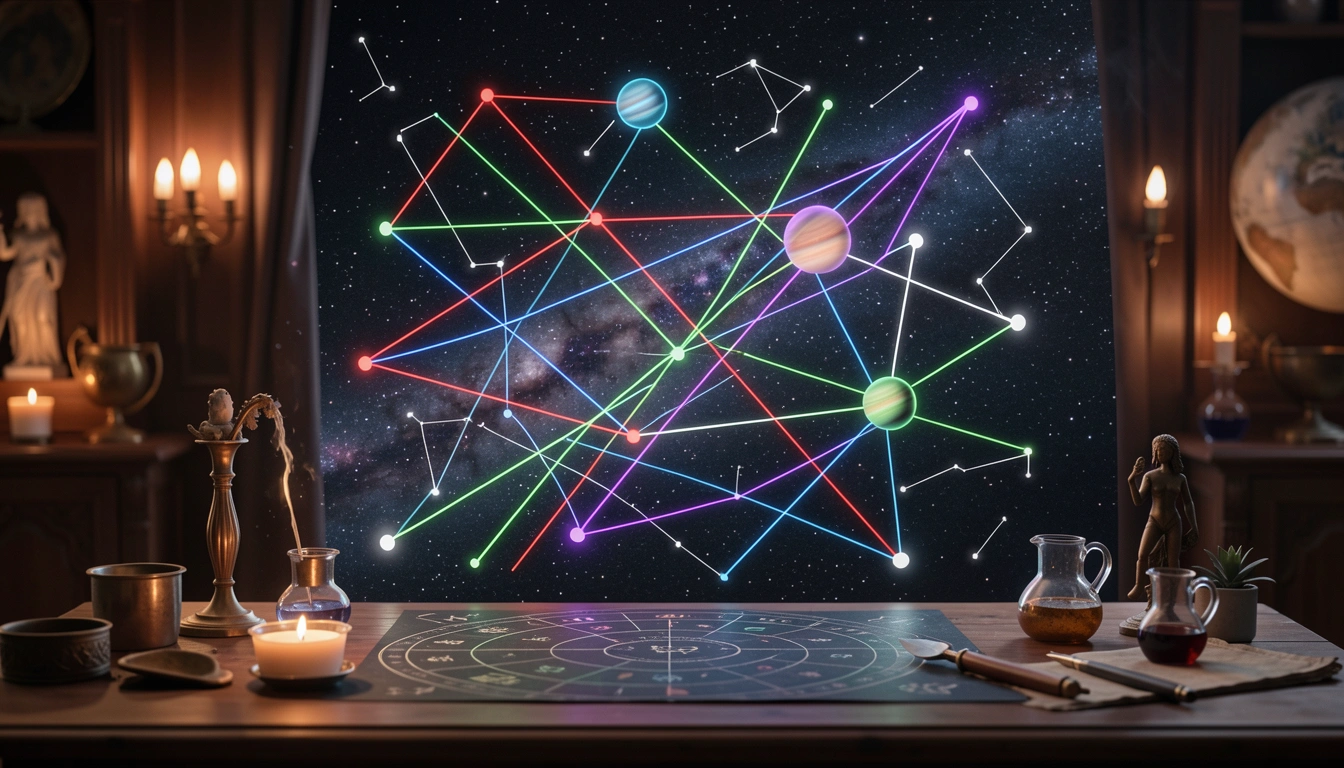
Aspects are the angular relationships between planets in a birth chart. They describe how the energies of different planets interact, whether harmoniously or with tension. The five major aspects are conjunction (0°), sextile (60°), square (90°), trine (120°), and opposition (180°). Each aspect has a specific quality: conjunctions blend energies, sextiles offer opportunity, squares create friction and motivation, trines bring ease and flow, and oppositions highlight polarity and balance. Minor aspects like the quincunx (150°) and semisextile (30°) add nuance.
Orbs define how close an aspect must be to be considered active. For the Sun and Moon, a typical orb is 8° to 10° for major aspects. For other planets, orbs of 5° to 8° are common for major aspects, and 2° to 3° for minor aspects. Some astrologers use tighter orbs for faster planets and wider orbs for slower planets. An aspect is considered exact when the degrees match precisely (0° orb), which is rare but powerful. Applying aspects (where the faster planet is moving toward the slower planet) are considered stronger than separating aspects.
Aspects also have a quality of being either positive (sextile, trine) or challenging (square, opposition), but modern astrology views all aspects as having both potential and challenge. A square can drive growth, and a trine can lead to complacency. The overall chart pattern, such as a grand cross (four planets in square) or a yod (two quincunxes forming a triangle), creates additional themes. Aspect patterns are a higher-level synthesis that experienced astrologers use to see the big picture.
Applying vs. Separating Aspects
An applying aspect means the faster planet is moving toward the exact degree of the slower planet, indicating that the energy is building and will become more prominent. A separating aspect means the faster planet has already passed the exact degree, and the energy is waning or integrating. Applying aspects are generally considered more potent because they represent an unfolding dynamic. This distinction is especially important in predictive techniques like transits and progressions.
Astrology Elements and Modalities Explained
The four elements in astrology are Fire, Earth, Air, and Water. Each element groups three signs and represents a fundamental energy type. Fire signs (Aries, Leo, Sagittarius) are passionate, energetic, and action-oriented. Earth signs (Taurus, Virgo, Capricorn) are practical, grounded, and material. Air signs (Gemini, Libra, Aquarius) are intellectual, social, and communicative. Water signs (Cancer, Scorpio, Pisces) are emotional, intuitive, and nurturing. A chart with a strong element emphasis will show a personality colored by that element's qualities.
The three modalities, also called quadruplicities, are Cardinal, Fixed, and Mutable. Cardinal signs (Aries, Cancer, Libra, Capricorn) initiate and lead. Fixed signs (Taurus, Leo, Scorpio, Aquarius) stabilize and persevere. Mutable signs (Gemini, Virgo, Sagittarius, Pisces) adapt and communicate. Each sign combines one element and one modality: for example, Aries is Cardinal Fire (initiating action), Taurus is Fixed Earth (stable materiality), and Gemini is Mutable Air (adaptable thought). The balance of elements and modalities in a chart indicates a person's natural style of action, reaction, and growth.
Understanding elements and modalities helps in chart synthesis. A chart with too much Fire and not enough Water may indicate a person who burns out or lacks emotional depth. A chart with too much Earth and not enough Air may be rigid or overly cautious. Modality balance shows how a person handles change: Cardinal-heavy charts initiate constantly, Fixed-heavy charts resist change, and Mutable-heavy charts adapt easily but may lack direction. Astrologers often look for missing elements or modalities to identify areas for development.
Elemental Compatibility in Relationships
In synastry (relationship astrology), elemental compatibility is a quick indicator of natural harmony. Fire and Air signs tend to energize each other, while Earth and Water signs nurture each other. Fire and Water can create steam or conflict, and Air and Earth may struggle to connect. However, challenging elemental combinations can also create growth and balance, so they are not inherently negative. The overall chart and aspects always provide the full picture.
Different Types of Astrology
Astrology is not a single practice but a family of related systems. Natal astrology, the most common, interprets birth charts for individual insight. Horary astrology answers specific questions by casting a chart for the moment the question is asked. Electional astrology helps choose the best timing for events like weddings, business launches, or surgeries. Mundane astrology examines world events, political trends, and natural disasters through charts of countries, leaders, or significant moments. Medical astrology correlates planetary placements with health and body systems.
Within these branches, there are cultural traditions. Western astrology uses the tropical zodiac and is popular in Europe and the Americas. Vedic (Jyotish) astrology uses the sidereal zodiac and includes the lunar mansions (nakshatras) and a complex system of dashas (planetary periods). Chinese astrology is based on a lunisolar calendar and a 12-year animal cycle. Hellenistic astrology, the foundation of Western practice, emphasizes lots, terms, and time-lord techniques. Modern psychological astrology focuses on archetypes and personal growth rather than prediction.
There are also specialized techniques: synastry and composite charts for relationships, solar returns for yearly forecasts, progressions for inner development, and transits for timing. Solar return synastry calculators help compare a person's solar return chart with another's natal chart for relationship timing. Each type and technique offers a different lens, and many astrologers combine multiple approaches for a richer reading.
Choosing the Right Type for Your Question
If you want to understand your personality and life path, natal astrology is the best starting point. If you have a specific question like 'Should I take this job?', horary astrology can provide a direct answer. For planning an event, electional astrology is ideal. For understanding global trends, mundane astrology is most relevant. Many people start with a natal chart and then explore other branches as their interest deepens.
Astrology vs. Astronomy: What Is the Difference?
Astronomy and astrology share a common origin but diverged centuries ago. Astronomy is a natural science that studies celestial objects, physics, and the universe's structure. It relies on empirical observation, mathematics, and the scientific method. Astronomers measure distances, compositions, motions, and origins of stars, planets, galaxies, and other phenomena. Their work is testable and predictive in a physical sense, such as predicting eclipses or planetary orbits.
Astrology, on the other hand, is a symbolic and interpretive system. It uses the same celestial positions as astronomy but interprets them as meaningful patterns rather than physical causes. Astrology does not claim that planets physically cause events; rather, it uses the sky as a symbolic clock or mirror. The distinction is often misunderstood: an astrologer uses astronomical data (ephemerides) to calculate chart positions, but the interpretation is hermeneutic, not scientific.
Modern astronomy has no mechanism to support astrological claims, and controlled studies have not demonstrated statistically significant predictive power for astrology. However, astrology's value lies in its psychological and archetypal framework, not in empirical prediction. Many people find it useful for self-reflection, narrative coherence, and personal insight, much like mythology or art. The two fields can coexist peacefully when their different domains are respected: astronomy describes what is physically happening, while astrology explores what it might mean symbolically.
Why the Confusion Persists
Because both fields use the same vocabulary (planets, stars, orbits, eclipses) and because astrology historically preceded astronomy as a formal discipline, the boundary is blurry for the public. In academia, the two are clearly separated, but in popular culture, they are often conflated. Understanding the difference helps set appropriate expectations: astronomy offers facts, while astrology offers meaning. Neither invalidates the other when used in its proper context.

Is Astrology a Science or a Belief System?
Astrology is not considered a science by the mainstream scientific community. It does not produce falsifiable hypotheses, its claims are not testable under controlled conditions, and it does not rely on empirical evidence in the way physics or biology does. Scientific studies of astrology have generally failed to support its predictive claims, and the mechanisms it proposes (such as planetary influence on personality) have no known physical basis. For these reasons, astrology is classified as a pseudoscience or a divinatory art.
However, astrology functions as a belief system and a symbolic language for many people. It offers a framework for self-understanding, narrative coherence, and personal meaning. In this sense, it is closer to mythology, philosophy, or psychology than to natural science. The practice of astrology can be intellectually rigorous, mathematically precise (in chart calculation), and psychologically insightful. Many users report that astrology helps them articulate feelings, identify patterns, and make decisions with greater awareness.
The question of belief is personal. Some people treat astrology as a tool for reflection without literal belief in planetary causation. Others hold it as a spiritual or metaphysical system. The important distinction is between using astrology as a practical guide and claiming it as a proven science. Responsible astrologers and platforms, including YesAstrology, present astrology as a tool for exploration and insight, not as a substitute for professional advice in medicine, law, or finance.
The Role of Confirmation Bias in Astrology
Critics point out that astrology's perceived accuracy often stems from confirmation bias, where people remember hits and forget misses. The Forer effect (also called the Barnum effect) shows that people accept vague, general personality descriptions as highly accurate for themselves. Astrological descriptions can be specific enough to feel personal but broad enough to apply to many people. Being aware of these psychological factors helps users engage with astrology critically while still benefiting from its reflective potential.
How Accurate Is Astrology?
The accuracy of astrology depends on what you expect from it. As a predictive tool, astrology has not been scientifically validated. However, as a descriptive and reflective tool, many people find it remarkably insightful. A well-done birth chart reading can feel uncannily accurate because it uses a structured symbolic language to describe universal human experiences. The accuracy also depends on the skill of the astrologer, the quality of the birth data, and the interpretive framework used.
Factors that increase accuracy include a precise birth time (within a few minutes), a reputable ephemeris, and a thoughtful synthesis of multiple chart factors. A reading that only mentions the Sun sign is less accurate than one that considers the Moon, Ascendant, houses, aspects, and dignities. Additionally, transits and progressions can add a timing dimension that feels predictive. For example, a Saturn return (Saturn returning to its natal position around age 29) is widely observed as a period of major life restructuring.
Ultimately, the value of astrology is not in its scientific accuracy but in its ability to provide a coherent narrative for self-exploration. Many users find that astrology helps them understand their strengths, challenges, and life patterns in a way that feels meaningful and actionable. The best approach is to use astrology as one of many tools for personal growth, alongside therapy, reflection, and practical life planning.
When Astrology Feels Inaccurate
If a reading feels off, it may be due to an incorrect birth time, the use of a house system that does not resonate, or an overly simplistic interpretation. It can also be that the astrologer focused on the wrong chart factors. A skilled astrologer will always consider the whole chart and adjust the interpretation based on feedback. If you are new to astrology, try getting a full chart reading rather than relying on Sun sign horoscopes, which are generalized for millions of people.