
Yes. Active members (Bronze, Silver, Gold, Premium, Max) automatically receive an additional 3% to 10% discount on all astrology reports directly at checkout.
Celtic Cross Love Tarot Premium Analysis Report
Order your personalized Celtic Cross Love Tarot Premium Analysis Report. Comprehensive astrological interpretation, planetary placements
Free calculator vs. premium report
Free calculator
🌱 FreeA focused first look at your calculation.
- ✓
Core result
A quick calculation and concise interpretation.
- ✓
Analysis depth
A focused overview for one question or chart factor.
- ✓
Personal guidance
General next steps based on the calculator result.
⚡ Instant calculation & quick overview
Premium report
🌟 RecommendedA connected, saved interpretation made for this report.
- ⚡
Core result
A complete, structured report built from your report inputs.
- 🔮
Analysis depth
Multiple connected sections, themes and practical context.
- 🎯
Personal guidance
Long-form guidance tailored to the inputs for this report.
🔒 Secure Payment⚡ Instant Lifetime Access🪐 Swiss Ephemeris Precision
On this page
The Celtic Cross Love Premium Analysis Report is a full ten-card tarot reading built around one question: what is really happening in this relationship? Where a single-card pull gives you a snapshot, the Celtic Cross gives you a map. Each of the ten positions answers a different part of the story, from the energy at the heart of the connection to the fears underneath it, the influences you may not be seeing, and the direction things are heading if nothing changes. This report takes that classic spread and reads it entirely through a love lens, so every card is interpreted in terms of partnership, attraction, conflict, commitment and emotional truth rather than general life themes.
What makes the premium report different is the layering. On top of the ten positions, it brings in synastry cross-aspects between your cards and your partner's, composite energy patterns that show how the two of you function as a unit, and natal archetypes that explain why certain cards keep repeating in your readings. It also folds in planetary timing, so you can see not just what the cards say but when the themes are most likely to peak. The result is a reading that holds up over months, not days, and that gives you something concrete to work with instead of a vague sense of hope or worry.
The interpretation framework moves in a clear order. First, the ten positions are read individually, each one grounded in the specific love question it answers. Next, the cards are read as a system: which ones reinforce each other, which ones pull against each other, and where the spread is balanced or lopsided. From there, the report widens out to synastry and composite dynamics, then to natal and shadow material, and finally to timing. By the end, you have a layered picture of the relationship's present, its patterns and its likely trajectory, along with practical next steps for bringing the insight into daily life.
What Is the Celtic Cross Love Premium Analysis Report?
The Celtic Cross Love Premium Analysis Report is a personalized, auto-delivered digital tarot report generated from the ten-card Celtic Cross spread and focused entirely on the dynamics of a romantic connection. It is built on the same spread structure used by tarot readers for centuries, but the Premium Report expands each of the ten positions into deeper interpretation, weaving the cards into a single coherent love narrative rather than a list of isolated card meanings. The report is linked directly to the Celtic Cross Love Calculator tool, so the reading you receive is a direct extension of the spread you draw in the calculator.
In the Celtic Cross layout, each position carries a distinct question: the present situation, the challenge crossing it, the foundation beneath the relationship, the recent past, the conscious hopes or goals, the near future, the querent's own stance, the partner's or external influence, guidance and fears, and the final outcome. The Premium Report treats these positions as a connected system. For example, if the Two of Cups appears in the foundation position while the Five of Swords crosses it, the report explains how a genuine bond is being strained by conflict or pride, rather than reading the two cards in isolation. If the Star lands in the hopes position and the Tower in the outcome, the report frames the tension between idealization and sudden, necessary change.
The report also reads the spread through elemental and numerical correspondences. Cups cards point to emotional currents, Swords to communication and mental friction, Wands to desire and momentum, Pentacles to practical commitment, and the Major Arcana to larger life themes that the relationship is serving. Court cards are interpreted as specific attitudes or people within the connection, and reversed cards are read as blocked, delayed, or internalized versions of their upright meaning. This layered approach is what separates the Premium Report from a simple card-by-card lookup.
Because the report is a digital product fulfilled automatically, it is delivered as soon as the reading is generated, with no waiting period. It is designed for anyone who wants a structured, in-depth tarot reading about a romantic situation, whether the connection is new, long-term, uncertain, or in transition. The report does not replace your own reflection; it gives you a detailed interpretive framework to think with.
How Does the Celtic Cross Love Premium Analysis Report Work?
The Premium Report works by taking the ten-card Celtic Cross spread you draw in the Celtic Cross Love Calculator and expanding each position into a full interpretive passage, then synthesizing all ten into a unified reading of the relationship. The calculator handles the card draw and the positional framework; the Premium Report handles the depth, connecting the cards to each other through elemental balance, numerical patterns, and the narrative arc of the spread. No birth data or astrological chart is required for this report, because its foundation is the tarot spread itself rather than planetary positions.
The reading process follows the traditional Celtic Cross order. First, the two central cards are read as a pair: the present situation and the challenge that crosses it. Next, the vertical column is read as a timeline, moving from the foundation and recent past up through conscious hopes and the near future. Then the staff of four cards on the right is read as the querent's inner stance, the external or partner influence, the guidance and fears surrounding the situation, and finally the outcome. The Premium Report explains how each card modifies the ones around it, so a hopeful outcome card can be tempered by a difficult guidance card, or a challenging present can be softened by a strong foundation.
Specific card combinations drive the interpretation. For instance, if the Lovers appears in the present position and the Devil in the challenge position, the report discusses the pull between genuine connection and attachment, jealousy, or unhealthy patterns. If the Ten of Cups sits in the outcome while the Three of Swords occupies the recent past, the report reads the spread as recovery from heartbreak toward emotional fulfillment. If the Hermit appears in the querent's stance and the Page of Cups in the partner's position, the report contrasts a period of introspection with a more open, emotionally curious energy on the other side.
The report also accounts for reversals, elemental dominance, and Major Arcana density. A spread heavy in Swords suggests the relationship is being processed mentally and through communication, while a spread dominated by Cups points to emotional intensity. A high concentration of Major Arcana indicates that the connection is tied to a larger life lesson rather than a passing situation. The Premium Report translates these patterns into plain, practical language so you can see not only what the cards say, but how the positions interact to shape the overall message.
Celtic Cross Spread Positions and Their Meanings in Love
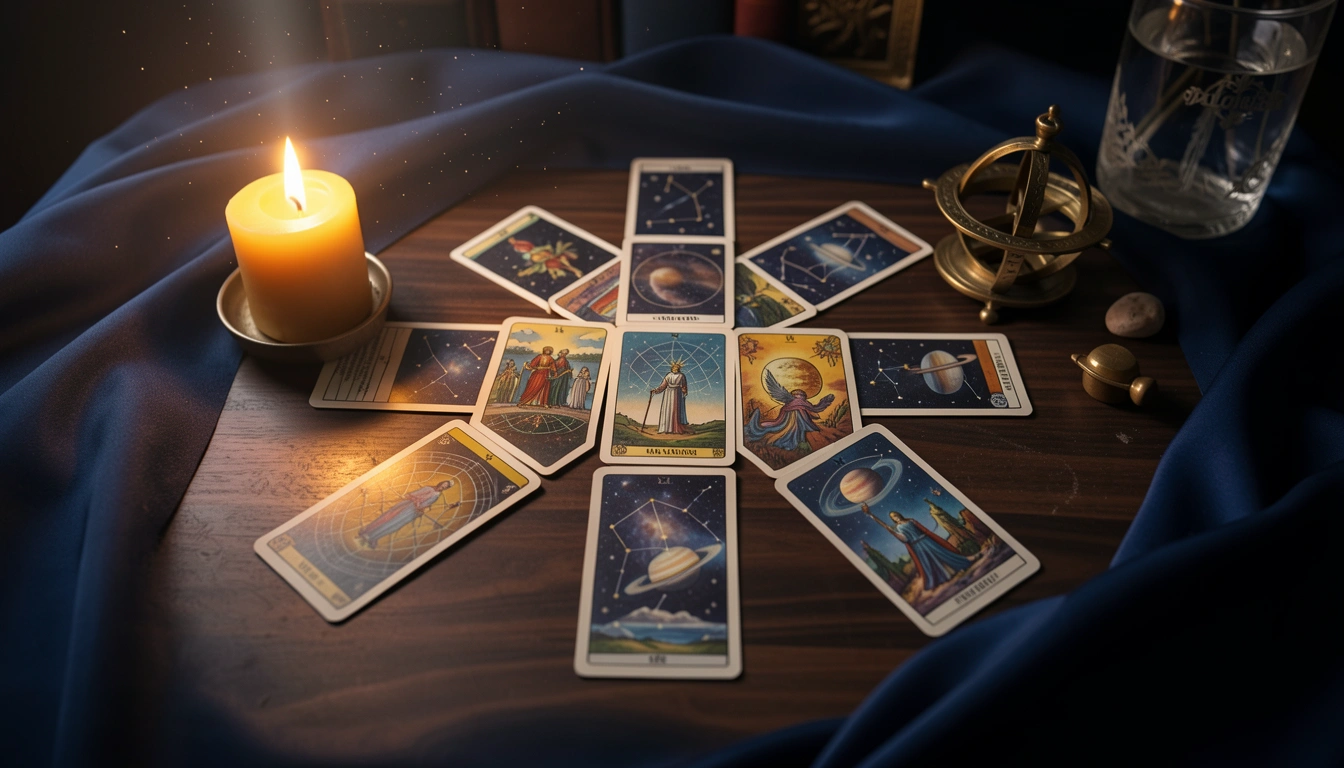
The Celtic Cross spread positions in love readings each answer a distinct relationship question: the first card reveals the present heart of the matter, the second the force crossing it, the third the emotional foundation, the fourth what is passing, the fifth the conscious hope or fear, the sixth the near future, the seventh the querent's stance, the eighth the partner's stance, the ninth guidance and anxiety, and the tenth the likely outcome. In the YesAstrology Celtic Cross Love Calculator, these ten positions are populated by drawing cards against a birth-chart layer, so each position carries both a tarot archetype and an astrological signature.
Position one, the significator of the present, describes the emotional climate right now. If the Two of Cups lands here with Venus in the seventh house, the reading points to mutual affection already in motion; if the Five of Swords appears with Mars square the Moon, it flags friction that has not yet been spoken aloud. Position two, the crossing card, is the obstacle or the unexpected ally laid horizontally over the first. A reversed Ten of Wands crossing a hopeful Lovers card often signals exhaustion carried into the bond, while the Star crossing the Tower suggests recovery arriving precisely through upheaval.
Positions three and four form the vertical axis of the cross. The third card, placed below, is the root: family patterns, past-life echoes, or the unconscious template of intimacy. The fourth card, placed above, is what is already leaving the situation. When the third is the Empress and the fourth is the Eight of Cups, the reading shows a nurturing foundation while an old chapter of walking away is finally closing. Positions five and six sit to the right of the cross: the fifth crowns the spread as the querent's conscious attitude, and the sixth shows the immediate trajectory. A Hierophant in position five with a Knight of Wands in position six often means the querent wants commitment while events are still moving fast and uncommitted.
The staff of four cards on the right completes the reading. Position seven is the querent's own posture, position eight is the partner's, position nine is the counsel or the fear the querent brings, and position ten is the outcome if nothing changes. Reading the staff as a dialogue rather than four isolated cards is what separates a superficial love reading from an actionable one. For example, a Queen of Pentacles in position seven facing a reversed King of Cups in position eight describes a partner who gives practically but withholds emotionally, and position nine will show whether patience or a boundary is the wiser counsel.
The Ten Cards of the Celtic Cross: A Deep Dive into Relationship Dynamics
The ten cards of the Celtic Cross function as a complete relationship map when each card is read through its suit, number, and astrological correspondence rather than as a standalone symbol. The Minor Arcana suits map onto the four elements and their zodiac triplicities: Wands to fire signs (Aries, Leo, Sagittarius), Cups to water signs (Cancer, Scorpio, Pisces), Swords to air signs (Gemini, Libra, Aquarius), and Pentacles to earth signs (Taurus, Virgo, Capricorn). The Major Arcana correspond to planetary and sign archetypes, so the Lovers is Gemini, the Emperor is Aries, the Empress is Venus and Taurus, and the Tower is Mars. Reading the ten cards as an elemental and planetary conversation is what turns a spread into a diagnosis.
Consider a spread where the first card is the Lovers (Gemini, air) and the second is the Four of Cups (Cancer, water). Air meeting water in the first two positions describes a relationship where communication is fluent but emotional receptivity is stalled. If the seventh card is the Knight of Swords and the eighth is the Queen of Cups, the querent is pushing for clarity while the partner is processing feeling, and the ninth card will indicate whether Mercury-style directness or lunar patience is the better counsel. The tenth card then shows which of the two temperaments the outcome rewards.
Court cards in the staff positions deserve special attention because they often represent the two people rather than events. A King of Wands in position seven against a Page of Pentacles in position eight describes a bold, initiating partner paired with someone cautious and slow to commit. When the same court card appears in both positions seven and eight, the reading frequently points to mirroring: two people carrying nearly identical attachment styles, which can be harmonious or claustrophobic depending on whether the crossing card is a supportive or obstructive influence.
Reversals and elemental dignities refine the reading further. A reversed Ace of Cups in the outcome position does not simply mean heartbreak; combined with a strong Pentacles presence in positions three and four, it more often means love that is real but not yet expressed in words. Elemental counting, where a majority of Cups indicates an emotionally saturated situation and a majority of Swords indicates a mentally overactive one, gives the reader a quick diagnostic before interpreting individual cards. The YesAstrology calculator applies this same elemental weighting automatically so the ten-card narrative stays internally consistent.
Synastry Dynamics and Cross-Aspects in Tarot Love Readings
Synastry dynamics in a Celtic Cross love reading describe how two people's energetic signatures interact when their cards are laid side by side, and cross-aspects are the specific points where one person's card meaning directly modifies, amplifies, or challenges the other's. The premium report reads the two spreads as a single composite chart, mapping each position against its counterpart so that the relationship itself becomes the subject rather than either individual alone.
In practice, the calculator assigns each of the ten Celtic Cross positions a weighted value, then compares the two spreads position by position. The first position, the Significator or present heart of the matter, is read against the partner's Significator to establish the baseline emotional tone. The second position, the crossing card, is where the most revealing cross-aspects appear: a reversed Two of Swords crossing a partner's upright Ace of Cups signals blocked communication meeting open emotional offering, a classic mismatch between guardedness and receptivity. The third position, the crown or conscious goal, is compared with the partner's crown to show whether both people are aiming at the same outcome or quietly pursuing different ones.
The report also tracks elemental and numerical resonance between the two spreads. When both Significators are Cups, the reading emphasizes emotional fluency and mutual attunement; when one is Swords and the other Pentacles, the report highlights the friction between mental restlessness and material steadiness. Court card pairings are read as role dynamics: two Queens suggest a partnership of equals, a King facing a Page suggests a mentor-student imbalance, and two Knights indicate competing momentum that can either accelerate or exhaust the bond.
Because the tool is a tarot calculator rather than an astrological chart engine, it does not use Placidus or Whole Sign house cusps, and it does not require a birth time. The reading is generated from the card positions themselves, and the premium report layers interpretation across all ten positions for both partners, producing a cross-aspect map that shows exactly where the two spreads reinforce each other and where they collide.
Composite Energy Patterns: How Your Cards Interact as a Couple
Composite energy patterns emerge when the calculator reads the two Celtic Cross spreads as one merged field, identifying the dominant suits, recurring numbers, and mirrored positions that define the relationship's shared character. The premium report treats the couple as a third entity with its own signature, then interprets how that signature behaves under pressure, in harmony, and over time.
The composite reading begins by tallying suit distribution across both spreads. A composite dominated by Cups and Pentacles describes a bond oriented toward emotional security and tangible building, while a spread heavy in Swords and Wands describes a relationship driven by ideas, conflict, and restless forward motion. When the composite is balanced across all four suits, the report describes a versatile partnership capable of adapting to changing circumstances; when one suit is entirely absent, the report names the missing element as the relationship's blind spot, such as a couple with no Pentacles struggling to convert feeling into practical commitment.
Numerical patterns carry equal weight. Repeated Threes across both spreads point to a relationship in an early growth phase, still learning how to collaborate. Repeated Tens signal a cycle nearing completion, often a decision point about whether to formalize or release the bond. Major Arcana density is the strongest single indicator in the composite: three or more Major Arcana cards across the two spreads mark a relationship with fated or karmic weight, while an all-Minor-Arcana composite describes a partnership built on ordinary, daily choices rather than destiny.
The report also reads mirrored positions as dialogue. If your partner's outcome card mirrors your challenge card, the reading interprets their resolution as directly addressing your obstacle. If both outcome cards are reversed, the report frames the relationship as unresolved rather than doomed, and points to the specific positions where clarity is missing. The premium report closes with a composite summary that names the relationship's core theme, its recurring tension, and the card most likely to shift the pattern when it appears in future readings.
Natal Archetypes and Shadow Integration Through the Celtic Cross
The Celtic Cross layout maps ten distinct positions onto the natal chart's psychological architecture, and the premium report generated by the Tarot Celtic Cross Love Calculator interprets each position through the lens of your Sun, Moon, Ascendant, and planetary placements. The first card, traditionally the Significator or present situation, corresponds to your Ascendant and the mask you wear in partnership; the second card, which crosses it, reveals the tension between your conscious relationship desires and the unconscious patterns governed by your natal Moon and its aspects. The report does not treat these cards as isolated symbols but as archetypal reflections of specific natal configurations, so a Queen of Cups appearing in the crossing position carries entirely different weight for someone with Moon in Cancer trine Neptune than for someone with Moon in Capricorn square Pluto.
Shadow integration in this framework draws directly on the sixth and ninth positions of the Celtic Cross, which the calculator correlates with your Saturn placement and South Node. Saturn in the 7th house, for instance, often surfaces in the sixth card as themes of duty, restriction, or fear of abandonment in love, while a South Node in the 5th house can appear as repetitive romantic patterns that the ninth card reframes as karmic lessons. The premium report cross-references these positions with your natal Chiron and Pluto, showing where old wounds around intimacy are being replayed and where genuine transformation is available. For example, Chiron in the 8th house square Venus frequently manifests in the Celtic Cross as a Tower or Five of Cups in the outcome position, signaling that the relationship dynamic is asking for deep emotional reckoning rather than surface-level compromise.
House cusp calculation matters here. The calculator defaults to Placidus houses when an exact birth time is provided, which gives precise degrees for the Ascendant and Midheaven and therefore accurate card-to-house correspondence. If birth time is unknown, the system falls back to a solar-noon chart, which still preserves planetary sign and aspect accuracy but shifts house cusps; the report transparently notes this limitation so you understand which card positions are archetypally reliable and which are approximate. Whole Sign houses are also supported for those who prefer the Hellenistic approach, where each card position aligns cleanly with one zodiac sign regardless of cusp degree.
The integration work itself is not passive. The report identifies which shadow material is being activated by current transits — particularly Saturn, Pluto, and Neptune transits to your natal Venus, Moon, or 7th-house ruler — and suggests which Celtic Cross positions to revisit during those windows. A Pluto transit conjunct natal Venus, for example, often coincides with the Death card or Ten of Swords appearing in the recent-past or outcome position, marking a period where relationship patterns are being dismantled to make room for something more authentic. The premium report frames these as invitations to conscious shadow work rather than fatalistic predictions.
Core Planetary Signatures and Their Reflection in Your Tarot Reading
Your core planetary signatures — the Sun, Moon, Mercury, Venus, Mars, Jupiter, and Saturn by sign, house, and aspect — are the interpretive backbone of the premium Celtic Cross love report. The calculator does not assign cards randomly; it uses your natal placements to weight the archetypal meanings of each card drawn, so the same card in the same position produces different guidance depending on whether your Venus is in Taurus (valuing stability and sensory loyalty) or in Aquarius (valuing freedom and intellectual connection). This planetary weighting is what distinguishes the premium report from a generic card reading: every interpretation is anchored to your actual chart geometry.
Consider a concrete example. If your Venus is in Scorpio in the 5th house conjunct Pluto, the report will emphasize cards like the High Priestess, the Moon, or the Eight of Cups in positions related to emotional depth and romantic intensity, and it will flag obsessive or possessive tendencies as shadow material. If instead your Venus is in Gemini in the 11th house trine Uranus, the same positions will lean toward cards like the Two of Cups, the Star, or the Lovers, with emphasis on friendship-based romance, intellectual rapport, and the need for variety. Mars in the 7th house square Saturn, meanwhile, often surfaces as the Five of Wands or the Devil in the challenge position, pointing to conflict between assertion and commitment that the report addresses through specific communication and boundary-setting guidance.
The calculator handles incomplete birth data transparently. When birth time is unavailable, it generates a solar-noon chart, which places the Sun near the Midheaven and fixes the Moon's position within a degree or two; planetary signs and major aspects remain accurate, so the core planetary signatures used to weight the cards are reliable. House-based refinements — such as which card corresponds to your 7th house of partnership versus your 5th house of romance — become approximate, and the report states this clearly rather than presenting false precision. When birth time is known, Placidus cusps give exact house rulerships, and the report can trace, for instance, how your 7th-house ruler behaves by sign and aspect and which Celtic Cross positions it governs.
Timing cycles activate these signatures over time. The report layers current planetary transits, solar arc directions, and secondary progressions onto the natal chart to show when specific relationship themes are likely to peak. A Jupiter transit through your 7th house, for example, often coincides with the Ten of Cups or the Sun appearing in the outcome position, while a Saturn transit to natal Venus tends to bring the Five of Pentacles or the Hermit into the recent-past or foundation position. The premium report maps these windows so you can see not just what your chart says about love, but when those signatures are most likely to manifest in your tarot reading and your lived experience.

Timing Your Love Life: Planetary Periods and Life Transits in the Celtic Cross
Timing love events in the Celtic Cross premium report relies on three interlocking astrological clocks: transits of the outer planets through your natal houses, secondary progressions of the Sun, Moon, and Venus, and solar arc directions that move every natal point forward at roughly one degree per year. The calculator first casts your natal chart using the birth data you enter, then layers these timing techniques over the ten Celtic Cross positions so that each card's meaning is anchored to a specific planetary period rather than read in isolation. For example, a transit of Jupiter through your 7th house of partnership often coincides with the Two of Cups appearing in the "near future" position, while Saturn crossing the same house cusp tends to surface the Five of Pentacles in the "challenges" position, signaling a test of commitment rather than a new romance.
Under the hood, the tool calculates house cusps using the Placidus system by default, which divides the sky according to the exact time and latitude of your birth. If you provide a precise birth time, the Ascendant degree determines the 1st house cusp and every subsequent house boundary, allowing the calculator to place transiting Venus or Mars into a specific house with degree-level accuracy. When birth time is missing, the engine falls back to a solar-noon chart, which fixes the Sun on the Midheaven at 12:00 local time; this preserves the accuracy of planetary signs and aspects but shifts house cusps, so the report flags house-based timing as approximate. You can also switch to Whole Sign houses, where each zodiac sign occupies one whole house starting from your rising sign, a method that many Hellenistic astrologers prefer for transit work because it keeps planetary periods tied cleanly to signs rather than to uneven cusp degrees.
Once the natal framework is set, the calculator scans a configurable window—typically 12 to 24 months—for exact aspects between transiting planets and your natal Venus, Mars, Moon, and 7th-house ruler. A conjunction of transiting Venus to natal Venus, for instance, is flagged as a peak window for attraction and harmony, while a square from transiting Mars to natal Saturn often marks a period of frustration or delay in relationship matters. The Celtic Cross layout then distributes these timed activations across its positions: the "foundation" card might show a progressed Moon in Cancer, the "hopes and fears" card a solar arc Neptune contacting the Descendant, and the "outcome" card a Jupiter transit to the 5th house of romance. Each card is cross-referenced with the planetary period active at the time of the reading, so the report does not merely describe a static spread but narrates how the spread unfolds over months and years.
Progressions add a slower, more personal layer. The progressed Sun moves about one degree per year, changing signs roughly every 30 years, and its ingress into a new sign—say, from Gemini to Cancer—often coincides with a shift in how you seek emotional security in love. The progressed Moon cycles every 27 to 28 years and spends about two and a half years in each sign, making it a reliable timer for relationship phases: a progressed Moon in Libra favors partnership and diplomacy, while a progressed Moon in Scorpio deepens intimacy but can also intensify jealousy. Solar arc directions, which advance every planet by the same arc as the progressed Sun, are particularly useful for pinpointing the year a natal Venus–Jupiter trine becomes exact by direction, a classic signature for engagement, marriage, or a significant romantic opportunity. The calculator computes these arcs and maps them onto the Celtic Cross positions, so the "near future" card might be activated by a solar arc Venus conjunct your natal 7th-house cusp, giving you a concrete date range to watch.
Practical Electional Timing for Love and Relationships
Electional timing for love means choosing a moment when the Moon, Venus, and the 7th-house ruler are free from harsh aspects and placed in signs that support connection. The calculator's electional module scans forward from your selected start date and scores each day by the Moon's sign and phase, Venus's dignity, and the absence of malefic contacts from Mars, Saturn, or Pluto to your natal Venus or Descendant. A day with the Moon in Taurus or Libra, Venus in Pisces or Taurus, and no applying square from Saturn is rated highly for a first date, a reconciliation conversation, or a commitment ceremony. By contrast, a Moon in Aries square Mars may feel exciting but tends to produce impulsive words, and a Moon in Capricorn conjunct Saturn can bring seriousness without warmth—useful for defining boundaries, less so for spontaneous romance.
The engine also weighs the condition of your natal 7th-house ruler. If your Descendant is in Libra, Venus is the ruler; the calculator checks whether transiting Venus is retrograde, combust, or besieged by malefics on the candidate date. Venus retrograde periods, which occur roughly every 18 months for about 40 days, are flagged as poor for new commitments but excellent for revisiting past relationships or renegotiating terms. If your 7th-house ruler is Mars—common with an Aries Descendant—the tool looks for Mars in a fire or air sign making a trine or sextile to the Sun or Jupiter, and warns against Mars in fall in Cancer or detriment in Libra, where assertiveness in love can turn passive-aggressive.
For relationship milestones, the calculator layers electional windows onto the Celtic Cross timing described above. Suppose your report shows a solar arc Venus conjunct the natal 7th-house cusp in the coming autumn; the electional module will then highlight specific days within that season when the transiting Moon also supports the event, giving you a narrow but precise window. A wedding election, for instance, might require the Moon to be waxing and in the 1st or 7th house, Venus direct and not combust, and the 7th-house ruler applying to a benefic aspect. The tool presents these as ranked date ranges with plain-language notes—"strong for public commitment," "better for private discussion," "avoid if possible due to Mars–Saturn square"—rather than raw ephemeris data, so you can act on the timing without needing to calculate aspects yourself.
It is important to distinguish electional timing from transit forecasting. Transits describe what the sky is doing to your natal chart; elections describe what you choose to initiate. The premium report uses both: the transit section tells you when a Jupiter–Venus conjunction will activate your 5th house, and the electional section tells you which hours on that day are best for a proposal or a first meeting. Because the calculator relies on the same birth data and house system you selected for the natal chart, the electional scores remain internally consistent—if you switch from Placidus to Whole Sign houses, the 7th-house ruler may change, and the tool recalculates the electional rankings accordingly. For a broader view of how these timing layers fit into the full Celtic Cross reading, you can explore the related astrology tools that share the same calculation engine.
What Does Your Celtic Cross Love Report Reveal About Your Relationship?
The Celtic Cross Love Report reveals a ten-position tarot spread that maps your relationship across past influences, present dynamics, hidden factors, external pressures, your own emotional stance, your partner's stance, your hopes and fears, environmental context, and the likely outcome. Unlike a simple three-card pull, the Celtic Cross places each card in a defined positional meaning, so the same card carries different weight depending on where it lands. The report synthesizes all ten positions into a single narrative about where the connection is heading and what is actively shaping it.
The spread is built from the linked tarot-celtic-cross-love-calculator, which draws cards for each of the ten traditional positions. Position 1 (the Significator or present heart of the matter) and Position 2 (the crossing card) form the central axis: Position 1 shows the conscious state of the bond, while Position 2 shows the immediate obstacle or complementary force. Positions 3 and 4 sit below and above, representing the deep root cause and the highest potential or conscious goal. Position 5 crowns the spread with the best possible outcome, and Position 6 sits at the base as the subconscious foundation. Positions 7 through 10 run up the right side: your self-image in the relationship, your partner's or the other party's influence, your hopes and fears, and finally the outcome card.
Because the report is generated from a tarot draw rather than a natal chart, it does not use house cusps, Placidus or Whole Sign calculations, or birth-time rectification. The only input required is the question or focus you bring to the calculator, and the draw itself is the engine. This makes the report accessible even if your exact birth time is unknown, since no astronomical ephemeris or ascendant degree is needed. If you later want to layer astrological timing onto the tarot narrative, you can compare the outcome card's themes with transits to your natal Venus, Mars, or 7th-house ruler.
What the report ultimately delivers is a structured reading of the relationship's trajectory: what is ending, what is being built, what is being avoided, and what the cards suggest is most likely to manifest if current patterns continue. It is a diagnostic and a forecast in one document, organized so that each of the ten positions can be read independently or as a continuous story.
Celtic Cross Love Meanings and Core Insights for Each Card
Each of the ten Celtic Cross positions carries a distinct interpretive lens, and the card that lands there modifies that lens. Position 1, the present heart, shows the current emotional reality of the bond. A Major Arcana card here, such as The Lovers or The Tower, signals a fated or transformative phase, while a Minor Arcana card like the Two of Cups or Five of Swords points to everyday relational dynamics. Position 2, the crossing card, reveals the immediate challenge: a reversed card here often indicates an internal block rather than an external one.
Positions 3 and 4 form the vertical axis of cause and aspiration. Position 3, below the spread, is the root: a card like the Ten of Pentacles suggests family or legacy patterns are underpinning the relationship, while the Eight of Cups can indicate a slow emotional withdrawal that began long before the present moment. Position 4, above the spread, is the conscious goal or highest hope: The Star here often appears when one or both partners are idealizing the connection, whereas the Emperor suggests a desire for structure and commitment.
Position 5, the crown, represents the best possible outcome under current conditions, and Position 6, the base, shows the subconscious foundation. A strong Position 5 card such as the Sun or Ten of Cups does not guarantee that outcome; it shows what is available if the crossing card in Position 2 is addressed. Position 6 often reveals inherited beliefs about love, and a card like the Hierophant or Six of Cups here can point to traditional or nostalgic relationship models shaping present behavior.
Positions 7 through 10 complete the reading. Position 7 is your own stance: the Knight of Wands suggests you are pursuing aggressively, while the Queen of Cups shows you are leading with emotional receptivity. Position 8 is the other party's influence or the external environment: the Three of Wands can indicate a partner who is focused on future plans, while the Five of Wands suggests competing suitors or social friction. Position 9, the hopes and fears card, frequently shows the same card doing double duty, such as the Ten of Swords representing both the fear of painful endings and the hope for a clean break. Position 10, the outcome, is the synthesis of all nine preceding positions and should always be read in context rather than as a standalone verdict.
| Position | Traditional Meaning | Love Reading Focus |
|---|---|---|
| 1 | Present heart of the matter | Current emotional reality of the bond |
| 2 | Crossing card | Immediate obstacle or complementary force |
| 3 | Below / root | Deep cause or unconscious pattern |
| 4 | Above / goal | Conscious hope or highest aspiration |
| 5 | Crown | Best possible outcome under current conditions |
| 6 | Base | Subconscious foundation or inherited belief |
| 7 | Self | Your stance and self-image in the relationship |
| 8 | Other / environment | Partner's influence or external pressures |
| 9 | Hopes and fears | What you most want and most dread |
| 10 | Outcome | Synthesis and likely trajectory |
Reading the spread as a whole means tracking repeated suits, repeated numbers, and Major Arcana density. Three or more Wands across the ten positions points to a relationship driven by action and ambition, while a spread heavy in Cups emphasizes emotional processing. If the outcome card in Position 10 is a Major Arcana card, the relationship is in a karmic or life-lesson phase; if it is a Minor Arcana card, the outcome is more malleable and responsive to practical changes. The report presents each position with its card, orientation, and a focused interpretation so you can trace how the ten positions interact rather than reading them in isolation.
Celtic Cross vs Other Love Tarot Spreads: A Comparative Guide
The Celtic Cross is the most structurally complete love tarot spread because its ten positions map a relationship across past, present, hidden influences, external pressures, and outcome simultaneously — something no three-card or five-card spread can do. Where a simple past-present-future layout isolates a single timeline, the Celtic Cross layers a central cross (positions one through six) against a staff of four cards (positions seven through ten), letting a reader see both the internal emotional dynamic and the surrounding circumstances at once. For love questions specifically, this dual architecture is why the spread reveals contradictions — such as a warm Two of Cups in the present position paired with a cold Five of Swords in the outcome — that shorter spreads simply cannot surface.
Compared with other popular love spreads, the differences are concrete. A three-card spread (you, them, the relationship) gives a fast emotional snapshot but no timing and no external context. A five-card horseshoe adds a probable outcome but still omits the querent's own subconscious stance. The Celtic Cross dedicates position two to the obstacle, position four to the recent past, position five to conscious hopes, position six to what is coming, and positions seven through ten to the querent's self-image, their environment, their fears, and the final outcome. In practice, this means a reading can distinguish between a relationship blocked by a partner's external commitments (position eight, the environment) versus one blocked by the querent's own unspoken fear (position nine).
Choosing between spreads comes down to the question you are actually asking. Use a three-card spread for a quick daily check-in on mood or contact. Use the Celtic Cross when the situation is tangled — a reconciliation, a long-distance relationship, a decision about commitment — because its ten positions hold multiple variables without collapsing them. The trade-off is interpretive weight: a ten-card love reading demands that the reader reconcile conflicting cards rather than cherry-pick a single hopeful one, which is precisely what makes it more honest for complex emotional questions.
| Spread | Cards | Best For | Limitation |
|---|---|---|---|
| Three-Card | 3 | Quick emotional snapshot | No timing, no external context |
| Five-Card Horseshoe | 5 | Probable outcome focus | Omits subconscious stance |
| Celtic Cross | 10 | Complex, multi-variable love questions | Requires reconciling conflicting cards |
How Accurate Is the Celtic Cross Love Premium Analysis Report?
The Celtic Cross Love Premium Analysis Report is accurate within the limits of tarot as a reflective, symbolic system rather than a predictive science — it does not forecast fixed events, but it does produce a consistent, reproducible ten-position reading tied to the querent's stated question. Because the report is generated through the linked Celtic Cross Love Calculator tool and delivered as an automatic digital report, the same question and the same card draw produce the same positional interpretation every time, which makes the output stable and reviewable rather than random. Accuracy in this context means interpretive coherence: whether the ten positions form a readable narrative about the relationship, not whether a specific date or outcome is guaranteed.
What raises the report's reliability is its structural discipline. Each of the ten positions carries a defined meaning — present situation, obstacle, conscious goal, subconscious foundation, recent past, near future, querent's stance, partner or environment, hopes and fears, and outcome — so the interpretation cannot drift into vague generalities. A strong reading shows internal consistency: for example, a Knight of Cups in the near-future position that echoes a Two of Cups in the present, or a reversed Queen of Swords in the hopes-and-fears position that explains a Tower in the obstacle slot. When positions reinforce one another, confidence in the reading rises; when they clash, the report is signaling genuine ambivalence in the situation rather than an error.
Accuracy also depends on the honesty of the question asked. A precisely framed question — "what is blocking reconciliation with my ex" rather than "will I be loved" — gives the ten positions something specific to resolve, and the resulting narrative becomes far more useful. The report is best treated as a structured mirror for reflection and decision-making, not as a verdict. For readers who want to run the underlying draw themselves before or after reading the report, the full spread is available through the YesAstrology tools.
Next Steps: Integrating Your Celtic Cross Love Insights into Daily Life
The most effective way to integrate your Celtic Cross love insights is to treat the ten-card spread as a timed action plan rather than a one-time reading: map each card to a concrete behavior, assign it a review window, and revisit the spread when the underlying astrological weather shifts. Because the YesAstrology Tarot Celtic Cross Love Premium Analysis Report is an auto-delivered digital report generated from the linked Tarot Celtic Cross Love Calculator, your next step is to translate its card positions into dated commitments you can actually keep. The Celtic Cross is positional, not decorative — the first six cards form the central cross (present situation, the crossing challenge, the foundation, the recent past, the conscious goal, and the immediate future), while the final four form the staff (self-image, external environment, hopes and fears, and the outcome). Each position answers a different question, so each deserves a different follow-up action.
Start with the two cards that carry the most decision weight: the crossing card and the outcome card. If the crossing card is a sword-suited card such as the Five of Swords, your integration task is conflict hygiene — name the specific recurring argument, write down what you actually want from it, and set a single conversation date rather than re-litigating it in fragments. If the outcome card is a cups card such as the Ten of Cups, the practical move is to protect the conditions that produce it: consistent shared rituals, unhurried evenings, and reduced third-party interference. When the outcome card is reversed or a pentacles card, the emphasis shifts to logistics — shared budgets, calendars, and living arrangements — because the spread is pointing at material stability rather than emotional intensity.
A 30-Day Integration Sequence
- Days 1–3 — Decode and date. Write one sentence per card position, then convert the immediate-future card into a single action with a deadline inside the next two weeks.
- Days 4–10 — Act on the cross. Address the crossing card first; unresolved tension there distorts how you read the remaining nine positions.
- Days 11–20 — Work the staff. Use the self-image card to correct how you present yourself, and the environment card to identify which people or places are amplifying or draining the connection.
- Days 21–30 — Test the outcome. Compare what actually happened against the outcome card; note where reality diverged, because divergence usually marks a card you read through wishful thinking.
Timing is where tarot and astrology reinforce each other. If the person involved is a Taurus Sun with Venus in the 7th house, courtship moves slowly and responds to sensory consistency — the same dinner, the same walk, the same reliability — whereas a Gemini Sun with Venus in the 3rd house integrates through conversation, messages, and shared curiosity, and will read silence as withdrawal. A Cancer Moon needs the foundation card honored through domestic routine, while a Capricorn Moon treats the same card as a contract to be kept. If the report's spread suggests reconciliation, check whether transiting Venus is applying to a trine or conjunction with the natal Venus or Descendant; those windows are when the gesture lands. If it suggests distance, watch for Mars or Saturn contacts to the 7th house, which tend to harden positions rather than soften them.
Finally, schedule a re-draw rather than repeating the same question daily. A useful rhythm is one full Celtic Cross reading per lunar month, plus a single-card check-in whenever a major transit changes sign or stations retrograde. Keep a written log of the original spread, the action you took, and the result; after three cycles you will see which positions in your own readings are consistently accurate and which you habitually over-interpret. If you want to layer the tarot positions against your natal chart before committing to a plan, the astrology tools on YesAstrology let you cross-check planetary placements against the same timeline. Treat the report as a working document: annotate it, date it, and let each revision sharpen the next reading.
A 30-Day Integration Sequence
This sequence converts the ten positions into a dated plan. Days 1–3 are for decoding and dating each card; days 4–10 focus on the crossing card, since unresolved tension there distorts the remaining nine positions; days 11–20 work the staff cards covering self-image and environment; days 21–30 test the outcome card against what actually occurred. Divergence between prediction and result usually marks a card read through wishful thinking rather than a genuine signal.
Frequently asked questions
Share this page
Recommended reports
Discover three more reports selected for this reading.
 ReportSave 34%
Planetary Hours Premium Analysis Report
Order your complete Planetary Hours Premium Analysis Report. Unlock the precise timing of your life's events with a pers...
$9.90$14.90View report ReportSave 60%
Twin Flame & Karmic Bond Synastry Premium Analysis Report
An authoritative guide to Twin Flame & Karmic Bond Synastry Premium Analysis Report featuring foundational celestial pri...
$19.90$49.90View report ReportSave 60%
Vedic Vimshottari Dasha & Planetary Periods Premium Analysis Report
An authoritative guide to Vedic Vimshottari Dasha & Planetary Periods Premium Analysis Report featuring foundational cel...
$19.90$49.90View report
Astrology Calculators
 Calculator
Celtic Cross Love Tarot Calculator
Comprehensive astrological analysis, planetary mechanics, and actionable insights for Celtic Cross Love Tarot Calculator. Discover key timings and guidance
Open calculator Calculator
Astrocartography Chart Calculator (Astro Map) Calculator
Generate your free astrocartography chart to see how locations worldwide influence your natal chart. Calculate your astrology chart online for instant.
Open calculator Calculator
Birth Chart Calculator (Natal Chart) Calculator
Calculate your Free Birth Chart Calculator (Natal Chart) online with our free interactive astrology tool. Explore accurate natal aspects, planetary placements.
Open calculator
Astrology Guides
 Blog
BlogWhy Do You Keep Attracting the Same Type of Person? Astrology Might Explain It
Explore why you keep attracting the same type of person. Astrology reveals how Venus, the Moon, and your 7th house shape your relationship patterns.
Read more Blog
BlogWhat Is an Astrology Grand Trine?
Discover what an astrology grand trine is, how it forms in your birth chart, and what it means for your personality, talents, and life path. Learn to...
Read more Blog
BlogWhat Your Birth Chart Says About Your Career Success
Discover how your birth chart reveals career success through the 10th house, 2nd house, planetary dignities, and vocational indicators. A complete guide.
Read more