
A three card tarot reading is a classic spread in which three cards are drawn and read together, most often in past, present and future positions, to give guidance on your current situation.
Three Card Tarot Reading Premium Analysis Report
Order your complete Three Card Tarot Reading Premium Analysis Report. Draw past, present and future tarot cards in a classic three-card spread for guidance
Free calculator vs. premium report
Free calculator
🌱 FreeA focused first look at your calculation.
- ✓
Core result
A quick calculation and concise interpretation.
- ✓
Analysis depth
A focused overview for one question or chart factor.
- ✓
Personal guidance
General next steps based on the calculator result.
⚡ Instant calculation & quick overview
Premium report
🌟 RecommendedA connected, saved interpretation made for this report.
- ⚡
Core result
A complete, structured report built from your report inputs.
- 🔮
Analysis depth
Multiple connected sections, themes and practical context.
- 🎯
Personal guidance
Long-form guidance tailored to the inputs for this report.
🔒 Secure Payment⚡ Instant Lifetime Access🪐 Swiss Ephemeris Precision
On this page
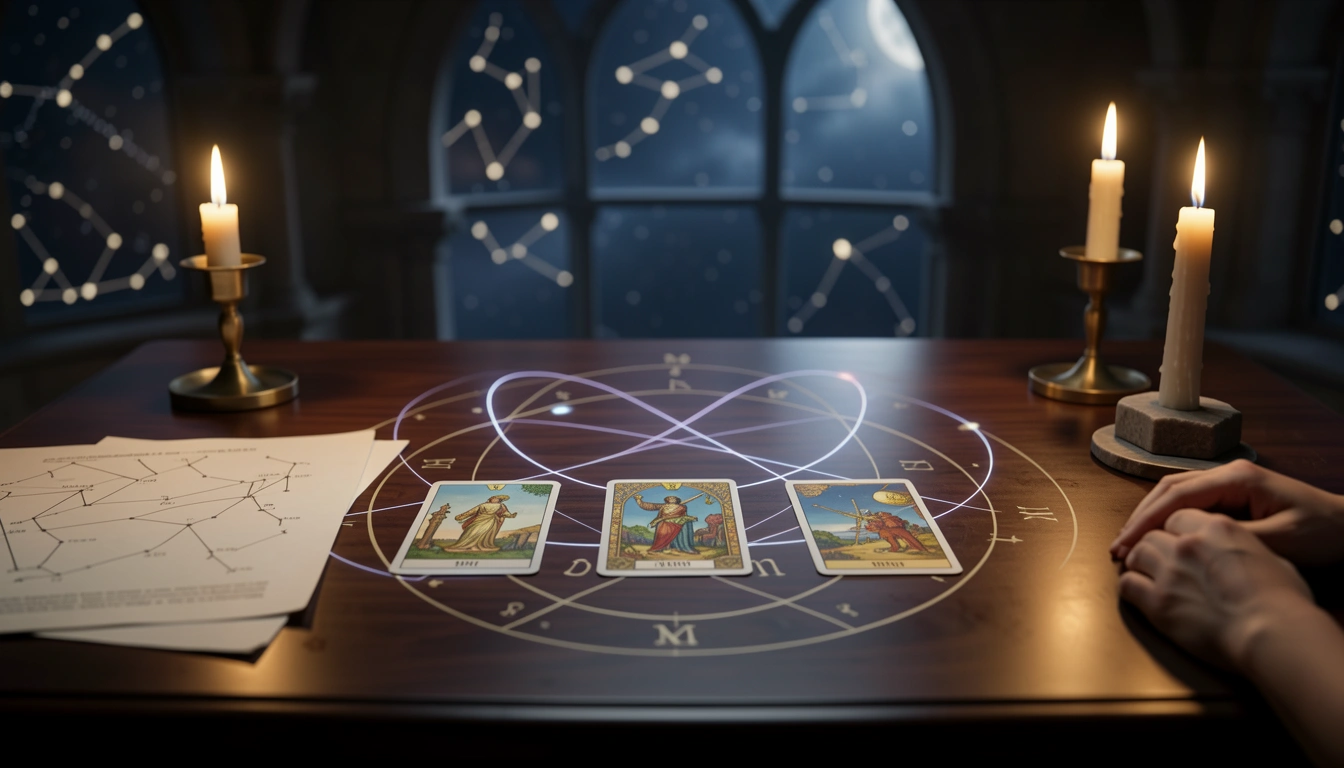
A Three Card Tarot Reading Premium Report is a structured, written interpretation of a classic three-card tarot spread, in which three cards are drawn and read in sequence to shed light on a situation you are facing right now. Rather than a single-card answer or a quick daily pull, the three-card layout gives you a narrative arc: where the situation came from, where it stands today, and where it appears to be heading. The premium report turns that arc into a considered, readable document you can return to as events unfold.
The value of this report lies in how it connects the three positions into one coherent story. Each card is interpreted on its own terms, then read in relation to the other two, so the reading shows patterns and tensions rather than isolated meanings. The report also applies the spread to the areas readers ask about most often: love and relationships, career and purpose, and the subconscious inner life and self-expression. Along the way it explains the past, present and future positions in plain language, and it places the three-card spread alongside the Celtic Cross so you can see when a simpler layout is enough and when a deeper spread may serve you better.
Delivered as an automatically generated digital report, it is designed to be practical as well as reflective. You will find guidance on how to find and interpret your own three card tarot spread, an honest look at how accurate a three card tarot reading can be, and concrete next steps for putting the insights to work. Whether you are new to tarot or have read for years, the report gives you a clear framework for working with three cards and a lasting record of what they revealed about your situation.
What Is a Three Card Tarot Reading?
A three card tarot reading is a classic spread in which three cards are drawn and laid in sequence to represent the past influences, present circumstances, and future trajectory of your current situation. It is one of the most widely used spreads because it compresses a full narrative arc—origin, condition, and outcome—into a compact, readable structure that even beginners can interpret without extensive study of the Major Arcana.
In practice, each position reframes the same question through a different lens. The first card reveals the root cause or history shaping the matter (for example, a prior decision, an unresolved pattern, or an ancestral expectation). The second card describes what is active right now—your emotional state, the dominant energy, or the immediate obstacle. The third card points toward where things are heading if the present trajectory continues. Because the three cards are read in relation to one another, a spread might show The Tower in the past position, The Hermit in the present, and The Star in the future: a story of collapse, withdrawal into solitude, and gradual hope returning.
Unlike a full Celtic Cross with ten positions, the three-card spread does not map onto specific houses of an astrological chart, yet the same interpretive logic applies. Just as a transit of Saturn square natal Moon pressures emotional foundations while a trine from Jupiter to the Midheaven eases public standing, the three tarot positions weigh tension and support across time. Readers often pair the spread with a birth chart—checking how the drawn cards echo the querent's Sun sign, lunar phase, or current transits—to ground the reading in concrete celestial context rather than abstract symbolism.
How Does a Three Card Tarot Reading Premium Report Work?
The Three Card Tarot Reading Premium Report is an auto-digital report linked to the three-card-tarot-reading tool: you draw your past, present, and future cards through the classic three-card spread, and the system compiles the result into a structured written report delivered automatically, without manual fulfillment or scheduling.
The process follows three steps. First, you focus on your current situation and draw three cards in order—past, present, future. Second, each card is interpreted in its positional context: the past card is read for root causes, the present card for active conditions, and the future card for the emerging direction. Third, the report synthesizes the three positions into a single narrative, noting how the cards reinforce or contradict one another. A spread such as the Four of Swords in the past, Seven of Cups in the present, and Knight of Cups in the future would be read as a sequence moving from forced rest, through confused desire, toward emotional action—each card conditioned by the ones beside it.
Because fulfillment mode is automatic, the report is generated and made available as soon as the reading is completed; there is no waiting period or analyst queue. The report is catalogued under SKU RPT-THREE-CARD-TAROT-READING and sits alongside YesAstrology's broader toolset, where you can cross-reference your drawn cards against your natal chart placements—such as a Gemini Mercury or a Scorpio Moon—to see whether the spread echoes current transits like a Saturn opposition or a Venus trine. Pricing for this report is not specified in the source catalog; consult the live product page for current availability.
Explore Your Personalized Three Card Tarot Reading Report
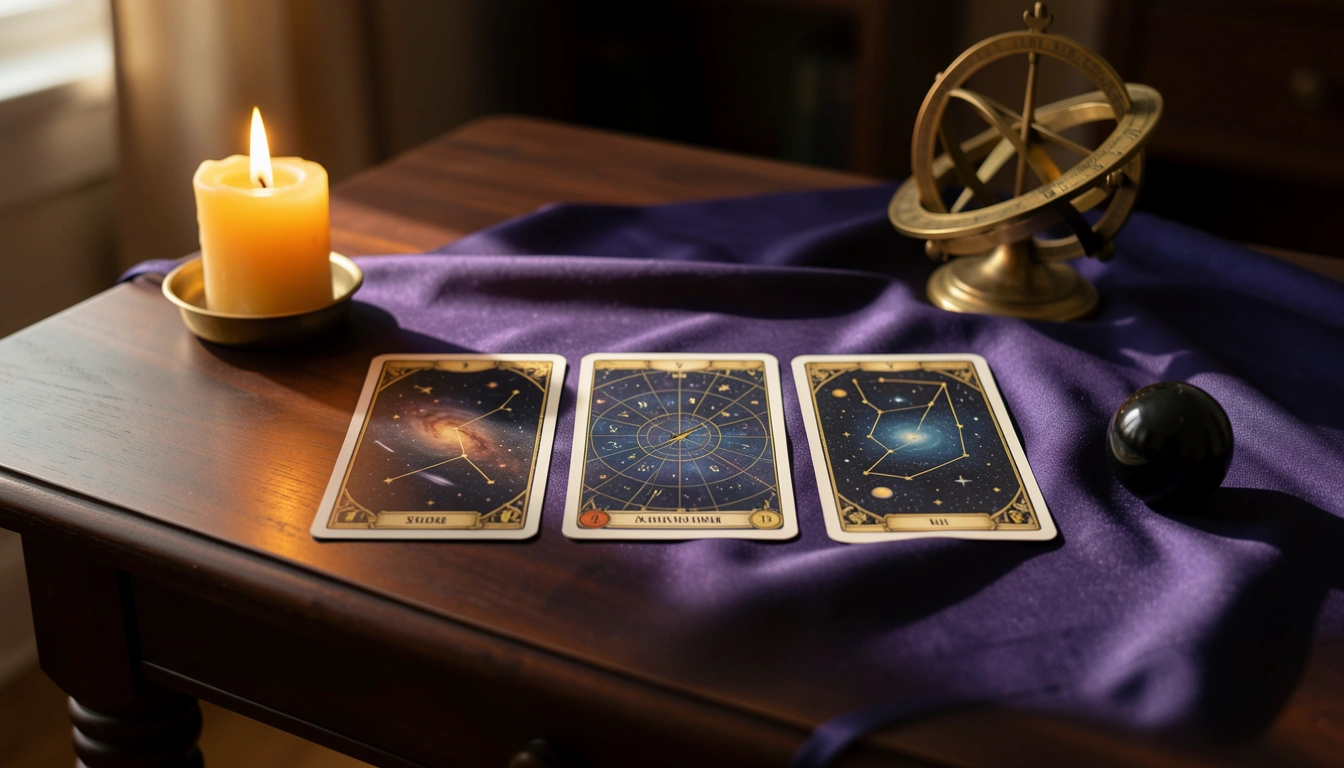
The Three Card Tarot Reading Premium Report is a digital, auto-delivered report that presents your drawn past, present, and future cards in the classic three-card spread, each interpreted in relation to your current situation. It is generated from the linked three-card tarot reading tool, so the card sequence you draw directly shapes the narrative arc of the report — from the root causes behind you, through the active present, toward the emerging trajectory ahead.
Because the spread follows a linear timeline, the report reads as a coherent story rather than three isolated meanings. The past position reveals the karmic groundwork — much like a natal Moon placement shows inherited emotional patterns — while the present card functions like a transit hitting your Ascendant, marking what is live and pressing now. The future card behaves like a secondary progression, indicating where the momentum leads if current conditions hold. For example, a Three of Swords in the past position paired with a Four of Swords in the present echoes the Saturn–Neptune dynamic of wound followed by deliberate recovery, whereas The Tower in the future slot signals an abrupt structural shift comparable to a Uranus opposition to the Midheaven.
Each card interpretation in the report cross-references elemental and planetary correspondences so you can map the spread onto your birth chart. Cups cards align with Neptune and the 4th house realm of inner life, Swords with Mercury and the 10th house of public decisions, Wands with Mars and the 5th house of creative drive, and Pentacles with Venus or the 2nd house of material security. If your natal Venus squares Saturn, a spread heavy in Pentacles will read with extra weight on commitment and constraint; if Jupiter trines your Ascendant, a court card in the future position tends to expand opportunity rather than restrict it.
The report is delivered automatically as a digital product once your draw is complete, so there is no waiting period between drawing and receiving your full interpretation. Pricing for this report is not specified in the current catalog; you can review the live product listing on YesAstrology for availability details, or explore related divination and chart tools at YesAstrology Tools.
How to Find and Interpret Your Three Card Tarot Spread
To find your Three Card Tarot Spread, open the linked three-card tarot reading tool on YesAstrology, draw your three cards in sequence, and the premium report is generated and delivered automatically in digital form. The spread is read left to right as past, present, and future — a fixed positional structure that anchors every interpretation regardless of which cards appear.
Interpreting the spread starts with positional discipline before card-by-card meaning. The first position is the past: it names the originating condition, the root event or pattern feeding the present. The second position is the present: the active situation as it stands, analogous to a transit currently applying to your chart. The third position is the future: the direction of travel if the present trajectory continues, comparable to a secondary progression unfolding over the coming months. Reading the three as a sequence — rather than as three separate answers — is what gives the spread its diagnostic power. A Magician in the past, a Seven of Pentacles in the present, and a Sun in the future traces a clear arc from initiated intent, through patient cultivation, to illumination and success.
Layer elemental and planetary correspondences onto the positions for depth. Fire cards (Wands) carry Mars and Jupiter energy and speak to initiative and expansion; Earth cards (Pentacles) carry Venus and Saturn and speak to material consolidation; Air cards (Swords) carry Mercury and speak to mental clarity or conflict; Water cards (Cups) carry the Moon and Neptune and speak to emotional current. A spread dominated by Air in the present position, for instance, mirrors a strong Mercury placement — decisions are being made on logic, not feeling — while a Water-heavy future position echoes Neptune's dissolving quality, suggesting the outcome will be shaped more by intuition and relationship than by plan. Court cards introduce a person or a mode of maturity: a Queen is receptive mastery, a Knight is active pursuit, much as a well-aspected natal Venus attracts while an unaspected Mars acts alone.
Timing cues come from the cards' numerology and from aspect logic. Numbered cards moving upward (from Two toward Ten) suggest progression comparable to a planet advancing through house cusps in Placidus or Whole Sign order; a repeated number across two positions indicates a stalled cycle, similar to a stationing planet. Major Arcana cards function like outer-planet transits — Uranus, Neptune, Pluto — marking fated or large-scale turns rather than daily weather. For a complementary look at how planetary cycles time these shifts, see the YesAstrology blog at YesAstrology Blog.
What Does Your Three Card Tarot Reading Reveal?
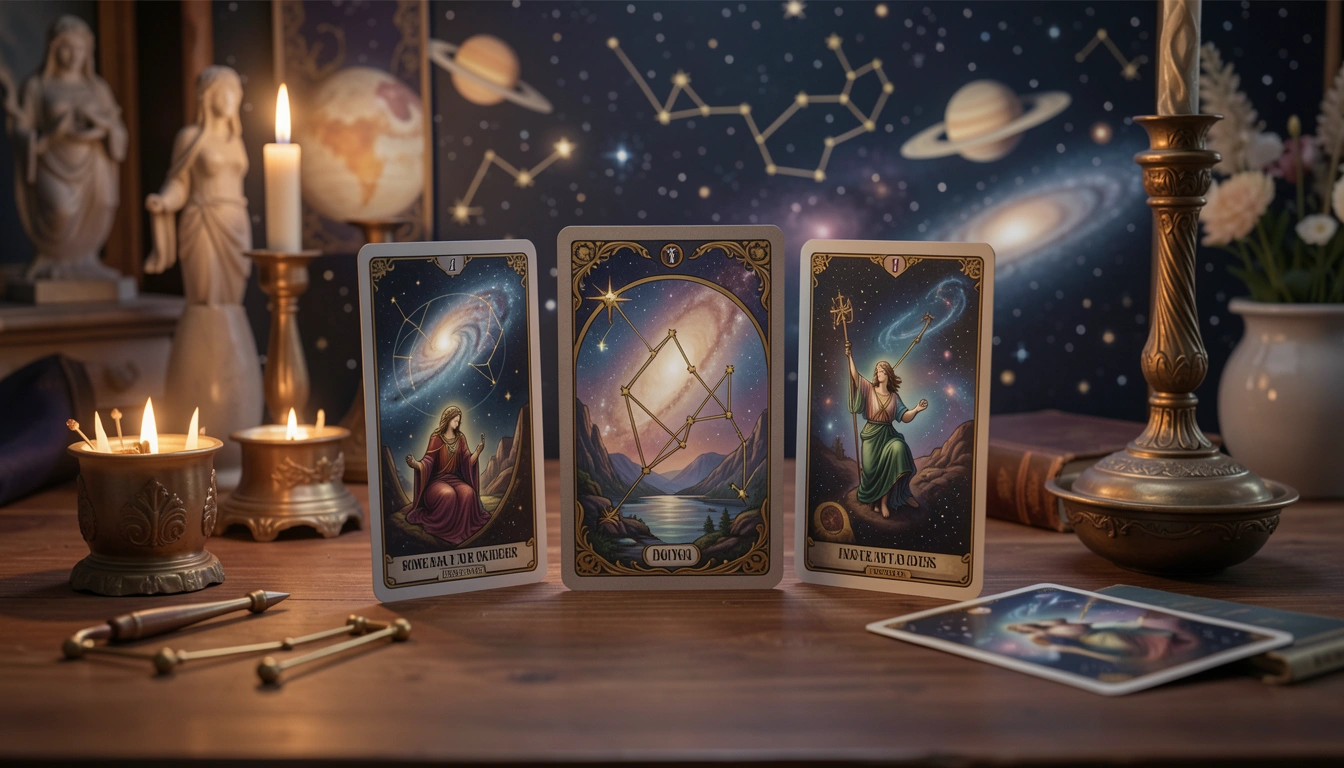
A three card tarot reading reveals the past influences, present conditions, and future trajectory of your current situation by assigning one card to each position in the classic Past–Present–Future spread. In the Three Card Tarot Reading Premium Report from YesAstrology, each drawn card is interpreted against the astrological backdrop active at the moment of your draw — the Moon's sign and phase, the day's ruling planet, and the current transits through the houses of your natal chart — so the guidance is anchored to real celestial timing rather than generic card meanings.
The first card shows what has led here: unresolved threads from earlier choices, karmic residue carried from a previous lunar cycle, or the lingering effect of a hard aspect such as Saturn square Moon in your 4th house of home and roots. The second card describes the energy you are standing in right now — for example, a card ruled by Mercury while Mercury is retrograde in your 7th house of partnerships points squarely at miscommunication in close relationships. The third card projects the likely outcome if current conditions continue, showing where the path opens if you align with the prevailing planetary flow and where it narrows if you resist it.
What distinguishes this report from a casual single-card pull is the layered synthesis: card imagery, numerology, elemental balance (Fire, Earth, Air, Water), and Major versus Minor Arcana weighting are read together. Three Major Arcanas in a row signal a fated, high-stakes period governed by outer-planet forces — Pluto, Uranus, Neptune — while a spread heavy in Pentacles (Earth) grounds the reading in 2nd-house matters of income, 6th-house daily work, or 10th-house career standing. The report also cross-references the spread against your Sun, Moon, and Rising sign so the same card reads differently for a Cancer Sun than for an Aquarius Sun.
Three Card Tarot Reading Meanings and Core Insights
Core insights in a three card tarot reading come from reading the three positions as a connected narrative rather than three isolated verdicts — the past card explains the root, the present card names the active dynamic, and the future card shows where the current vector leads. In the Three Card Tarot Reading Premium Report, every card meaning is tied to concrete astrological mechanics: a Wands card aligns with Mars and Fire-sign rulership (Aries, Leo, Sagittarius), a Cups card with the Moon and Water signs (Cancer, Scorpio, Pisces), a Swords card with Mercury and Air signs (Gemini, Libra, Aquarius), and a Pentacles card with Venus and Earth signs (Taurus, Virgo, Capricorn).
Consider a concrete example: drawing the Ten of Swords in the past position while your natal North Node sits in Libra in the 12th house suggests a completed cycle of mental exhaustion tied to a karmic lesson about releasing one-sided partnerships. Followed by the Ace of Cups in the present and the Three of Cups in the future, the spread traces a clean arc from collapse to emotional renewal through community — a trajectory reinforced if transiting Jupiter is currently trining your natal Venus. Conversely, a spread of Five of Pentacles (past), Seven of Cups (present), and Tower (future) warns that financial scarcity plus illusion is building toward a sudden structural break, especially if Pluto is squaring your 2nd-house cusp.
The report also weighs elemental and numerical patterns across the three cards. Two or more Cups indicate a Moon-ruled period where feelings outweigh facts; three Swords cards point to Mercury-driven conflict or decisions made under mental pressure. Sequential minor arcana numbers (e.g., 2–3–4) show steady progression, while a jump from 9 to 10 to a Major Arcana signals completion followed by a fated turning point. Timing is layered in through current transits, solar arc directions, and secondary progressions — a progressed Moon crossing into a new sign, for instance, typically shifts emotional tone over a two-and-a-half-year arc, marking when the future card's promise begins to manifest. For complementary practice, explore the YesAstrology Tools collection to run the draw alongside your transit calendar.
Three Card Tarot Reading and Love and Relationships
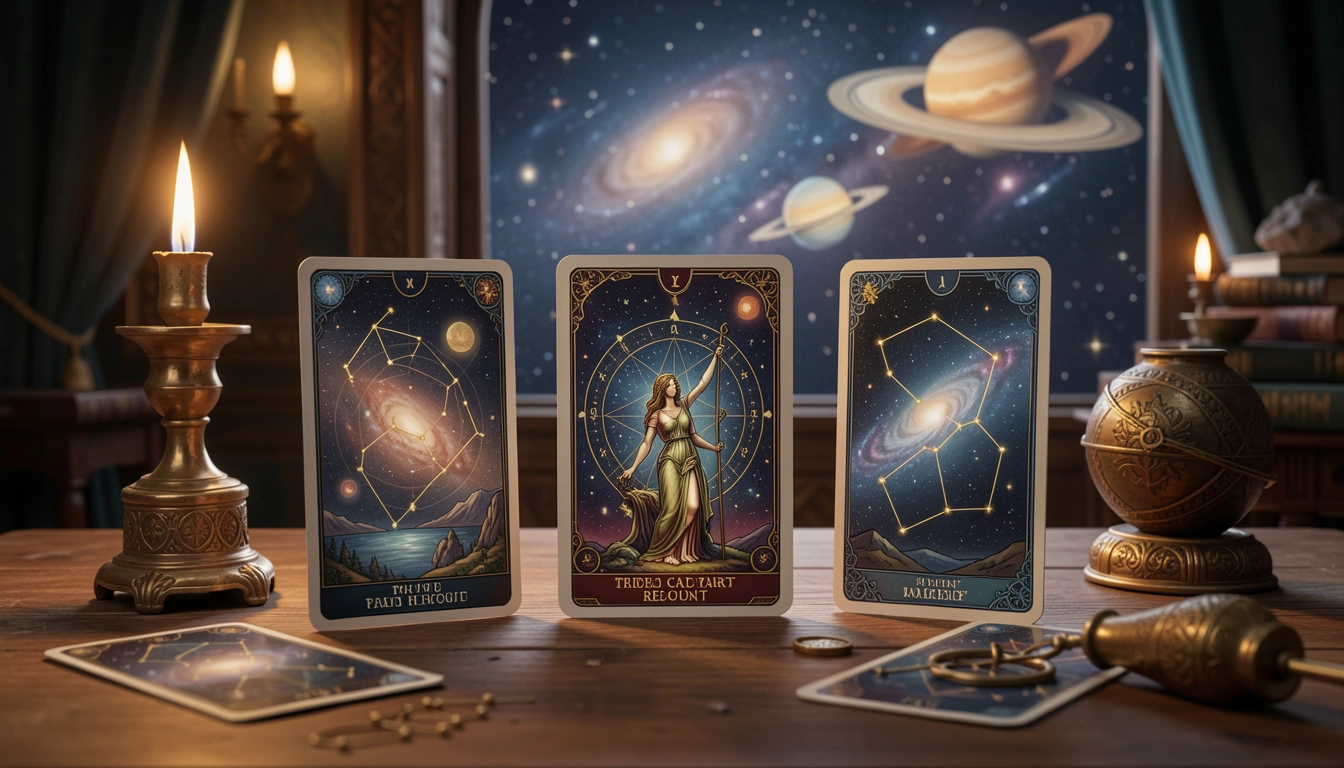
A three card tarot reading applied to love and relationships reads left to right as the emotional past, the present relational dynamic, and the near-future trajectory of the bond. The first card shows which Venus and Moon patterns — a Taurus Moon's need for security versus a Scorpio Moon's demand for depth — set the tone of how you attach today; the second card reveals the living dynamic between you, often mirroring the house placement of your Venus (5th house romance versus 7th house partnership versus 8th house intimacy); the third card points to where the current arc leads if nothing shifts.
Card combinations carry specific relational signatures. A Cups-heavy spread (Two of Cups, Queen of Hearts, Ten of Cups) echoes a Venus trine Neptune aspect — merging, idealization, spiritualized love — while a Swords-heavy spread (Three of Swords, Five of Swords) mirrors Venus square Saturn or Mars square Pluto, signaling guardedness and power struggles. Court cards usually personify a real figure: a King of Cups often maps to a Cancer, Scorpio, or Pisces Sun with strong Neptune, while a Queen of Wands points to a Leo or Sagittarius presence ruled by an expressive Sun-Jupiter dynamic.
To anchor the reading in your chart, note your Venus sign and its house. Venus in the 7th house seeks formal partnership and reads the third card as a commitment indicator; Venus in the 11th house treats friendship as the gateway to romance, so a third card like the Star or the Fool suggests the relationship evolves through shared community rather than courtship. Timing arrives through transits: when transiting Venus crosses your Descendant or trines your natal Venus, the third card's promise tends to actualize; a Venus retrograde period instead reopens the first card's history for revision. The report cross-references your drawn cards against these natal placements so the spread speaks to your specific chart rather than generic relationship advice.
Three Card Tarot Reading and Career and Purpose
In a three card tarot reading focused on career and purpose, the spread maps directly onto the tenth-house versus sixth-house versus second-house axis: the first card shows the professional history and skill set you carry (Saturn's accumulated mastery in your 10th), the second card describes your current daily work reality and job environment (6th house routines, Mercury's role in trades and communication), and the third card forecasts the direction of your professional arc — whether it points toward income growth (2nd house), public standing (10th house), or a calling that engages Chiron's wounded-healer vocational pattern.
Each card corresponds to recognizable career archetypes. Pentacles-heavy draws (Eight of Pentacles, King of Pentacles) echo a strong Taurus or Capricorn signature with Saturn or Venus in earth signs — steady craft, material results, institutional roles. Wands draws (Knight of Wands, Ace of Wands) mirror Mars in Aries or Sagittarius, favoring launches, sales, and entrepreneurial risk. Swords cards (Three of Swords, Page of Swords) often reflect Mercury in Gemini or Virgo environments — analysis, writing, negotiation — while Cups cards (Six of Cups, Queen of Cups) point to caretaking, counseling, or creative fields ruled by Neptune and the 12th house.
Timing the third card's promise relies on transits and progressions to your Midheaven. When transit Jupiter conjuncts or trines your MC, expansion and visibility arrive; when transit Saturn squares it, restructuring and earned responsibility dominate the period. A solar arc Sun moving toward your natal MC often coincides with the recognition the third card describes. If your exact birth time is uncertain, house cusps soften — the tool defaults to a solar-noon chart so planetary signs and aspects stay accurate while house-based career houses (10th, 6th, 2nd) are treated as indicative rather than exact; a birth time rectification pass can later sharpen the house assignments. The report pairs your drawn cards with these natal and timing factors to produce a career reading grounded in your actual chart mechanics.
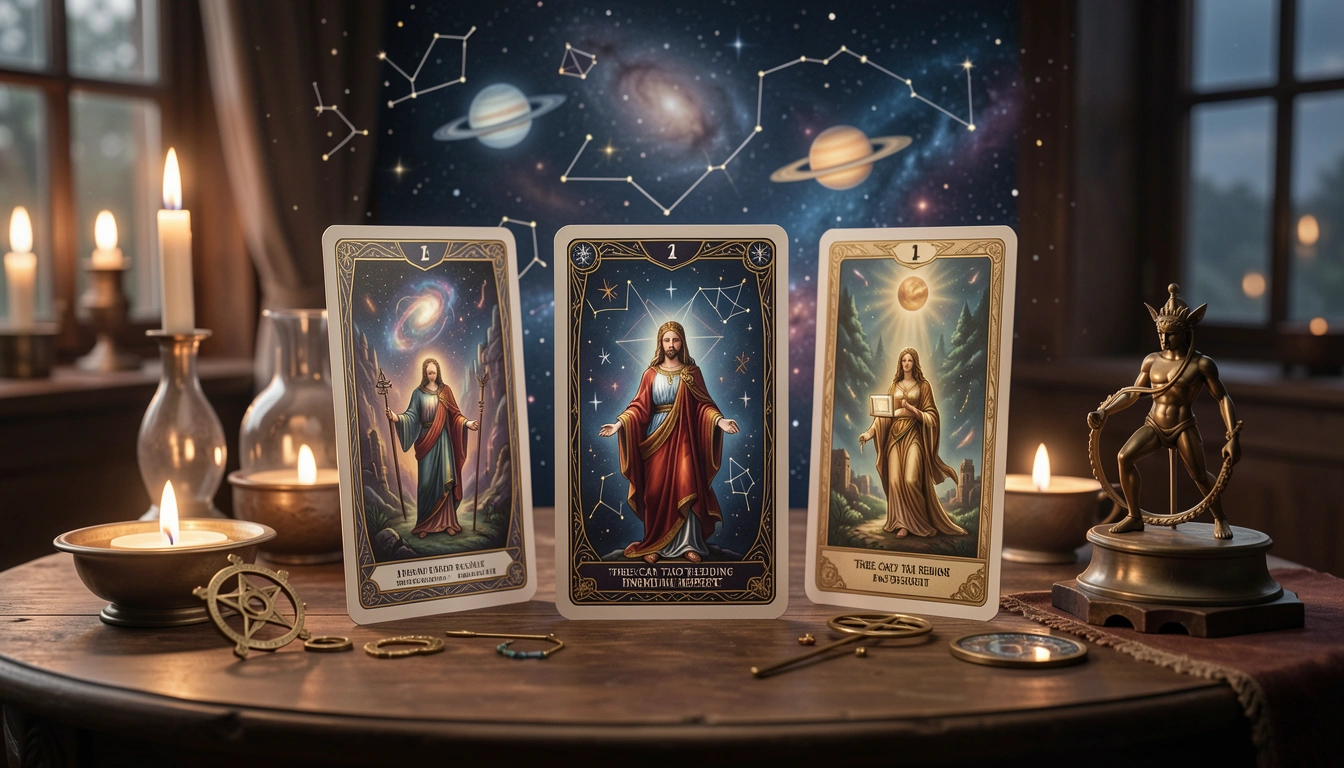
Three Card Tarot Reading and Subconscious Inner Life and Expression
A three card tarot reading illuminates your subconscious inner life by reading the spread's Cups and Moon-ruled imagery as a map of what sits beneath conscious awareness — the past card reveals emotional roots held in the 4th house and natal Moon, the present card shows the feeling-state you are currently expressing through your Ascendant, and the future card previews how that inner material wants to surface. In the Three Card Tarot Reading Premium Report, each position is cross-referenced with your chart so the cards describe not just events but the hidden psychological currents driving them.
The subconscious layer is read primarily through three factors: your natal Moon sign and house, the condition of Neptune and the 12th house, and the elemental balance of the drawn spread. A Moon in Scorpio in the 4th house, for example, carries buried intensity around family and safety that a past-position card like the Moon or the High Priestess would name directly; the same card drawn by someone with Moon in Gemini in the 3rd house instead points to racing thoughts and unspoken conversations. If Neptune squares your Sun or sits prominently in the 12th house, any Cups-heavy spread — say, Three of Cups past, Five of Cups present, Ten of Cups future — should be read with extra care, since Neptune's veil can idealize both memory and expectation.
Expression is the other half of this axis: how the inner material reaches the outer world. The 1st house Ascendant and its ruling planet show your instinctive manner of presentation, while Mercury's sign and house describe how you articulate what you feel. A spread whose present card is a Wands figure (Knight of Wands, say) during a period when Mars transits your 1st house suggests you are expressing buried energy impulsively, perhaps before you have fully understood it; the same card with Mercury in Libra trine your natal Venus would instead indicate graceful, well-timed speech. The report reads the draw against these placements so you can see whether your expression is running ahead of your awareness or finally catching up to it.
Under the hood, the report's engine computes your chart with Placidus house cusps when an exact birth time is supplied — this matters here because the 12th house cusp degree shifts minute by minute, and whether Neptune falls in your 12th versus your 1st changes the entire subconscious reading. Without a birth time, the system defaults to a solar-noon chart, preserving planetary sign and aspect accuracy (a Moon-Neptune square remains valid) while treating house attribution as approximate. Timing cycles then show when inner material surfaces: a progressed Moon crossing your natal Neptune, or a solar arc directing Venus to your Ascendant, often coincides with the moment a future-position Cups card begins manifesting in real relationships. For complementary chart context, explore the Tools directory.
The Past Present and Future Positions in Your Three Card Tarot Reading
The past, present and future positions in a three card tarot reading assign each drawn card a fixed temporal role: the first card describes the root conditions and prior events shaping your question, the second card captures the active forces at work right now, and the third card indicates the most likely trajectory if current energies continue. In the Three Card Tarot Reading Premium Report, each position is interpreted on its own terms first, then synthesized with the other two so the spread reads as one continuous narrative rather than three isolated meanings.
Each position corresponds to a distinct astrological layer. The past card mirrors completed or lingering transits — a natal Saturn square that already tested your 10th house career sector, or a South Node placement in Libra pointing to old partnership habits you inherit from prior cycles. The present card reflects the exact current sky: Venus transiting your 7th house, Mercury retrograde affecting your 3rd house communications, or Mars crossing your Midheaven. The future card behaves like a secondary progression or solar arc direction — a progressed Venus about to enter your 7th house, or a solar arc Sun approaching a trine with your natal Jupiter — showing where the pattern leads and roughly when it activates. For instance, a present-position Tower paired with Uranus currently conjunct your natal Moon describes the same disruption from two angles, while a future-position Wheel of Fortune aligns naturally with Jupiter's upcoming transit through your 9th house of expansion.
Positional reading also depends on house context, which is why exact birth time matters. With an exact time, the report computes Placidus cusps so a card tied to your 2nd house of income can be distinguished from one tied to your 10th house of public standing — a Page of Pentacles in the future position reads as a modest income opportunity under the 2nd house but as a career apprenticeship under the 10th. Without a birth time, the engine defaults to a solar-noon chart, keeping sign and aspect accuracy intact (a Sun in Capricorn square Mars in Aries stays correctly computed) while flagging house-specific attribution as approximate. Timing for the future card is then refined through transits, solar arcs, and progressions: a progressed Moon entering your 4th house might activate a Home-themed future card in a particular season, while a Saturn transit to your 7th house cusp would delay a relationship outcome the cards otherwise promise.
Read the sequence for movement, not just content. A spread progressing from heavy cards in the past (Death, Ten of Swords) to lighter ones in the future (Sun, World) signals release and recovery; the reverse warns that a stable present is eroding. Elemental flow matters too — a Cups-heavy past giving way to a Swords-heavy future marks a shift from emotional attachment to decisive clarity, much as a natal Moon trine Neptune softens into a Mercury-Saturn square demanding honest speech. The report walks through each card's rank, suit, and position, then ties the arc back to your chart so the three positions resolve into a single, dated-in-timing statement about where you have been, where you are, and where you are heading.
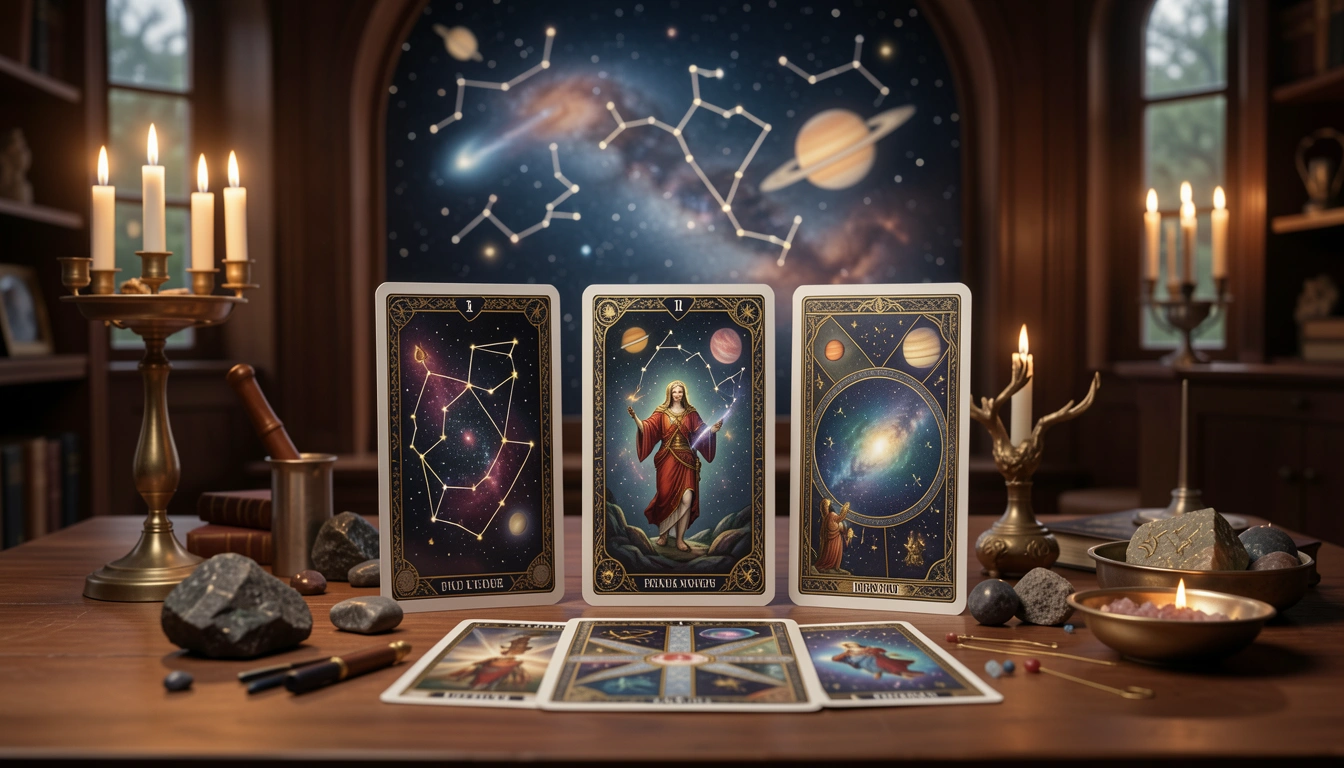
Three Card Tarot Reading vs Celtic Cross Tarot Reading
A three card tarot reading and a Celtic Cross tarot reading differ in scale, focus, and interpretive demand: the three-card spread compresses a situation into past, present, and future positions for a focused question, while the Celtic Cross lays out ten cards covering your core situation, conscious and unconscious influences, environmental context, near outcome, and the deeper arc across five to six additional positions. The three-card spread answers "what is happening with this specific matter right now and where is it going," whereas the Celtic Cross answers "give me the full architecture of my life situation at this moment." The Three Card Tarot Reading Premium Report is built for the former — a structured, readable narrative rather than a ten-card web of cross-currents.
The interpretive mechanics diverge sharply. In a three-card draw, each card must relate to only two neighbors, so the narrative stays linear: a Ten of Swords in the past position feeding into a Six of Wands in the future position reads as a clean recovery arc. In a Celtic Cross, the fifth card (the likely outcome) must be reconciled with the tenth card (the overarching theme), and the fourth and sixth cards (the recent past and near future) form a horizontal axis that can contradict the vertical axis of cards two and three — much like a natal chart where a square between Saturn in your 10th house and your Moon in the 4th house creates tension between career demands and domestic needs that no single position can resolve alone. Beginners often misread the Celtic Cross because of this cross-axis complexity; the three-card spread avoids it by design.
Astrologically, the two spreads map onto different chart techniques. The three-card spread behaves like a transit reading — a snapshot of the current sky acting on your natal placements, such as Venus transiting your 7th house of partnerships right now. The Celtic Cross behaves more like a full natal chart synthesis, where house cusps computed with the Placidus system, aspect patterns between your Sun, Moon, and Saturn, and nodal axis placements all need to be weighed simultaneously. If your exact birth time is known, the report's engine fixes your Midheaven degree precisely; if not, it defaults to a solar-noon chart that preserves planetary sign and aspect accuracy while treating house attribution as approximate — a fallback that suits the three-card spread's situational focus better than the Celtic Cross's demand for detailed house-by-house mapping. For readers who want to compare spread mechanics directly, the Tools directory pairs the three-card draw with complementary timing calculators.
Practically, choose the three-card spread when you have a live decision or an unresolved question — whether a relationship will stabilize, why a job search has stalled, what is blocking a move. Choose the Celtic Cross when you need a broad life audit and have the interpretive stamina to hold ten symbols at once. The Three Card Tarot Reading Premium Report delivers the compact version: three cards, three positions, one coherent story, cross-referenced against your planetary placements and zodiac correspondences so the narrative carries astrological weight without the density of a ten-card layout.
How Accurate Is a Three Card Tarot Reading?
A three card tarot reading is accurate as a reflective decision-making tool when the spread is drawn with a clear question and read through the fixed past–present–future structure — accuracy comes from coherence between the three positions, not from supernatural certainty. The first card shows the root cause or preceding conditions, the second describes the current energetic state, and the third projects the likely trajectory if present tendencies continue unchanged. The Three Card Tarot Reading Premium Report treats the spread as a structured snapshot of momentum rather than an unchangeable decree, which is precisely what makes its readings dependable enough to act on.
From an astrological standpoint, the three positions mirror how a natal chart unfolds through time. The past card corresponds to conditions set by your natal Moon and 4th house roots; the present card reflects the transiting Sun or current lunar phase acting on your 1st house self; the future card behaves like a secondary progression or solar arc direction, showing where the pattern leads. For example, if the present card lands upright in a fire suit while Mars transits your 10th house, the reading often points to visible career initiative, whereas a reversed water card during a Saturn square to your natal Venus would suggest emotional withholding that must be resolved first. A spread drawn while Mercury is retrograde in Gemini will more often surface blocked or reversed cards in the present slot, mirroring the 3rd house themes of unfinished conversations.
The Premium Report deepens accuracy by cross-referencing each card position against your birth chart factors: house cusps are computed with the Placidus system when an exact birth time is available, Whole Sign serves as a fallback, and a solar-noon chart default preserves planetary sign and aspect accuracy even when the birth time is unknown — so a Sun in Capricorn square Mars in Aries remains correctly computed regardless. Timing for when the third card's outcome activates is estimated from transit hits, solar arc contacts, and secondary progressions to the angles, so you see not just what may happen but roughly which planetary cycle triggers it. A future card aligning with Jupiter trine your Midheaven typically indicates an outcome arriving with ease, while a hard Saturn square suggests the same outcome requires sustained effort across months rather than weeks.
Readings are most reliable for pattern recognition and less reliable as fixed prophecy. Two people with the same present card — say, The Tower — will experience it differently depending on whether Uranus is conjunct their natal Moon (sudden domestic disruption) or whether the card appears during a period when no major outer-planet aspect is active (a smaller, more personal shake-up). The report's accuracy section also addresses common misconceptions: the future card is a probable outcome conditioned on present choices, much as a transit of Saturn through your 10th house describes a window of career pressure whose expression depends on whether you meet its demands. Used this way, the three-card spread functions as a reliable mirror of current dynamics rather than a crystal ball.
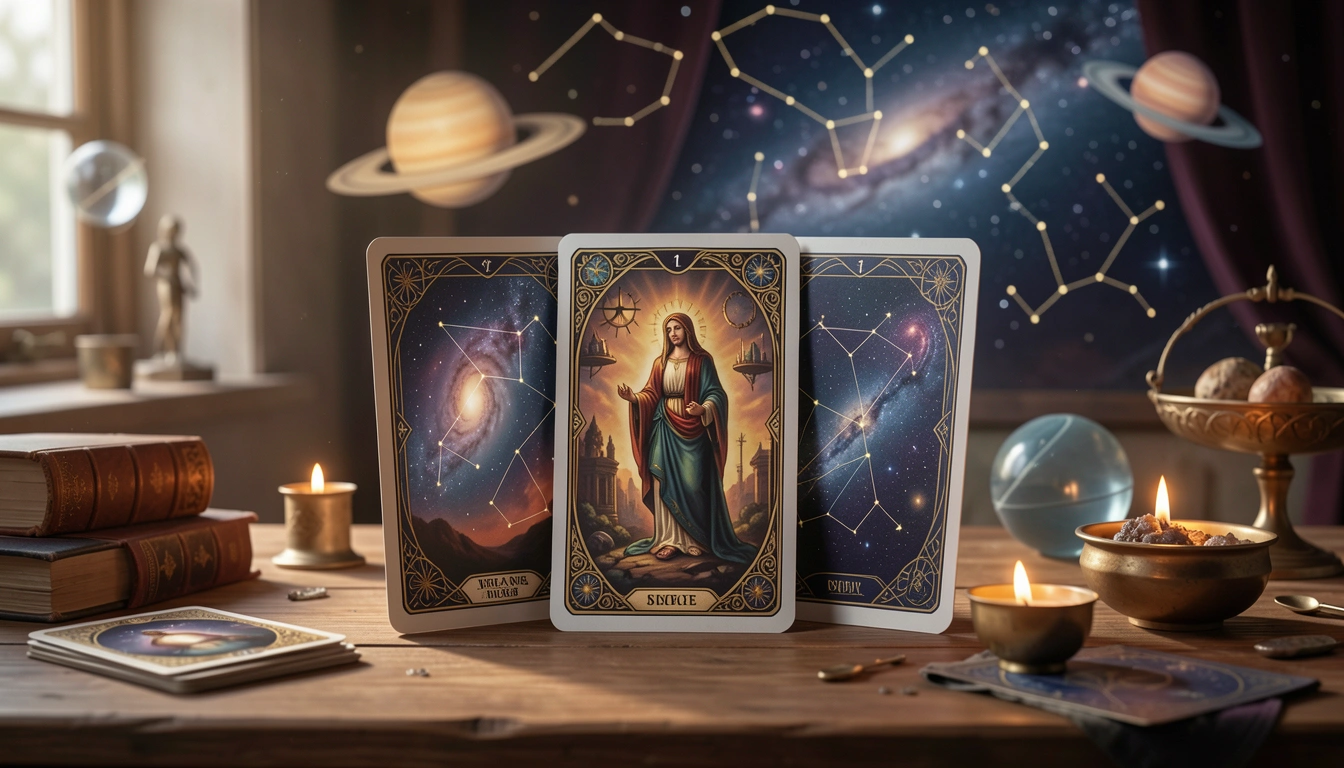
Practical Advice and Next Steps for Your Three Card Tarot Reading
The practical next step after a three card tarot reading is to read the spread as one connected narrative — past, present, future — and convert each position into a single concrete action you can take within the current lunar cycle. Start with the past card as context, treat the present card as the active dynamic you must respond to now, and read the future card as a probable trajectory conditioned on what you do with the present, not as a fixed verdict.
Work through the spread position by position before acting. If the past card is a heavy Saturn-ruled archetype such as the Devil or a reversed Tower, journal about the restriction you internalized — often traceable to a 4th house family pattern or a natal Moon–Saturn aspect. If the present card lands in a fire suit like Wands while Mars is transiting your 6th house of daily work, the restlessness you feel in routine is the card and the sky describing the same thing; choose one grounding action to rebalance it. A present-position Swords card under a Mercury–Saturn square, by contrast, calls for transparent communication rather than impulse.
Then anchor the future card to timing. Cross-reference it against active cycles: a future-position Wheel of Fortune aligns with Jupiter transiting your 9th house of expansion, while a future-position Pentacles card under Saturn in your 10th house points to slow, earned consolidation rather than a sudden turn. Track your follow-up draws against the Moon's phases — set intentions at the New Moon, act on the waxing Moon, review at the Full Moon, release at the Waning Moon — across three consecutive lunations, so the spread's promise takes root in measurable behavior. If you need the underlying chart mechanics to date the activation, house cusps are computed with the Placidus system when an exact birth time is supplied, and a solar-noon chart default preserves planetary sign and aspect accuracy when the birth time is unknown, with house attribution treated as approximate. You can pair your draw with complementary calculators in the Tools directory to time the future card's window.
Frequently asked questions
The report is a written interpretation of your three-card spread. It explains each card in its position, reads the three cards as a connected narrative, and applies the reading to love and relationships, career and purpose, and your subconscious inner life and self-expression.
You draw your past, present and future cards using the three card tarot reading tool, and the premium report is generated automatically as a digital document. It is delivered without manual waiting, since the product is fulfilled as an automatic digital report.
The first card shows the background and influences that led to where you are, the second card describes the situation as it currently stands, and the third card points to the direction things are moving if the present course continues.
A three card spread is compact and focused, making it well suited to a specific question or a quick look at a situation. The Celtic Cross uses ten cards and gives a far more detailed picture, covering influences, obstacles, hopes and outcomes in greater depth.
Yes. The same spread is interpreted for career and purpose, so the cards can speak to your professional direction, the forces shaping your work life, and the path opening ahead of you.
Tarot offers guidance rather than fixed prediction. A three card reading is most useful when you approach it with a clear question and read the cards as a framework for reflection, then check the insights against your own judgement as events develop.
The report closes with practical advice: note which card resonated most strongly, revisit the reading after a few weeks to.
Calculations are grounded in high-precision Swiss Ephemeris astronomical data combined with comprehensive astrological synthesis for accurate planetary coordinates.
Yes. Active members (Basic, Pro, Max) automatically receive an additional 3% to 10% discount on all astrology reports directly at checkout.
Share this page
Recommended reports
Discover three more reports selected for this reading.
Astrology Calculators
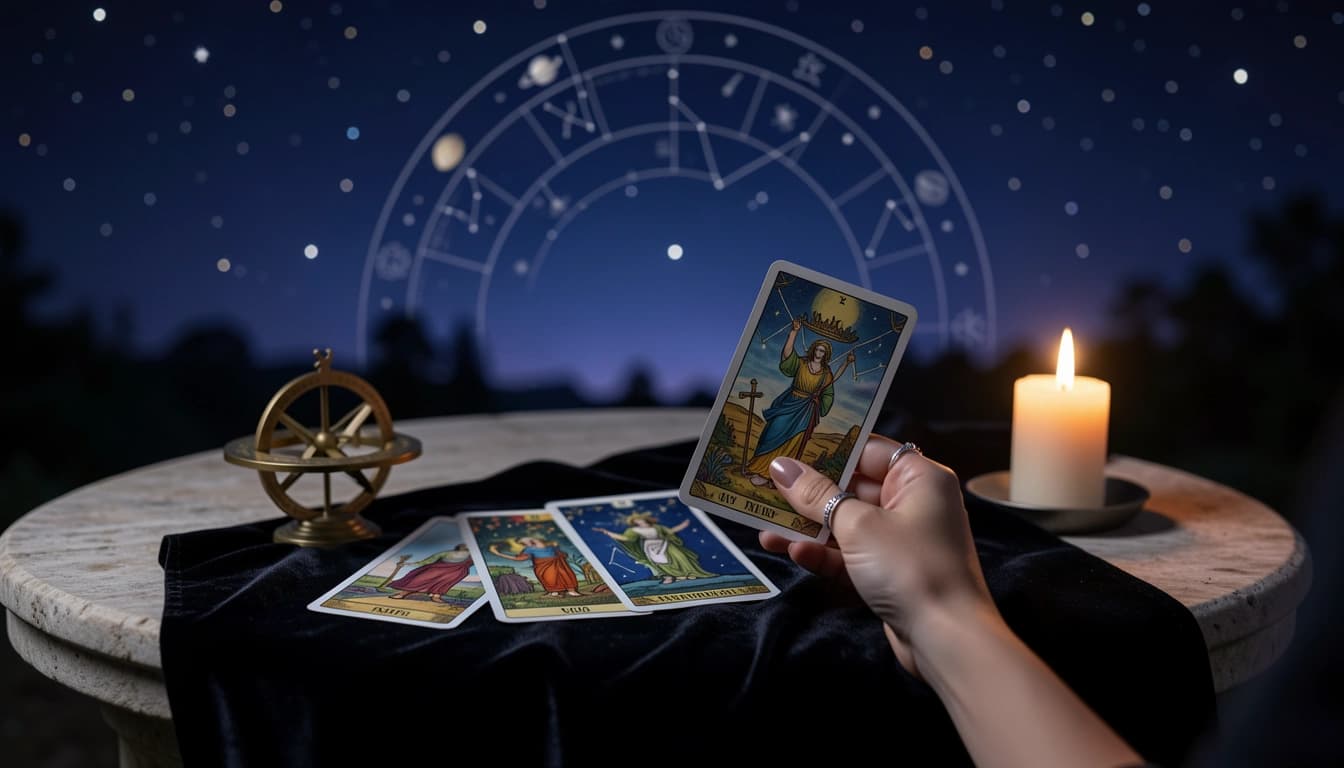 Calculator
Three Card Tarot Reading
Draw past, present and future tarot cards in a classic three-card spread for guidance on your current situation. Free, instant, no sign-up required.
Open calculator Calculator
Astrocartography Chart Calculator (Astro Map) Calculator
Generate your free astrocartography chart to see how locations worldwide influence your natal chart. Calculate your astrology chart online for instant.
Open calculator- Astrocartography City Finder CalculatorCalculator
Astrocartography City Finder Calculator
Rank 2–5 selected cities by the closest planetary MC/IC meridian and compare their relocated chart angles and house assignments.
Open calculator
Astrology Guides
 Blog
BlogWhat Your Birth Chart Says About Your Career Success
Discover how your birth chart reveals career success through the 10th house, 2nd house, planetary dignities, and vocational indicators. A complete guide.
Read more Blog
BlogWhy You Feel Different After Moving: Astrocartography and Relocation Astrology
Discover why moving changes how you feel. Learn how astrocartography and relocation astrology map planetary lines to your new home, identity, and life...
Read more Blog
BlogEmpty Houses in Astrology: Do They Mean Something Is Missing From Your Life?
Empty houses in astrology do not mean something is missing. Learn how to find them, read their ruling planets, and understand what a blank house truly says.
Read more