On this page
The Celtic Cross is one of the most iconic and comprehensive tarot spreads ever devised. Unlike simple three-card past-present-future layouts, this ten-card structure maps out the full narrative of a situation: what is happening now, what lies beneath the surface, what challenges block your path, and where events are headed. A Free Celtic Cross Tarot Reading gives you immediate access to this powerful interpretive framework without cost or sign-up.
Each of the ten positions answers a specific question about your life. The centre cross represents your current circumstances and the immediate challenge. The staff to the right traces the timeline from your past through to the likely future. The final four cards explore your inner world: your conscious goals, your environment, your hopes and fears, and the eventual outcome. Together they form a complete psychic map.
This article explains every card position in detail, shows you how to interpret the spread for love and career, and gives you step-by-step guidance to perform your own reading. Whether you are a beginner or an experienced reader, the Celtic Cross rewards deep study. You can start your free reading right now or read on to master the art.
For further reading, you can also explore Tarot Readings — Single, Three-Card & Yes-No.
What Is a Celtic Cross Tarot Reading?
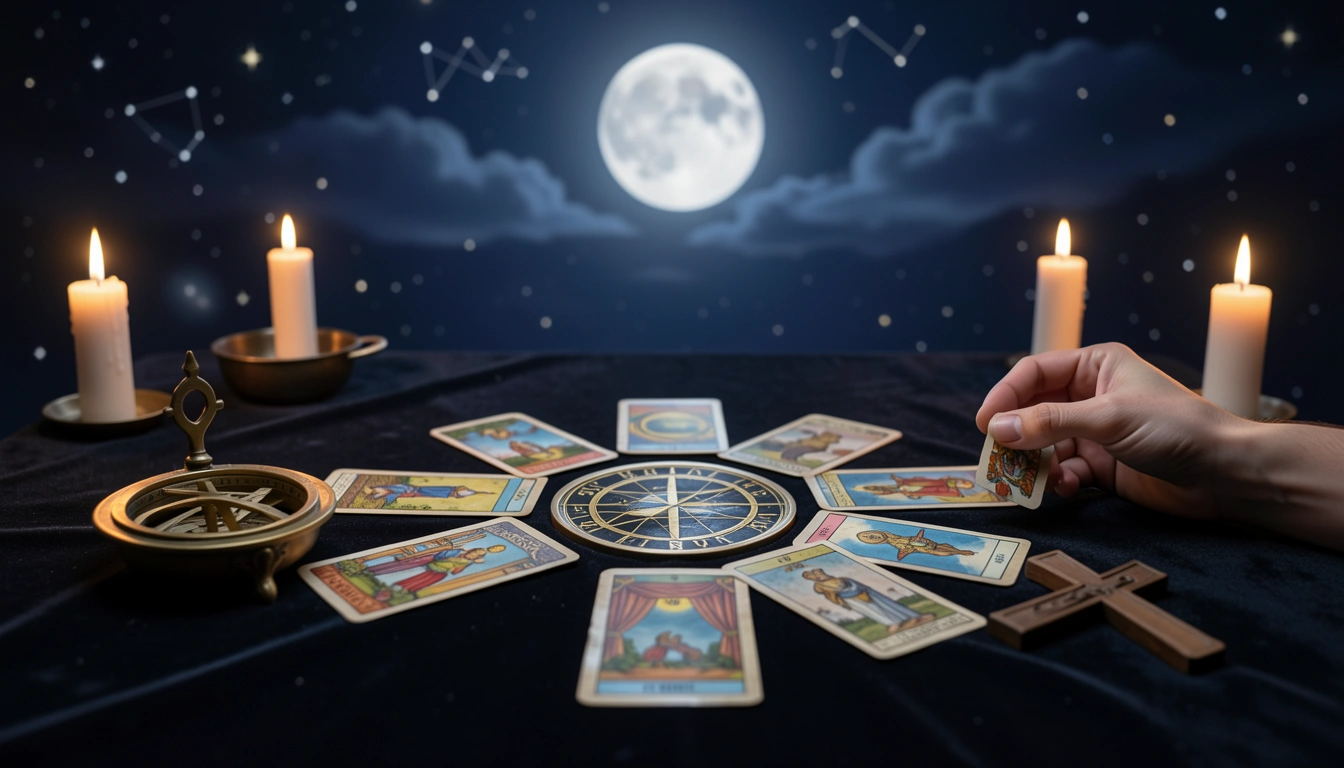
The Celtic Cross tarot spread dates back to at least the early 20th century and was popularised by the Rider-Waite-Smith deck. It uses ten cards arranged in a distinct cross-and-staff pattern. The first six cards form a cross: the centre card represents the present situation, the card crossing it signifies the immediate challenge, the card below is the foundation, the card to the left is the past, the card above represents the conscious goal, and the card to the right shows the future. The remaining four cards are placed vertically along the right side of the cross, representing the querent's inner state, external environment, hopes and fears, and the final outcome.
Unlike simpler spreads, the Celtic Cross does not assume a linear timeline. Instead it layers multiple dimensions: what is visible versus what is hidden, what you control versus what influences you, and where your soul is heading. This makes it exceptionally useful for complex life questions about relationships, career changes, and personal growth.
The reading is non-judgemental. No card is inherently good or bad; each carries both light and shadow meanings. A skilled reader considers card positions, neighbouring cards, and the overall narrative flow. With a Free Celtic Cross Tarot Reading, the interpretation is generated algorithmically but follows the same traditional positional meanings.
Origins of the Celtic Cross
The spread's name evokes Celtic mysticism, but there is no direct evidence that ancient Druids used it. The first known printed description appears in Arthur Edward Waite's 1910 book The Pictorial Key to the Tarot. Waite, who co-created the Rider-Waite-Smith deck, described a ten-card layout that he called the 'Celtic Cross'. His version placed card 1 on the left and card 2 crossing it horizontally, with the remaining cards arranged in a line to the right. Over time, readers adapted the layout to the familiar cross shape we use today.
Despite the uncertain historical origin, the spread has proven remarkably durable. Its blend of temporal and psychological layers gives it a depth that simpler spreads lack. Many professional readers still use the Celtic Cross as their primary tool for comprehensive consultations.
What Makes It Different from Other Spreads
The Celtic Cross covers ten distinct angles on one question. Compare this to a three-card spread (past, present, future) or a one-card daily draw. The added positions allow you to see hidden obstacles, unconscious influences, and the likely trajectory of events. It also includes a position for external influences – other people, institutions, or unexpected factors – which many simpler spreads omit entirely.
This depth comes with complexity. Interpreting ten cards takes practice, especially when reversed cards, court cards, and major arcana enter the mix. But the payoff is a reading that feels like a complete story rather than a fragment. For anyone facing a major decision, the Celtic Cross provides clarity that smaller spreads cannot match.
Start Your Free Celtic Cross Tarot Reading
You do not need any special equipment or prior experience to begin. Visit the Free Celtic Cross Tarot Reading page on YesAstrology, where the tool will shuffle a digital deck and deal ten cards into the traditional positions. Each card is displayed with its name, elemental association, and upright or reversed orientation. You can choose to interpret the cards yourself using the guide below, or read the automated interpretation that appears after the draw.
The reading is completely free and does not require registration. You can repeat it as often as you like, though it is best to focus on one question per session for clarity. The tool uses a standard 78-card Rider-Waite-Smith deck, so all Major Arcana and Minor Arcana cards are included. Reversals are enabled by default, adding nuance to the meanings. If you prefer only upright cards, you can toggle that option before drawing.
To get the most out of your reading, take a moment to centre yourself before clicking the draw button. Hold your question in mind, or simply ask for guidance about your current life path. The cards respond to the energy you bring. Once the spread appears, read the positions in order: begin with card 1 (present) and proceed to card 10 (outcome).
What to Focus On While Drawing
The most effective readings happen when you ask a specific, open-ended question. Instead of 'Will I get the job?', try 'What do I need to know about my career path right now?' Open questions allow the spread to reveal influences you may not have considered. It also helps to write your question down before you draw.
If you have no particular question, simply asking 'What message do I most need to hear today?' works beautifully. The Celtic Cross is flexible enough to address general life themes. Avoid asking the same question repeatedly in a short period; the cards may become repetitive or confusing. Give yourself at least a day between readings on the same topic.
Interpreting the Automated Reading
YesAstrology's automated interpretation draws on traditional meanings for each card in each position. It considers card element, number, and whether the card is reversed. For example, The Tower reversed in the challenge position suggests resistance to necessary change, while the same card upright might indicate an unavoidable upheaval. The algorithm also factors in the relationship between cards – for instance, the presence of many Cups suggests emotional themes, while many Wands points to action and ambition.
Automated readings are a great starting point, but they cannot replace human intuition. Use the automated text as a prompt for your own reflection. Notice which parts resonate and which feel off. Your personal context always matters more than a generic interpretation.
How Does the Celtic Cross Spread Work?
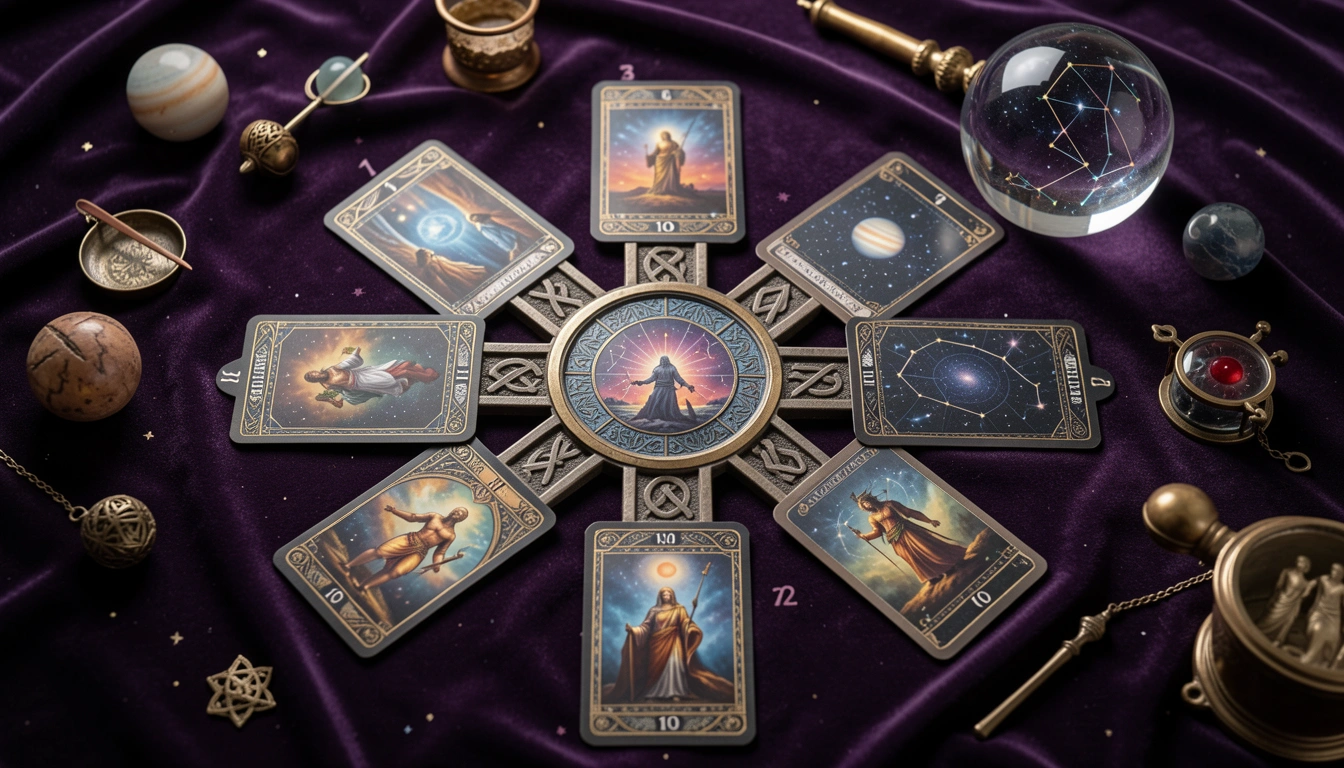
The geometry of the Celtic Cross is not random. The central cross (cards 1 to 6) represents the conscious and unconscious forces active at the moment of the reading. The vertical line of the cross – cards 1, 3, and 5 – shows the core issue: present situation, foundation, and conscious goal. The horizontal line – cards 2, 4, and 6 – shows the timing and influences: challenge, past, and future. The staff (cards 7 to 10) adds depth: the querent's inner state, external environment, hopes and fears, and final outcome.
When you draw the cards, each one interacts with its neighbours. For example, card 3 (foundation) directly supports card 1 (present). If card 3 shows the Ten of Pentacles, the present foundation is stable and family-oriented. If it shows the Five of Cups, the foundation is tied to loss or regret. Similarly, card 2 (challenge) crosses card 1, representing a barrier or conflict affecting the present moment.
The staff cards are read in sequence: they show a progression from inner to outer to final. Card 7 (self) reveals how you see yourself within the situation. Card 8 (environment) shows how others or external factors shape events. Card 9 (hopes and fears) exposes your emotional investment. Finally, card 10 (outcome) suggests where the energy is heading if current trends continue.
Why the Positions Matter
Each position has a fixed meaning, but the specific card that falls there modifies that meaning. The same card can appear positive in one position and challenging in another. For instance, The Magician in card 5 (conscious goal) suggests you have all the tools to achieve your aim. In card 9 (hopes and fears), it might indicate a fear of not being resourceful enough. Always read the card through the lens of its position.
The position order is deliberate. The cross is read first because it sets the stage. Then the staff reveals the personal and external layers. Many readers find that card 10 (outcome) is often a surprise that reframes the entire reading. It is not a fixed destiny, but a probable trajectory based on the energy of the other nine cards.
The Interplay of Elements
Tarot cards are associated with four elements: Wands (Fire), Cups (Water), Swords (Air), and Pentacles (Earth). Major Arcana cards can be assigned elements based on astrological correspondence (e.g., Strength is Fire, The Moon is Water). When the spread has an even distribution of elements, it suggests balance. A dominance of Fire indicates passion or conflict; too much Water suggests emotional overwhelm; heavy Air points to mental chatter; and excess Earth may mean stagnation or materialism.
Elemental imbalances are not bad – they simply highlight the area of life that needs attention. A spread with many Cups in the staff positions (cards 7-10) indicates that emotions will heavily influence the outcome. A spread with many Swords in the cross suggests that thoughts and decisions are central to the situation.
How to Read the Ten Tarot Card Positions
Reading a ten-card spread can feel overwhelming at first. The key is to take it one position at a time. Start with card 1 (Present) and card 2 (Challenge) because they form the core conflict. Then read downward to card 3 (Foundation), then left to card 4 (Past), then up to card 5 (Goal), and finally right to card 6 (Future). After the cross is understood, move to the staff: card 7 (Self), 8 (Environment), 9 (Hopes and Fears), and 10 (Outcome). This order mirrors the natural flow of a story: what is happening, what is blocking it, what lies beneath, what came before, what you want, where you are going, who you are, who is around you, what you feel, and how it ends.
Pay special attention to repeated numbers, suits, and themes. If the same card appears in multiple positions (very rare but possible), it carries amplified energy. If several Major Arcana cards appear, the reading has a fated or karmic quality. Court cards often represent specific people – Page for youth or messages, Knight for action, Queen for nurturing or authority, King for mastery or control.
Reversed cards are read as blocked, internalised, or unbalanced expressions of the upright meaning. For example, reversed Justice may indicate avoidance of accountability, while upright Justice suggests fairness and legal resolutions. Reversals add a rich layer that makes the Celtic Cross especially powerful for personal growth readings.
A Quick Reference for Each Position
| Position | Name | What It Reveals |
|---|---|---|
| 1 | Present | Current situation, the main energy now |
| 2 | Challenge | Immediate obstacle or opposing force |
| 3 | Foundation | Root cause or unconscious influence |
| 4 | Past | Recent events that led here |
| 5 | Goal | Conscious intention or ideal outcome |
| 6 | Future | Near-future trajectory |
| 7 | Self | Your inner state, self-image |
| 8 | Environment | External people, place, or influences |
| 9 | Hopes and Fears | Emotional investment, deepest hopes and anxieties |
| 10 | Outcome | Probable result based on current energy |
Common Mistakes When Reading All Ten Cards
One mistake is reading each card in isolation. The Celtic Cross is a web. Card 4 (Past) is not just a random past event; it specifically led to card 1 (Present). Card 6 (Future) is the likely result of the challenge (card 2) not being resolved. Always ask: how does this card connect to the ones around it?
Another mistake is jumping to card 10 (Outcome) first. The outcome depends on the other nine cards. If you read it too early, you may force the rest of the interpretation to fit. Let the story unfold naturally from positions 1 through 9, and then see what card 10 has to say.
The Present Situation and Current Energy
Card 1, the centre of the cross, represents the present moment. It is the energy that surrounds you right now, the atmosphere of your life. This card may confirm what you already know, or it may reveal an overlooked layer. For example, if you drew the Two of Swords, it suggests a present situation of stalemate or difficult choice. The Eight of Pentacles indicates diligent work and skill-building. The Empress points to creativity, nurturing, or abundance.
This card is the anchor of the reading. All other positions relate back to it. When interpreting, ask yourself: 'How does this card describe my current reality?' Be honest – if you drew the Three of Swords (heartbreak) and you are not in obvious pain, consider that the pain may be subconscious or that it relates to a different area of life than you expected.
The element of card 1 sets the tone. Fire cards (Wands) signal action and passion. Water cards (Cups) signal emotion and relationships. Air cards (Swords) signal thought, struggle, or decisions. Earth cards (Pentacles) signal material matters, health, or work. Major Arcana indicates a significant life chapter or spiritual lesson unfolding now.
How Card 1 Interacts with Card 2 (Challenge)
The challenge card literally crosses the present card, forming an obstacle. If the present card is the Sun (joy, success) and the challenge is the Devil (addiction, bondage), the reading suggests that even in a happy situation there is a hidden trap or unhealthy attachment. The two cards must be reconciled. The question becomes: how can you enjoy the present without falling into the shadow represented by the challenge?
If both cards are from the same suit, the challenge is internal to the situation. Two Cups suggest emotional entanglement; two Wands suggest a power struggle or competition. If they are from different elements, the challenge comes from an external or contrasting energy.
For further reading, you can also explore Celtic Cross Tarot Reading Premium Analysis Report.
Challenges, Obstacles and Crossing Influences
Card 2 is placed horizontally across card 1, creating a cross. It represents the immediate challenge, barrier, or opposing force that must be acknowledged. This is not necessarily a negative card; a 'positive' card in this position can indicate an obstacle in the form of excess energy. For instance, the Knight of Wands in the challenge position may suggest impulsive action that disrupts stability, even though the Knight is generally a card of adventure.
This card often reflects what you are resisting. If you drew the Nine of Swords, the challenge may be anxiety or insomnia. If you drew the Five of Pentacles, it could be financial hardship or exclusion. The challenge is not permanent – it is the thing that, once understood, can be worked with or overcome. The reading will offer clues through the other positions.
Reversed cards here intensify the internal nature of the obstacle. A reversed King of Swords might indicate a struggle with authoritative thinking or a lack of mental clarity. The challenge position deserves careful thought because it shapes the direction of the entire reading.
Turning Challenges into Allies
Every challenge card carries a gift. For example, the Tower card (often feared) in the challenge position indicates that the obstacle is a necessary shattering of false structures. The gift is liberation. The Moon card suggests that fear of the unknown is the challenge, and the gift is deep intuition. To discover the gift, look at the card's number and element. Number 7 cards (Chariot, Seven of Wands, etc.) often involve overcoming opposition. Number 5 cards (Hierophant, Five of Cups) involve learning through hardship.
When analysing card 2, also glance at card 10 (Outcome). If the outcome is a card that suggests resolution (e.g., Ten of Cups, Star, World), then the challenge will be surmounted. If the outcome is also challenging (e.g., Ten of Swords), the reading may suggest a more difficult path ahead, but one with eventual lessons.
Past Events and Hidden Foundations
Card 3 lies below the centre, representing the foundation or root of the situation. This card often reveals unconscious patterns, childhood influences, or very recent events that you may not be fully aware of. It is the 'below' position – what is hidden but supportive or undermining. The Ten of Wands in this position indicates a foundation of overwork and burden. The High Priestess suggests a foundation of intuition or secrets.
Card 4 (Past) is to the left of the centre and shows events from the recent past, usually within the last few weeks or months, that directly led to the present. Unlike card 3, this is conscious memory. The Six of Swords in the past indicates that you left a difficult situation behind. The Three of Cups suggests social gatherings or celebrations that preceded the current situation.
Together, cards 3 and 4 tell the backstory. Card 3 is the unseen root; card 4 is the visible events. If both cards are positive (e.g., card 3 is the Ace of Pentacles and card 4 is the Six of Wands), the foundation is strong and past successes support you. If both are challenging, the reading suggests that old wounds or unresolved issues are shaping the present.
Healing Through the Foundation Card
Card 3 is particularly powerful for personal growth because it reveals what is below your conscious awareness. If, for example, the Eight of Cups appears here, it indicates that you have already walked away from something emotionally, but the foundation of your current situation still has echoes of that departure. The card invites you to complete the leaving process emotionally. The Seven of Pentacles reversed might mean that your foundation is built on impatience or unmet expectations.
To work with card 3, journal about what the card suggests about your upbringing, ingrained beliefs, or hidden strengths. The foundation is not fixed – you can strengthen it by addressing the root. If card 3 is the Four of Cups (apathy), try to reconnect with gratitude. If it is the Page of Pentacles, commit to a new study or skill.
Future Possibilities and Emerging Outcomes
Card 6 is placed to the right of the centre and indicates the near future – typically the next few weeks or months. This is the trajectory you are on if you continue with current behaviours and attitudes. It is not a fixed prediction but a likely future based on the energy of the other cards. The Six of Wands in this position suggests public recognition or success ahead. The Five of Cups suggests disappointment or regret unless you shift your perspective.
It is important to read card 6 in relation to card 5 (Goal) and card 10 (Outcome). Card 5 is what you consciously want; card 6 is where you are actually heading. If they align, your goal and trajectory are in harmony. If they conflict (e.g., card 5 is the Ace of Cups – you want emotional fulfilment, but card 6 is the Eight of Swords – a future of feeling trapped), the reading suggests that your conscious goal may be blocked by unconscious fears or external factors.
Card 6 is also influenced by card 2 (Challenge). If you resolve the challenge, the future may change. Some readers treat card 6 as the 'advice' card: what you should focus on to create a better outcome. For instance, the Page of Pentacles in the future suggests that diligent study or practical planning will pay off.
How to Change an Unwanted Future Card
If card 6 shows a difficult outcome, you have the power to alter the trajectory. The Celtic Cross is a diagnostic tool, not a sentence. Look at card 5 (Goal) and card 2 (Challenge) to identify what needs to shift. For example, if card 6 is the Ten of Swords (painful ending) but card 5 is the Star (hope, healing), your conscious desire is already pointing in a better direction. The gap between them suggests that you need to actively work on releasing whatever is holding you to the painful path.
Also examine card 7 (Self) and card 9 (Hopes and Fears). If card 7 shows weakness (e.g., Five of Pentacles reversed) and card 9 shows fear (e.g., Nine of Swords), these inner states may be steering you toward the unfavourable future. Addressing those inner issues can redirect the trajectory.

Your Conscious Goals and Inner Thoughts
Card 5 is positioned above the centre and represents your conscious goal, what you think you want. It can also show the ideal outcome you are envisioning. This card is often surprising because it reveals how you are framing the situation in your own mind. If you drew the Magician, you see yourself as capable and resourceful. If you drew the Seven of Swords, your goal may involve strategy or even deception, either from you or someone else.
Card 5 is not always positive. It reflects your mindset, which may be unrealistic. The Moon in this position suggests that your conscious goal is based on illusion or confusion. The Devil suggests that your goal is driven by attachment or material desire. The card's element also matters: a Fire card in this position indicates a passionate pursuit; an Air card suggests a need for clarity; a Water card points to emotional desires; an Earth card indicates practical ambitions.
Compare card 5 to card 1 (Present). Is your goal aligned with your current situation? If card 1 is the Five of Pentacles (hardship) and card 5 is the Ten of Cups (perfect family bliss), the discrepancy is large. You may need to break your goal into steps that respect your present circumstances.
When Your Goal Conflicts with the Spread
Sometimes card 5 contradicts other cards, especially card 3 (Foundation) and card 10 (Outcome). If card 5 is the Wheel of Fortune (optimism, change) but card 3 is the Ten of Swords (a painful foundation), the reading suggests that your optimism may be out of touch with reality. It does not mean you cannot achieve your goal, but it warns you to build a stronger foundation first.
Card 5 can also indicate what you are not saying aloud. If you are asking about a relationship but card 5 is the Four of Pentacles (possessiveness, hoarding), you may subconsciously want to control the other person. Honesty with yourself about this card's message is essential for meaningful interpretation.
External Influences and Other People
Card 8 shows the external environment: the people, place, or institutions that surround the situation. This card can represent a specific person (especially if it is a Court card), a social dynamic, or even physical surroundings like a workplace or home. The Queen of Cups in this position suggests a nurturing person in your life, while the Seven of Wands might indicate competition or opposition from others. Major Arcana cards in this position signal powerful external forces – fate, timing, or societal pressures.
This card is often read as 'how the world sees you' or 'what others are contributing to the situation.' If card 8 is the Justice card, external factors may involve legal matters, contracts, or fairness. If it is the Ten of Pentacles, family or long-term financial structures are involved. In a relationship reading, card 8 can represent the other person's energy or a third party influencing the couple.
Card 8 interacts with card 7 (Self) by showing whether you are in alignment with your environment or in conflict. For example, if card 7 shows the Hermit (introspection) and card 8 shows the Three of Cups (social gatherings), you may feel pulled between solitude and social obligations.
Reading Court Cards as People
When a Court card appears in position 8, it is highly likely to represent an actual person. The Page often represents a young person or a message, the Knight an active person with a specific agenda, the Queen a female energy or authority, and the King a male energy or authority. Consider the suit: Page of Cups might be an emotionally open young person; Knight of Swords a fast-thinking or aggressive person; Queen of Pentacles a nurturing provider; King of Wands a charismatic leader.
If the Court card is reversed, the person's energy may be blocked, manipulative, or immature. For example, reversed Queen of Swords could indicate a cold or overly critical woman. You do not need to identify the person immediately – sometimes the card describes a general archetype present in your environment.
Hopes, Fears and Emotional Patterns
Card 9 is one of the most revealing positions in the Celtic Cross. It shows your deepest hopes and fears about the situation – often both at the
The Final Outcome Card Explained
The tenth and final card in the Celtic Cross spread is often the one everyone flips over first. It represents the culmination of the energies and events described by the previous nine positions. This card shows you where the current path is leading if nothing changes—but it's not set in stone. Think of it as a snapshot of the most likely future based on your present trajectory, not a fortune etched in destiny.
In many readings, the outcome card interacts with the near future card (position 6) and the external influences (position 7). For example, if the near future shows conflict and the outcome is the Ten of Swords, the reading is warning you that unresolved tension could lead to a painful ending. Conversely, if the outcome is the Sun, you're being encouraged to keep moving forward because brighter days are ahead.
When interpreting this card, always ask: what does this outcome require me to do or let go of? If the card is challenging, the reading is giving you time to pivot. If it's positive, it's affirming that your current choices align with your highest good. The outcome card is not a verdict—it's a compass.
Celtic Cross Tarot for Love and Relationships
The Celtic Cross spread is one of the most powerful tools for examining romantic relationships because it doesn't just skim the surface—it dives into the hidden dynamics, past baggage, and future potential. When you use this spread for love, the ten positions take on specific relationship-focused meanings that reveal the truth beneath the surface tension or bliss.
Position 1 (the present) often shows the current state of the relationship or your own emotional energy. If you're single, this card reflects your readiness for love. Position 2 (the challenge) is crucial here—it often points to the core issue blocking intimacy, like fear of vulnerability, unresolved trust issues, or external pressure. The past card (position 3) can reveal patterns from previous relationships that are still influencing you, while the hidden foundation (position 4) might expose subconscious beliefs about love you picked up in childhood.
For couples, the external influences card (position 7) frequently represents friends, family, or ex-partners whose opinions are affecting the relationship. The hopes and fears card (position 9) is especially telling in love readings—it shows what you secretly desire versus what you're afraid will happen. Finally, the outcome card (position 10) offers a glimpse of where the relationship is heading if both partners continue on their current emotional paths.
To get the most out of a love-focused Celtic Cross, ask specific questions before you shuffle. Instead of 'What will happen in my love life?' try 'What do I need to understand about my current relationship to grow?' or 'What is blocking me from finding a healthy partnership?' The cards respond better to clarity.
Celtic Cross Tarot for Career and Life Decisions
When you're standing at a crossroads in your career or facing a major life decision, the Celtic Cross spread provides the clarity you need to move forward with confidence. This spread is especially effective for professional readings because it maps out not just the external circumstances—like job offers or office politics—but also your internal motivations, fears, and hidden talents.
Position 1 in a career reading represents your current professional energy. Are you burning out, feeling stagnant, or buzzing with ambition? Position 2 (the challenge) often reveals the specific obstacle: a difficult boss, lack of qualifications, fear of failure, or even imposter syndrome. The past card (position 3) can show how previous jobs or career choices are influencing your present situation, while the hidden foundation (position 4) might uncover subconscious beliefs about money, success, or your own worth.
The future card (position 6) is especially actionable in career readings—it often points to upcoming opportunities like a promotion, a new job offer, or a necessary transition. External influences (position 7) might represent coworkers, mentors, or industry trends that are shaping your options. Your hopes and fears (position 9) in a career context usually revolve around financial security, recognition, or the fear of making the wrong choice.
For major life decisions—like moving to a new city, changing industries, or starting a business—the Celtic Cross helps you weigh not just the pros and cons but the emotional and spiritual dimensions of the choice. The outcome card (position 10) in this context is less about predicting the future and more about showing you which path aligns with your authentic self. If the outcome feels wrong, the spread is inviting you to reconsider your assumptions before you commit.
For further reading, you can also explore Daily Tarot Card Reading.