
On this page
The Vertex & Fated Encounters Axis Calculator is a specialized astrological tool that maps the electric doorway of destiny in your birth chart. While your Ascendant describes the conscious identity you present to the world, the Vertex marks a secondary electrical axis in the western hemisphere where sudden, compulsive, and life-altering encounters enter your life through other people, eclipses, and fated synastry contacts. This calculator computes the exact degree and sign of your Vertex and its opposite point, the Anti-Vertex, giving you a precise reference for understanding where destiny intersects with free will.
Using the calculator is straightforward: enter your birth date, time, and location, and the tool generates your Vertex-Anti-Vertex axis based on the intersection of the ecliptic with the western horizon at your moment of birth. The resulting placements reveal the zodiacal degrees most sensitive to fated meetings, soul contracts, and irreversible turning points. You can then explore how transits, progressions, and synastry contacts activate this axis over time, turning abstract destiny into a concrete timeline of relationship milestones and karmic encounters.
The interpretation framework begins with the Vertex sign and house, which describe the nature of fated encounters and the life area where they are most likely to unfold. The Anti-Vertex, exactly 180 degrees opposite, points to personal initiation and conscious agency, showing where you must act rather than wait for destiny. From there, you can examine cross-aspects in synastry, composite chart patterns, and eclipse triggers that light up the axis. Each layer adds nuance, helping you recognize the difference between ordinary attraction and the electric pull of a soul contract.
For further reading, you can also explore Home.
What Is the Vertex and Anti-Vertex Axis?
The Vertex is an electrical point in the chart representing fated, irreversible encounters and destiny turning points. It is calculated as the intersection of the ecliptic with the prime vertical in the western hemisphere, typically falling between the 5th and 8th houses. The Anti-Vertex is exactly 180 degrees opposite the Vertex, representing personal initiation and conscious agency. Together they form the Vertex-Anti-Vertex axis, a secondary destiny line that complements the Ascendant-Descendant axis.
Unlike the Ascendant, which reflects conscious identity and how you meet the world, the Vertex operates through other people, sudden compulsive attractions, and eclipse contacts. For instance, a Vertex in Libra in the 7th house often brings fated partnerships that feel karmic and unavoidable, whereas a Vertex in Aries in the 1st house may trigger destiny through self-initiated actions. The sign and house placement of the Vertex reveal the arena where fate intervenes: a Vertex in Capricorn in the 10th house suggests fated career encounters with authority figures, while a Vertex in Pisces in the 4th house points to destiny through family or ancestral roots.
The Anti-Vertex, by contrast, shows where you must take conscious action to meet your destiny. If your Vertex is in Virgo in the 6th house, your Anti-Vertex falls in Pisces in the 12th house, indicating that fated encounters may arrive through daily work and health routines, but your conscious agency lies in spiritual surrender and releasing control. This axis is activated by transits from outer planets, eclipses, and nodal returns. For example, when transiting Saturn conjuncts your Vertex, you may experience a fated commitment or separation that carries long-term karmic weight. When Uranus squares the axis, sudden awakenings or unexpected meetings disrupt your path.
In synastry, contacts to the Vertex axis between two charts often indicate soulmate or karmic ties. A conjunction of one person's Sun to another's Vertex can feel like a destined recognition, while a square from Mars may bring compulsive attraction and conflict. The Vertex is not a planet but a calculated point, so its influence is felt most strongly during significant life transitions, eclipse seasons, and progressed lunations. Understanding this axis helps you recognize when fate is knocking and where you must respond with awareness.
How Does a Vertex and Fated Encounters Axis Calculator Work?
The Vertex & Fated Encounters Axis Calculator computes your Vertex and Anti-Vertex by using your exact birth time, date, and location to determine the intersection of the ecliptic with the prime vertical in the western hemisphere. It then places these points within your natal chart using your chosen house system—Placidus, Whole Sign, or Equal House—and generates a full chart with aspects, transits, and synastry overlays. The calculator requires a full chart access mode, meaning it uses your complete birth data to ensure accuracy.
Under the hood, the calculator first converts your birth time to Universal Time and calculates the local sidereal time. It then solves for the Vertex degree using spherical trigonometry, which depends on your latitude and the obliquity of the ecliptic. If your birth time is unknown, the calculator defaults to a solar-noon chart, which still ensures planetary sign and aspect accuracy but may shift the Vertex by several degrees. For example, a solar-noon chart for a birth in New York on July 4, 1990, will place the Sun at the same degree as the exact time, but the Vertex may vary by up to 15 degrees depending on the actual time. This means house cusps and the Vertex axis are less precise without an exact birth time, but the sign and major aspects remain reliable.
Once calculated, the tool identifies the Vertex and Anti-Vertex by sign, house, and aspect to planets, nodes, and angles. It also flags upcoming transits, solar arcs, and progressions that will activate the axis. For instance, if your Vertex is at 15° Scorpio in the 8th house, the calculator will show when transiting Jupiter conjuncts that degree, indicating a fated opportunity for shared resources or deep intimacy. It will also highlight eclipses that fall within 3 degrees of the axis, as these are powerful triggers for destiny events. The tool integrates synastry by comparing your Vertex axis to another person's planets, revealing fated contacts such as their Venus conjunct your Vertex or their Saturn square your Anti-Vertex.
The calculator handles incomplete data by using the solar-noon default, which ensures that planetary signs and aspects are accurate even without an exact birth time. However, it will note that house placements and the Vertex degree are approximate. For users with exact birth data, the tool provides precise house cusp degrees and can compare Placidus, Whole Sign, and Equal House systems side by side. For example, in Placidus, your Vertex might fall in the 7th house, while in Whole Sign it could shift to the 8th, altering the interpretation of where fated encounters occur. The calculator also includes timing cycles: it tracks transits from outer planets (Uranus, Neptune, Pluto), nodal returns, and progressed lunations that cross the Vertex axis, giving you dates when fated events are most likely. This makes it a dynamic tool for forecasting soulmate meetings, karmic turning points, and irreversible life changes.

Calculate Your Free Vertex and Fated Encounters Axis
The Vertex & Fated Encounters Axis Calculator is a full-chart tool that computes your Vertex and Anti-Vertex points — the electric destiny axis where fated, irreversible encounters and relationship turning points enter your life. The Vertex is not a planet but a calculated point in the western hemisphere of the chart, and the Anti-Vertex sits exactly 180 degrees opposite it, representing personal initiation and conscious agency rather than destiny delivered through others.
To run the calculation, the tool needs your birth date, birth time, and birth place. The Vertex is derived from the intersection of the ecliptic with the prime vertical in the western sky, which means its exact degree depends heavily on your birth time and latitude. A birth time recorded even twenty minutes off can shift the Vertex by several degrees, potentially moving it from one zodiac sign into the next. If your exact birth time is unknown, the calculator defaults to a solar-noon chart, which keeps planetary signs and aspects accurate while treating the Vertex degree as approximate — useful for sign-level interpretation, less reliable for precise degree work.
Under the hood, the tool supports multiple house systems. In Placidus, the Vertex typically falls in the 5th, 6th, 7th, or 8th house region of the western chart, tying fated encounters to romance, service, partnership, or shared resources. In Whole Sign houses, the Vertex is read against the whole sign occupying that western sector, which changes how you interpret its house placement. The calculator also cross-references your Vertex against the natal positions of the Sun, Moon, Venus, Mars, Saturn, and the lunar nodes, flagging conjunctions, oppositions, and squares that color how fated contacts actually feel.
Once calculated, the tool maps your Vertex axis against upcoming eclipses, nodal returns, and outer-planet transits. For instance, a solar eclipse conjunct your Vertex in Libra often coincides with a significant partnership arriving through another person, while Saturn transiting the Anti-Vertex can mark a period where you consciously choose to end or commit to a relationship. These timing layers are what turn a static chart point into a working forecast of fated encounter windows.
How to Find and Interpret Your Vertex and Anti-Vertex Placements
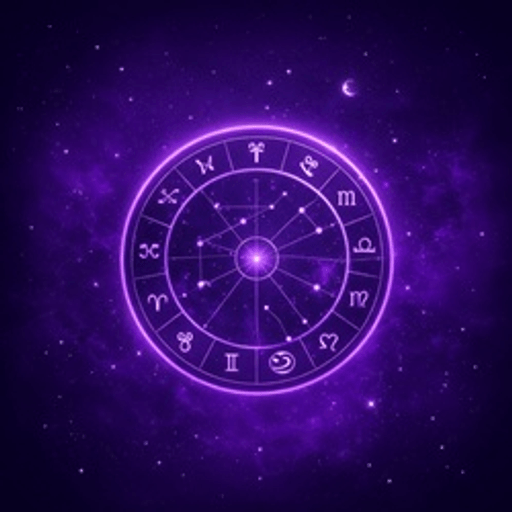
To find your Vertex, look to the western hemisphere of your chart — the right side of the wheel — where the Vertex appears as a calculated point, often marked with a Vx symbol, and the Anti-Vertex (AVx) sits directly opposite on the eastern side. The Vertex is an electrical point representing fated, irreversible encounters and destiny turning points, while the Anti-Vertex represents personal initiation and conscious agency. Reading them together shows where life arrives through other people versus where you must act first.
Interpretation begins with the zodiac sign on the Vertex. A Vertex in Cancer suggests fated encounters tied to emotional safety, family, and nurturing — often through partners who evoke deep belonging. A Vertex in Capricorn points to destiny arriving through duty, ambition, and long-term commitment, frequently via older or more established partners. Compare this to the Anti-Vertex sign, which describes the energy you must consciously generate: an Anti-Vertex in Leo, opposite a Vertex in Aquarius, asks you to step into visible, creative self-expression rather than waiting for the group to define you.
Next, examine the house placement and any planetary contacts. If Venus conjuncts your Vertex, fated encounters carry a romantic, aesthetic, or values-driven charge. If Saturn squares the Vertex, destiny arrives with delay, responsibility, or karmic lessons about boundaries. Mars conjunct the Anti-Vertex, by contrast, signals that you initiate fated turning points through bold, direct action rather than waiting for them to find you. The lunar nodes add another layer: a Vertex conjunct the South Node often indicates a past-life or inherited pattern pulling you toward familiar encounters, while a Vertex near the North Node points toward growth-oriented, unfamiliar fated meetings.
Finally, track how transits activate the axis over time. Eclipses, nodal returns, and outer-planet transits crossing the Vertex axis trigger significant soulmate meetings and life changes. A Jupiter transit over the Vertex can expand a fated relationship into a public or fortunate chapter, while a Pluto transit can transform it through power, depth, and irrevocable change. For a deeper layer of interpretation, you can explore the full astrology tools suite to compare your Vertex contacts against synastry charts and transit timelines.

What Does Your Vertex Axis Reveal About Fated Encounters?
Your Vertex axis reveals the precise zodiac degree where fated, irreversible encounters enter your life through other people — sudden meetings, compulsive attractions, and destiny turning points that feel scripted rather than chosen. In the YesAstrology Vertex & Fated Encounters Axis Calculator, the Vertex is calculated as the ecliptic point that intersects the western horizon when the ecliptic reaches its maximum northern or southern declination relative to your birth latitude, which is why it always falls in the western hemisphere of the chart. The Anti-Vertex sits exactly 180 degrees opposite, forming a single electric axis that maps where fate arrives (Vertex) and where you consciously initiate it (Anti-Vertex).
Unlike the Ascendant, which describes the mask you consciously wear, the Vertex behaves like a secondary electrical doorway. If your Vertex falls in the 7th house, fated encounters arrive through partnership and one-to-one commitment; if it lands in the 5th house, they arrive through romance, creative risk, and children; if it sits in the 10th house, destiny enters through public reputation, career summons, and mentors who appear at pivotal moments. The zodiac sign on the Vertex colors the encounter itself: Vertex in Scorpio brings magnetic, all-or-nothing unions that demand emotional transparency, while Vertex in Aquarius delivers encounters through groups, networks, and sudden ideological recognition.
The calculator runs on full-chart data, so the Vertex degree is only as exact as your birth time. When an exact time is unavailable, the engine defaults to a solar-noon chart, which preserves planetary sign and aspect accuracy but can shift the Vertex by several degrees — enough to move it between houses. For this reason, the tool treats the Vertex as a house-and-sign signature first and a precise degree second, and it flags when a birth-time rectification would sharpen the axis.
To see how this axis interacts with the rest of your chart, run the calculation alongside your full suite of astrology tools, then compare the Vertex house to your natal Venus, Mars, and nodal placements for a complete picture of where fated contact is most likely to strike.
Vertex and Anti-Vertex Meanings and Core Insights
The Vertex is an electrical point in the chart representing fated, irreversible encounters and destiny turning points, while the Anti-Vertex is exactly 180 degrees opposite the Vertex, representing personal initiation and conscious agency. Together they form one axis: the Vertex is where life happens to you through others, and the Anti-Vertex is where you happen to life through your own will. Reading both ends is essential, because a chart heavy on Vertex activation without Anti-Vertex awareness tends to produce people who wait for rescue rather than recognize their own authorship.
Interpretively, the Vertex sign and house describe the flavor and arena of fate. Vertex in the 8th house in Cancer suggests fated encounters tied to shared resources, inheritance, and deep emotional merging; Vertex in the 3rd house in Gemini points to destiny arriving through siblings, short journeys, and conversations that change everything. The Anti-Vertex then shows the counter-move: an Anti-Vertex in the 9th house asks you to initiate through travel, study, and belief, rather than waiting for someone else to expand your world.
Transits are what activate the axis over time. Eclipses, nodal returns, and outer planet transits crossing the Vertex axis trigger significant soulmate meetings and life changes — a solar eclipse conjunct the Vertex often coincides with a relationship that alters your trajectory, while Saturn transiting the Anti-Vertex can demand you take conscious responsibility for a connection you previously left to fate. Progressions and solar arcs move the Vertex slowly, so a progressed Vertex changing signs marks a multi-year shift in the type of destiny you attract.
Synastry is where the Vertex becomes most electric. When another person's Sun, Moon, Venus, Mars, or nodal axis conjuncts your Vertex within a tight orb, the contact is often described as instant recognition — a compulsive pull that bypasses ordinary compatibility logic. The same is true in reverse: your planets landing on a partner's Vertex can make you the catalyst in their story. For a deeper synthesis of these contacts, pair this calculator with the related premium analysis report and cross-check the Vertex against the 7th, 5th, and 8th house cusps to see which relationship arena is most karmically loaded.
Vertex and Anti-Vertex in Love and Relationships
The Vertex is the electrical point in the natal chart where fated, irreversible encounters enter your life through other people, while the Anti-Vertex, exactly 180 degrees opposite, marks where you initiate destiny through conscious choice. In love and relationships, the Vertex describes the compulsive, life-altering pull of a soulmate meeting — the kind of connection that feels orchestrated rather than chosen — whereas the Anti-Vertex reveals the relational turning points you actively create through your own agency. The Vertex & Fated Encounters Axis Calculator locates both points by degree and house, then maps the synastry contacts, eclipse triggers, and nodal returns that activate them over time.
Under the hood, the calculator computes the Vertex as the point where the ecliptic intersects the western horizon at the moment of birth, which means it is highly sensitive to birth time and location. The tool supports Placidus, Whole Sign, and Equal House cusp systems, and each method shifts the Vertex's house placement — for instance, a Vertex falling in the 7th house under Placidus may land in the 8th under Whole Sign, changing whether the fated encounter arrives through partnership or through shared resources and intimacy. If your birth time is uncertain, the calculator defaults to a solar-noon chart, which preserves the Vertex's zodiac sign and major aspect geometry even though the exact degree and house cusp may shift; for precise house placement, birth time rectification is recommended.
Specific manifestations depend on the Vertex sign and its ruler. A Vertex in Libra, ruled by Venus, often brings fated encounters through aesthetic or diplomatic settings, and if Venus sits in the 5th house, romance and creative collaboration become the delivery mechanism. A Vertex in Scorpio, ruled by Pluto or Mars, tends toward compulsive, transformative unions — especially if Pluto aspects the Vertex by conjunction or square, producing an obsessive, all-or-nothing quality. When the Vertex conjuncts the Descendant, fated partners arrive as mirrors of your unlived self; when it opposes the Ascendant from the 6th house, destiny enters through daily work, service, or health routines. The Anti-Vertex, by contrast, shows where you must stop waiting and start choosing: an Anti-Vertex in the 1st house means your destiny is to initiate, not to be chosen.
Transits and progressions time these activations. Eclipses crossing the Vertex axis — solar eclipses conjunct the Vertex or lunar eclipses conjunct the Anti-Vertex — frequently coincide with soulmate meetings, separations, or relationship turning points. Nodal returns every 18.6 years re-trigger the Vertex axis, and outer planet transits (Uranus, Neptune, Pluto) crossing the Vertex by conjunction, square, or opposition often mark irreversible relational shifts. Solar arc directions moving the Vertex forward by roughly one degree per year can also time fated encounters, while secondary progressions to the Vertex add emotional readiness to the external event. For instance, if transiting Pluto conjuncts your Vertex in the 7th house, expect a relationship that dismantles and rebuilds your sense of partnership; if transiting Jupiter trines the Vertex, the encounter may arrive with ease and expansion rather than upheaval.
For further reading, you can also explore Blog.
Vertex and Anti-Vertex in Career and Purpose
The Vertex in career and purpose points to fated professional encounters — mentors, collaborations, or vocational turning points that arrive through other people and feel destined rather than planned — while the Anti-Vertex marks the career moves you must consciously initiate. In the natal chart, the Vertex's house placement shows the arena where destiny delivers your purpose: a Vertex in the 10th house brings fated public recognition or a mentor who elevates your reputation, whereas a Vertex in the 6th house delivers purpose through daily work, service, and health-related routines. The Anti-Vertex, 180 degrees opposite, shows where you must act first — an Anti-Vertex in the 4th house means your career destiny requires you to build a private foundation before public success arrives.
The calculator determines the Vertex's house cusp using Placidus, Whole Sign, or Equal House systems, and the choice matters for career interpretation. Under Placidus, a Vertex in the 10th house emphasizes the Midheaven and public status; under Whole Sign, the same Vertex may fall in the 11th house, shifting the emphasis to networks, alliances, and collective goals. If birth time is missing, the solar-noon default preserves the Vertex's sign and aspects — so a Vertex in Capricorn trine Saturn remains visible — but the exact house cusp and degree are approximate; birth time rectification sharpens the career house placement. The tool also cross-references the Vertex with the Midheaven, 2nd house (income), 6th house (daily work), and 10th house (career) to show where fated professional events are most likely to land.
Concrete examples clarify the pattern. If your Vertex is in Aries and Mars sits in your 2nd house, fated career encounters arrive through bold, self-funded initiatives that directly affect your income — a sudden client, a competitive opportunity, or a solo venture. If your Vertex is in Capricorn and Saturn conjuncts it in the 10th house, destiny arrives through earned mastery, long apprenticeships, and authoritative mentors who demand discipline; the Anti-Vertex in the 4th house then asks you to consciously build a private base of support. If your Vertex is in Aquarius and Uranus squares it from the 11th house, fated career turns come through unexpected networks, technological shifts, or sudden departures from conventional paths. Compare this with Jupiter transiting the Vertex: expansion and visibility arrive with ease, whereas Saturn transiting the Vertex brings responsibility, tests, and slow, durable mastery.
Timing cycles activate the Vertex axis in career just as they do in love. Solar eclipses conjunct the Vertex often coincide with fated job offers, promotions, or vocational pivots; lunar eclipses on the Anti-Vertex mark the culmination of a self-initiated career effort. Nodal returns every 18.6 years re-trigger the axis, and outer planet transits — Uranus conjunct the Vertex bringing sudden change, Pluto conjunct the Vertex bringing power struggles and transformation, Neptune conjunct the Vertex bringing inspiration or confusion — time the major professional turning points. Solar arc directions to the Vertex add roughly one degree per year, timing fated career encounters with precision, while secondary progressions to the Vertex reveal when you are emotionally ready to accept the destiny being offered. For instance, if solar arc Uranus conjuncts your Vertex in the 10th house, expect an unexpected career breakthrough or a sudden departure from a long-held role.

Vertex and Anti-Vertex in Subconscious Patterns and Inner Life
The Vertex is an electrical point in the chart representing fated, irreversible encounters and destiny turning points, while the Anti-Vertex sits exactly 180 degrees opposite and represents personal initiation and conscious agency. In the inner life, the Vertex axis works like a subconscious threshold: the Vertex side receives, magnetizes, and surrenders to what arrives through other people, whereas the Anti-Vertex side pushes outward, chooses, and claims authorship of its own story. Unlike the Ascendant, which is the conscious mask you present to the world, the Vertex is a secondary electrical axis in the western hemisphere where sudden, compulsive, and life-altering encounters enter through other people, eclipses, and fated synastry contacts.
Because the Vertex is calculated as the intersection of the ecliptic with the prime vertical in the western sky, its sign and house placement are extremely sensitive to birth time. The Vertex & Fated Encounters Axis Calculator resolves this by computing the exact degree of the Vertex and Anti-Vertex from your birth data, then mapping the axis across the whole chart. If an exact birth time is unavailable, the engine falls back to a solar-noon chart, which keeps planetary signs and aspects accurate while flagging the Vertex degree as approximate — a transparent safeguard rather than a silent guess. House cusp method matters too: Placidus, Whole Sign, and Equal House each shift which house the Vertex lands in, and the calculator states which system it used so the interpretation stays honest.
Psychologically, a Vertex in the 12th house turns the fated axis inward — encounters arrive through dreams, retreats, and unseen emotional undercurrents, often with a Neptune or Pisces signature of dissolving boundaries. A Vertex in the 7th house, by contrast, externalizes destiny almost entirely into partnership, so the subconscious pattern is one of meeting yourself through the mirror of another person. The Anti-Vertex then describes where you must stop waiting and start initiating: an Anti-Vertex in the 1st house insists that you become the event rather than merely receive it.
Sign color deepens the reading. A Vertex in Scorpio carries compulsive, transformative undertones — the encounter that rearranges your inner architecture — while a Vertex in Capricorn delivers destiny through duty, structure, and hard-won responsibility, often via an older or more established figure. When the Vertex forms a conjunction to Neptune, the subconscious pattern is romantic idealization and spiritual longing; a square from Saturn to the Vertex adds fear, delay, and the sense that fate arrives only after you have earned it. Tracking transits, solar arcs, and progressions to the axis shows when these dormant patterns activate: eclipses crossing the Vertex degree, nodal returns, and outer planet transits are the classic triggers for soulmate meetings and irreversible life changes.
Synastry Dynamics and Cross-Aspects with the Vertex Axis
In synastry, the Vertex axis is the single most reliable marker of fated, compulsive attraction: when one person's Sun, Moon, Venus, Mars, or Ascendant conjuncts the other's Vertex, the meeting tends to feel pre-arranged, magnetic, and difficult to walk away from. The Vertex & Fated Encounters Axis Calculator compares both charts and highlights every cross-aspect to the Vertex and Anti-Vertex, so you can see exactly which contacts carry destiny and which simply carry chemistry. Eclipses, nodal returns, and outer planet transits crossing the Vertex axis are the classic triggers for these significant soulmate meetings and life changes.
Not all Vertex contacts behave the same way. A conjunction from Venus to the Vertex produces instant recognition and aesthetic harmony — the sense of having known someone before. A conjunction from Mars to the Vertex is far more volatile: raw desire, urgency, and a compulsive pull that can override judgment. Pluto conjunct the Vertex brings an obsessive, transformative bond that restructures identity, while Saturn conjunct the Vertex introduces duty, karmic debt, and a relationship that feels like an obligation to fulfill rather than a pleasure to enjoy. Squares and oppositions to the axis often manifest as timing friction — the right person arriving at the wrong moment, or a connection that repeatedly dissolves and reforms.
Directionality matters. When your Vertex falls in your partner's 7th house, the relationship is structurally fated for them; when their Anti-Vertex lands on your Sun, they become the agent who initiates what you were unconsciously waiting for. Compare this with the Nodes: the South Node describes familiar, karmic comfort, whereas the Vertex describes the electric, unfamiliar doorway that pulls you forward. A person who activates your North Node may feel like growth; a person who activates your Vertex often feels like destiny, and the two are not always the same individual.
Because the Vertex is so birth-time sensitive, the calculator is explicit about its method. It computes the axis using the selected house system, reports the exact degree and minute, and marks the result as approximate when a solar-noon default was applied — preserving planetary sign and aspect accuracy even without a precise birth time. It then layers transit, solar arc, and progression timing onto the axis so you can see when a fated contact is likely to culminate. For a deeper written interpretation of your own axis and its cross-aspects, the companion premium analysis report expands each contact into concrete life scenarios.

Composite Energy Patterns and the Vertex in Relationship Charts
The Vertex in a composite chart marks the shared fated axis of a relationship — the degree where two people's destinies intersect and where compulsive, life-altering encounters are most likely to occur. When one partner's Sun, Moon, Venus, Mars, or Ascendant conjuncts the composite Vertex within a tight orb (ideally 0–3 degrees), the bond carries an unmistakable sense of inevitability, as though the meeting was arranged by forces outside conscious choice. The Anti-Vertex, sitting exactly 180 degrees opposite, represents the relationship's conscious agency: the point where the couple must actively choose each other rather than surrender to fate.
Composite Vertex contacts behave differently depending on which planet is involved. A composite Vertex conjunct Venus produces a magnetic, aesthetic attraction that feels preordained and often manifests as a sudden meeting in a meaningful location. A composite Vertex conjunct Saturn, by contrast, brings a karmic contract weighted with obligation, endurance, and slow-built commitment — the relationship feels destined but demanding. When composite Vertex squares composite Mars, the fated pull arrives wrapped in conflict, competition, or a compulsive sexual charge that neither party can easily walk away from. Composite Vertex trine the composite Moon creates emotional recognition so immediate it feels like remembering rather than discovering.
Synastry adds a second layer. If your natal Vertex falls in your partner's 7th house, you embody their fated-partner archetype; if their Vertex lands on your Descendant, the recognition is mutual and often instantaneous. Compare this with a composite Vertex conjunct the composite North Node — a configuration that signals a relationship explicitly designed to advance both people's evolutionary direction, whereas a composite Vertex conjunct the South Node tends to replay old karmic patterns that feel familiar but may not progress. The Vertex axis is not the same as the Ascendant-Descendant axis: the Ascendant governs conscious identity and first impressions, while the Vertex operates as a secondary electrical axis in the western hemisphere, activating through eclipses, nodal returns, and outer-planet transits rather than through ordinary daily interaction.
For instance, if a couple's composite Vertex sits at 14° Scorpio and their composite Venus is at 16° Scorpio, the conjunction describes a relationship charged with obsessive depth, transformative intimacy, and an almost ritualistic sense of union. If instead the composite Vertex at 14° Scorpio opposes composite Uranus at 14° Taurus, the fated encounter arrives through sudden disruption — an unexpected meeting, a rapid separation, or a relationship that refuses to follow conventional timelines. Reading the composite Vertex alongside the natal Vertex of each partner reveals whether the destiny is shared, mirrored, or one-sided.
For further reading, you can also explore Reports.
Astronomical Mechanics and Planetary Periods of the Vertex Axis
The Vertex is not a physical body but a calculated point: it is the ecliptic degree that intersects the western horizon at the moment a specific location's latitude places the prime vertical and the ecliptic in a particular geometric relationship. Astronomically, the Vertex is the point where the ecliptic crosses the prime vertical in the west — the mirror of the Anti-Vertex in the east. Because this intersection depends on both geographic latitude and exact birth time, the Vertex degree shifts roughly one degree every four minutes of clock time, making an accurate birth time essential for precise placement. The Vertex & Fated Encounters Axis Calculator computes this intersection directly from your birth data and returns the exact degree and sign of both the Vertex and its 180-degree opposite, the Anti-Vertex.
Under the hood, the calculator resolves the Vertex using the same house-cusp framework that governs the rest of the chart. In Placidus, the Vertex is derived from the prime vertical's intersection with the ecliptic and is tightly coupled to the 5th–8th house axis; in Whole Sign houses, the Vertex is read against the sign boundaries rather than degree cusps, which changes how it is interpreted but not where it falls. Equal House systems preserve the Vertex degree exactly while shifting the surrounding house context. If an exact birth time is unavailable, the calculator defaults to a solar-noon chart, which preserves planetary sign and aspect accuracy but may shift the Vertex by several degrees — enough to change its house placement, so the Vertex should be treated as approximate in that scenario.
Timing cycles activate the Vertex axis in distinct waves. Eclipses are the primary trigger: a solar or lunar eclipse within 2 degrees of your natal Vertex often coincides with a fated meeting, a sudden relationship turning point, or an irreversible decision. Nodal returns — when the transiting North or South Node conjoins your natal Vertex — mark roughly 18.6-year cycles of destiny recalibration. Outer-planet transits provide the longer arcs: transiting Saturn crossing the Vertex brings a sober, contractual fated encounter; transiting Uranus crossing it delivers a sudden, destabilizing meeting; transiting Pluto crossing it signals a karmic bond with transformative, sometimes obsessive intensity. Jupiter's transit tends to expand the opportunity for fated connection rather than force it.
Solar arc directions and secondary progressions add a slower, more personal layer. A solar arc direction of Venus or the Sun to the natal Vertex often times a marriage, a significant partnership, or a meeting that reshapes the life path. Secondary progressed Venus conjunct the Vertex can mark the exact year a fated romance enters. To use the calculator effectively, enter your birth date, exact birth time, and birth location, then read the returned Vertex and Anti-Vertex degrees against your natal houses and any active transits. The Anti-Vertex, exactly 180 degrees away, shows where you must initiate rather than wait — the conscious counterpart to the Vertex's involuntary pull.

Vertex vs Descendant: Understanding the Difference
The Vertex and the Descendant are both located in the western hemisphere of the natal chart, but they describe fundamentally different relationship dynamics. The Descendant, which is the cusp of the 7th house, represents your conscious, everyday partnership style — the qualities you openly seek in a spouse, business partner, or close ally. The Vertex, by contrast, is an electrical point of destiny that reveals fated, compulsive encounters you cannot engineer through conscious choice. In short: the Descendant is who you choose; the Vertex is who fate chooses for you.
Astrologically, the Descendant is calculated as the point exactly opposite the Ascendant, and its sign and house placement describe the relational mirror you project onto others. For instance, if your Descendant is in Libra, you are drawn to harmony, diplomacy, and aesthetic balance in partnership; if it is in Capricorn, you seek reliability, structure, and long-term commitment. The Vertex, however, is calculated as the intersection of the ecliptic with the western horizon at the moment of birth — a mathematically distinct point that often falls in a different sign and house than the Descendant. A person with a Libra Descendant might have a Vertex in Virgo or Scorpio, indicating that their fated encounters carry a different karmic signature than their everyday relationship preferences.
The Anti-Vertex, exactly 180 degrees opposite the Vertex, represents personal initiation and conscious agency — the point where you actively pursue your own destiny rather than waiting for it to arrive through another person. When transiting planets, eclipses, or nodal returns cross the Vertex axis, they trigger sudden, life-altering meetings and irreversible turning points. For example, a solar eclipse conjunct your Vertex in the 5th house could coincide with a fated romantic encounter, while a Saturn transit over the Anti-Vertex might demand that you take personal responsibility for a destiny you have been avoiding.
Understanding the difference between these two axes is essential for accurate chart synthesis. The Descendant shows the relational contract you negotiate daily; the Vertex shows the soul contract you signed before birth. Both matter, but they operate on different timelines and through different mechanisms of choice and surrender.
How Accurate Is the Vertex and Fated Encounters Axis Calculator?
The Vertex and Fated Encounters Axis Calculator is highly accurate when provided with an exact birth time and birth location, because the Vertex is a time-sensitive point that moves approximately one degree every four minutes of clock time. The calculator uses the same house cusp calculation methods as professional astrology software — including Placidus, Whole Sign, and Equal House systems — to determine the precise degree and sign of your Vertex and Anti-Vertex. Without an exact birth time, the Vertex cannot be calculated with certainty, and the tool will default to a solar-noon chart, which ensures planetary sign and aspect accuracy but may place the Vertex axis in an approximate position.
Under the hood, the calculator computes the Vertex as the intersection of the ecliptic with the western horizon at the moment of birth, then derives the Anti-Vertex as the exact opposite point. It cross-references your birth data against ephemeris tables to identify current and upcoming transits, eclipses, and nodal returns that activate the Vertex axis. For example, if your Vertex is at 14° Scorpio and transiting Uranus is at 14° Taurus, the calculator will flag a Uranus opposition to your Vertex — a signature of sudden, fated encounters that disrupt established relationship patterns. Similarly, a solar eclipse conjunct your Anti-Vertex in the 11th house might indicate a destiny turning point involving community, friendship, or collective purpose.
Accuracy also depends on the house system you select. Placidus, the most commonly used system in modern Western astrology, divides the houses by time and works well for mid-latitudes but can distort the Vertex axis near the polar circles. Whole Sign houses, which assign one sign per house, offer a simpler and often more stable Vertex placement for fate-based interpretation. Equal House, which divides the chart into twelve equal 30-degree segments from the Ascendant, provides a consistent framework for comparing the Vertex across different charts. The calculator allows you to switch between these systems so you can see how the Vertex axis shifts and which interpretation feels most resonant.
For timing activations, the calculator tracks planetary transits, solar arc directions, and secondary progressions that contact the Vertex axis. Outer planet transits — especially from Uranus, Neptune, and Pluto — are the most potent triggers of fated encounters, while Jupiter transits tend to bring benevolent, expansive meetings and Saturn transits bring karmic commitments or endings. Eclipses within three degrees of the Vertex or Anti-Vertex are considered major destiny markers. The calculator flags these windows so you can prepare for the irreversible turning points they herald.
For further reading, you can also explore Products.