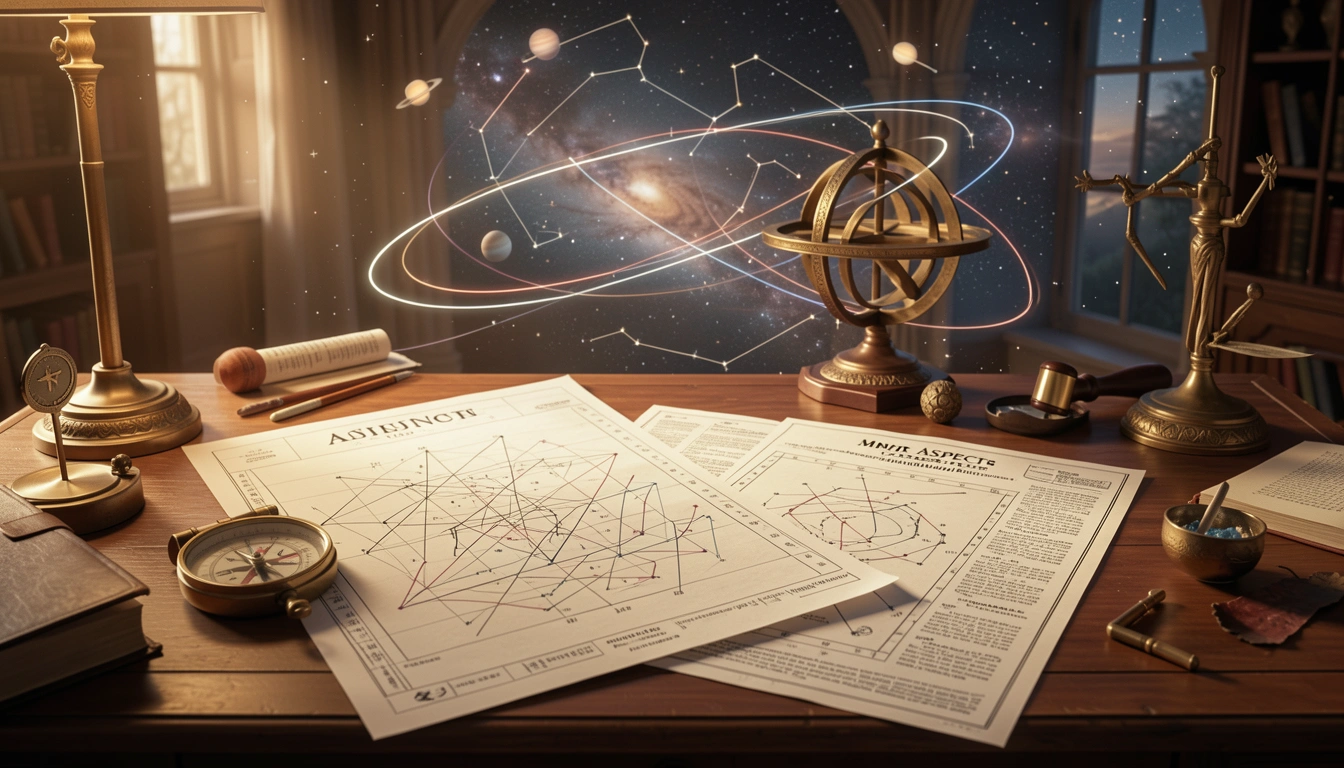
A connected, saved interpretation made for this report.
Prominent celestial alignments and growth opportunities
Personal potential and natal chart dynamics
Practical life guidance and conscious integration
1
Your Subtle Pattern Layer
This Your Subtle Pattern Layer reading draws on 39 calculator result(s). The details below are preserved from your calculation and anchor the interpretation to what was actually recorded.
Sun Semi-sextile Juno (orb: 1.12°)
Sun Semi-sextile Juno (orb: 1.12°)
The clearest anchor is Your Subtle Pattern Layer: Sun Semi-sextile Juno (orb: 1.12°). Reflect on how this recorded result relates to your original question.
Read a placement through its calculated point, sign, house, and contact details when those values are present. The listed positions describe this chart snapshot.
Use each detail as a focused reflection prompt for Your Subtle Pattern Layer: compare it with what you have observed, note where it helps clarify the question behind this reading, and choose one practical next step that fits your circumstances.
These values describe the calculation made from the supplied inputs. They are not a guarantee, diagnosis, or substitute for your own judgment.
Your Subtle Pattern Layer begins with Your Subtle Pattern Layer: Sun Semi-sextile Juno (orb: 1.12°). Treat quincunxes, semisextiles, semisquares, and sesquiquadrates as subtle links with their own listed orbs. Compare this anchor with the other supplied calculation details, and keep any differences visible instead of forcing a single conclusion.
Review the planets involved and note small adjustments or recurring friction without overstating minor contacts.
Sun Biquintile North Node (orb: 0.08°)
Sun Biquintile North Node (orb: 0.08°)
The clearest anchor is Your Subtle Pattern Layer: Sun Biquintile North Node (orb: 0.08°). Reflect on how this recorded result relates to your original question.
2
Quincunxes (Inconjuncts): Ongoing Adjustments
Insufficient Data for Analysis
Quincunxes (Inconjuncts): Ongoing Adjustments
Insufficient Data for Analysis
On this page
Minor Aspects Calculator (Natal Minor Aspects) Premium Report provides an authoritative framework for understanding celestial archetypes, energetic timing, and personal evolution. By combining classical astrological doctrines with modern chart synthesis, this analysis offers actionable clarity on innate strengths, relational dynamics, and developmental milestones.
Rooted in Swiss Ephemeris astronomical precision, every interpretation translates subtle planetary motions and geometric aspect configurations into clear, structured insights. Integrating this knowledge empowers you to navigate major life transitions with strategic awareness and grounded confidence.
What Is Minor Aspects (Natal Minor Aspects)?
Minor aspects are the natal chart angles beyond the five major Ptolemaic aspects — conjunction, sextile, square, trine, and opposition — that reveal subtler psychological and situational patterns. The Minor Aspects Calculator (Natal Minor Aspects) Premium Report focuses on four specific minor configurations: the quincunx (150°), semisextile (30°), semisquare (45°), and sesquiquadrate (135°), each carrying distinct interpretive weight that refines what major aspects alone cannot show.
Where a square between Saturn in the 10th house and Mars in the 1st house signals overt friction between ambition and self-assertion, a semisquare from the same Mars to a Uranus placement introduces a low-grade restlessness that operates beneath conscious awareness. The quincunx — for example, Venus in Taurus quincunx Pluto in the 8th house — describes an uncomfortable adjustment between two incompatible drives that never quite resolve, unlike an opposition which at least acknowledges both poles. Semisextiles, such as Mercury in Gemini semisextile the Moon in Cancer, indicate neighboring-sign energies that require conscious integration rather than harmony or conflict.
These minor angles matter because they explain recurring irritations, unconscious habits, and subtle health or relational tensions that major-aspect readings leave unexplained. A chart heavy in semisquares between Mars and Saturn or Neptune often shows chronic, low-level friction in action — quite different from the dramatic blockage of a full square — while repeated quincunxes involving the 6th house of daily work and health point to adjustment pressures that never fully settle.
How Does a Minor Aspects (Natal Minor Aspects) Report Work?
The Minor Aspects Report works by calculating the exact angular separation between every planetary pair and significant point in your natal chart, then flagging separations that fall within a tight orb of 150°, 30°, 45°, or 135° — typically 2–3° for minor aspects, tighter than the orbs used for major aspects because these angles lose interpretive meaning quickly as they widen.
Calculation begins with your birth data. An exact birth time allows the engine to compute house cusps using the Placidus system (or Whole Sign / Equal House if preferred), fixing the Ascendant, Midheaven, and house boundaries so each minor aspect can be tied to specific houses — for example, a sesquiquadrate between the 7th house cusp degree and natal Saturn reading differently than the same aspect connecting two planets in the 4th house of family. If birth time is unknown, the calculator defaults to a solar-noon chart, which preserves planetary signs and aspect accuracy (since planets move slowly relative to a single day) while leaving house-dependent interpretations flagged as approximate.
Once positions are fixed, the engine sweeps all planet-to-planet, planet-to-angle, and angle-to-angle pairs. A quincunx between Mars in Libra and Neptune in Pisces (roughly 150° apart) enters the report with its orb stated in degrees and minutes, alongside interpretive text covering the specific planets, signs, and houses involved. Semisquares and sesquiquadrates are grouped as a family since they share the 45° base; semisextiles are treated separately because they describe neighboring-sign integration rather than friction.
The report then layers timing cycles onto your natal minor aspect map. Transits, solar arc directions, and secondary progressions are checked against your natal minor aspect degrees, so you can see when, for instance, transit Saturn approaches your natal quincunx point — a period when the underlying adjustment pressure tends to surface concretely. This is how a static natal pattern becomes a forecastable event window rather than a fixed trait description. You can run the underlying calculations yourself through the Tools directory.
Get Your Personalized Minor Aspects (Natal Minor Aspects) Report
Your personalized Minor Aspects (Natal Minor Aspects) Report is generated directly from your birth data through the Minor Aspects Calculator tool, which measures the exact angular separation between every planetary pair and significant point in your chart, then flags separations falling within a tight 2–3° orb of 150° (quincunx), 30° (semisextile), 45° (semisquare), and 135° (sesquiquadrate). Because these angles lose interpretive meaning quickly as they widen, the orbs used here are deliberately tighter than those applied to conjunctions, trines, squares, and oppositions.
Under the hood, calculations leverage Swiss Ephemeris astronomical precision, computing exact zodiacal longitudes, retrograde motions, and aspect orbs down to arcminutes. House cusps are derived using your chosen house system — Placidus, Whole Sign, or Equal House — with an exact birth time fixing the Ascendant, Midheaven, and cusp degrees precisely. If your birth time is unknown, the calculator defaults to a solar-noon chart, which preserves planetary sign placements and aspect accuracy (planets move slowly relative to a single day) while house-dependent readings are flagged as approximate.
Each minor aspect is then interpreted through a layered framework: first its core archetype, then the specific planets and signs involved, and finally the life areas it touches — love and relationships, career and ambition, and personal growth. For example, a quincunx from Saturn in the 7th house to Venus in the 5th house describes constant recalibration between partnership duty and romantic freedom, whereas a semisextile between Venus and Uranus in the 11th house suggests friendship circles quietly feeding unconventional attractions. Timing cycles — planetary transits, solar arc directions, and secondary progressions — are layered over your natal minor-aspect grid so you can see when a pattern like transit Saturn approaching your natal quincunx point becomes concretely active.
For further reading, you can also explore Tools.
How to Find and Interpret Your Minor Aspects (Natal Minor Aspects)
To find your minor aspects, you need the exact zodiacal degree of every planet and key point in your natal chart, then measure the angular distance between each pair: a separation of roughly 150° is a quincunx, 30° a semisextile, 45° a semisquare, and 135° a sesquiquadrate — each accepted only within a tight 2–3° orb. The Minor Aspects Calculator automates this sweep across all planet-to-planet, planet-to-angle, and angle-to-angle pairs, reporting each hit with its orb stated in degrees and minutes alongside the planets, signs, and houses involved.
Interpretation begins with the aspect's archetype, then narrows to the specific planetary pair. A quincunx describes an unresolved adjustment between two functions that share neither element nor modality — Venus in Libra quincunx Mars in Taurus, for instance, pulls relational ideals and physical desire in incompatible directions that never fully reconcile, unlike an opposition which at least acknowledges both poles. A semisextile, such as Mercury in Gemini semisextile the Moon in Cancer, links neighboring signs whose energies sit side by side yet remain unintegrated, requiring conscious bridging rather than harmony or conflict. The semisquare and sesquiquadrate share a 45° base and carry square-like friction at roughly half the intensity: Mars semisquare Saturn registers as chronic, low-level self-doubt in action rather than the dramatic blockage of a full square between the same planets.
House placement then grounds the reading in concrete life areas. A sesquiquadrate between Mars and the 2nd house cusp describes friction between initiative and income, while the same 135° angle between Mars and the 10th house shows friction between action and public reputation — a meaningful distinction from a flowing trine from Jupiter to the Midheaven, which explains why someone with an apparently fortunate major-aspect career signature still meets daily resistance. Sign modality also colors the result: a cardinal semisquare like Jupiter in Aries semisquare Pluto in Capricorn erupts as sudden power struggles, whereas a mutable sesquiquadrate like Saturn in Pisces sesquiquadrate Venus in Sagittarius shows up as drifting, unfocused dissatisfaction. Finally, check timing — transiting Uranus semisquare your natal Pluto, or solar arc directions moving Saturn across a natal semisquare to the Midheaven, mark windows when a dormant pattern surfaces concretely, such as a career recalibration point or a relational dynamic reawakening during a Saturn return.
What Does Your Minor Aspects (Natal Minor Aspects) Reveal?
Your minor aspects reveal the quiet adjustments, low-grade frictions, and un-integrated energies operating between planets at 30°, 45°, 135°, and 150° — patterns that explain recurring irritations and subtle tensions your major conjunction, sextile, square, trine, and opposition readings leave unexplained. Where a Sun trine Jupiter shows obvious ease, a Sun semisextile Neptune (30°) shows an undercurrent of idealized self-image that never quite merges with how you actually present. The Minor Aspects Calculator (Natal Minor Aspects) Premium Report maps these four angles — quincunx, semisextile, semisquare, and sesquiquadrate — across your natal chart so you can see what has been quietly shaping your experience all along.
Each minor aspect reveals a different kind of signal. The quincunx (150°) exposes incompatible drives that demand constant recalibration: Venus in Libra quincunx Mars in Taurus, for instance, describes relational ideals and physical desires that never coordinate, unlike an opposition which at least acknowledges both poles. The semisquare (45°) and sesquiquadrate (135°) reveal chronic, half-intensity friction — a Mars semisquare Saturn registering as persistent low-level self-doubt in action rather than the dramatic blockage of a full square. The semisextile (30°) reveals neighboring-sign energies sitting side by side without natural conversation, such as Mercury in Gemini semisextile the Moon in Cancer, where intellect and feeling coexist but rarely speak.
House placement shows you where these patterns actually land in daily life. A sesquiquadrate touching the 10th house Midheaven reveals friction between action and public reputation, while the same 135° angle connecting Mars to the 2nd house cusp reveals initiative that does not convert cleanly into income — distinct from the 6th house of daily work routines or the 7th house of partnership. The calculator computes these house cusps using Placidus, Whole Sign, or Equal House depending on your birth latitude; an exact birth time fixes cusp degrees precisely, while a solar-noon default preserves planetary sign and aspect accuracy when birth time is unknown, flagging house-dependent readings as approximate.
Finally, your minor aspects reveal timing windows, not fixed traits. Transits, solar arc directions, and secondary progressions are checked against your natal minor aspect degrees, so a quincunx that stayed dormant for decades surfaces concretely when transit Saturn approaches it — or when a Uranus opposition to your natal Moon ignites it. This is how a static natal pattern becomes a forecastable event window. To explore the broader toolset behind these calculations, visit the Tools page.
Minor Aspects (Natal Minor Aspects) Meanings and Core Archetypes
Minor aspects are the four natal chart angles outside the five major Ptolemaic aspects — the quincunx (150°), semisextile (30°), semisquare (45°), and sesquiquadrate (135°) — each carrying a distinct core archetype: adjustment, un-integrated adjacency, low-grade friction, and half-intensity square tension respectively. The Minor Aspects Calculator (Natal Minor Aspects) Premium Report defines each archetype first, then reads it through the specific planets, signs, and houses it connects in your chart.
The quincunx, also called the inconjunct, is the archetype of restless recalibration. It links signs that share neither element nor modality — Virgo and Aries, Taurus and Scorpio, Libra and Pisces — so the two planetary functions simply do not coordinate. For example, Venus in Libra quincunx Mars in Taurus describes relational ideals and physical desires pulling in incompatible directions, requiring constant adjustment rather than resolution. Unlike an opposition, which at least acknowledges both poles, the quincunx never settles; a Venus quincunx Pluto in the 8th house describes an uncomfortable adjustment between affection and possessive depth that keeps resurfacing across decades.
The semisextile (30°) is the archetype of neighboring but un-integrated energies. It connects adjacent signs — Aries with Taurus, Scorpio with Sagittarius — which sit side by side in zodiacal order yet belong to different elements. Mercury in Gemini semisextile the Moon in Cancer suggests thinking and feeling occupy neighboring territory but rarely converse; a Sun in Scorpio semisextile Moon in Sagittarius shows the investigative self and the philosophical self coexisting without naturally merging. This is neither harmony nor conflict — it is material awaiting conscious integration.
The semisquare (45°) and sesquiquadrate (135°) form the 45°-family and carry square-like friction at roughly half the intensity of a full square. A Mars semisquare Saturn registers as chronic, low-level self-doubt in action rather than the dramatic blockage of a Mars-Saturn square; a semisquare between Saturn and the Midheaven creates persistent pressure between professional responsibility and personal standards. The sesquiquadrate, measured from the opposition back to the trine point, tends to feel like a hidden irritant — a sesquiquadrate between Mercury and the 7th house Descendant points to recurring misunderstandings in dialogue that never escalate into open conflict. Because these angles lose interpretive meaning quickly as they widen, the calculator applies tight orbs of roughly 2–3°, and house cusps are computed via Placidus, Whole Sign, or Equal House depending on your birth latitude — with an exact birth time fixing cusp degrees, while a solar-noon default preserves planetary sign and aspect accuracy when birth time is unknown. Timing cycles — transits, solar arcs, and secondary progressions — later activate these archetypes, turning a static natal pattern into a forecastable window. For related reading, browse the YesAstrology blog.
Minor Aspects (Natal Minor Aspects) and Love and Relationships
Minor aspects in a natal chart reveal the subtle relationship patterns that major aspects like the conjunction, opposition, square, and trine overlook: a quincunx (150°) between Venus and the Moon signals an uneasy adjustment between affection and emotional needs, a semisquare (45°) between Mars and Venus introduces friction and irritation into attraction, a sesquiquadrate (135°) between Mercury and the Descendant points to recurring misunderstandings in dialogue, and a semisextile (30°) between the Sun and Neptune blurs the line between idealized love and genuine intimacy. The Minor Aspects Calculator (Natal Minor Aspects) Premium Report maps these quiet angles so you can see why certain relationships feel subtly "off" even when the major aspects look harmonious.
Interpretation depends on which planets and houses are involved. A quincunx from Saturn in the 7th house to Venus in the 5th house, for example, describes a person who feels duty-bound in partnership yet restless in romance, requiring constant recalibration between commitment and personal freedom. By contrast, a semisextile between Venus and Uranus in the 11th house suggests that friendship circles and unconventional attractions quietly feed one another. The report weighs these configurations against the sign modalities — a semisquare involving fixed signs like Leo or Taurus stubbornly resists change, while the same 45° angle between mutable signs like Sagittarius or Gemini adapts more readily.
Timing matters as much as the natal pattern itself. When transiting Pluto or progressed Venus re-activates a natal minor aspect, a latent relational dynamic surfaces — a quincunx that stayed dormant for decades can erupt during a Saturn return or a Uranus opposition to the natal Moon. The Minor Aspects Calculator (Natal Minor Aspects) Premium Report cross-references these activation cycles so you can anticipate when a subtle pattern will demand attention. House cusps themselves are computed with Placidus, Whole Sign, or Equal House depending on your birth latitude, with an exact birth time fixing cusp degrees precisely, while a solar-noon default preserves planetary sign and aspect accuracy when the birth time is unknown.
Minor Aspects (Natal Minor Aspects) and Career, Ambition and Purpose
Minor aspects shape career by introducing the small frictions and quiet alignments that determine how ambition actually operates day to day: a semisquare (45°) between Saturn and the Midheaven creates persistent pressure between professional responsibility and personal standards, a quincunx (150°) from Jupiter in the 10th house to Pluto in the 6th house forces ongoing adjustment between public expansion and deep, private work, and a semisextile (30°) between Mercury and the North Node suggests that everyday communication skills subtly steer the vocational path. The Minor Aspects Calculator (Natal Minor Aspects) Premium Report isolates these angles so you can see the fine-grained mechanics behind your professional drive.
House placement refines the reading considerably. A sesquiquadrate (135°) between Mars and the 2nd house cusp describes friction between initiative and income — effort that doesn't always convert directly into earnings — whereas the same 135° angle between Mars and the 10th house shows friction between action and public reputation. Compare this with a trine from Jupiter to the Midheaven, which flows easily; the minor aspects explain why someone with an apparently fortunate major-aspect career signature still experiences daily resistance. Sign qualities also matter: a semisquare involving Capricorn or Scorpio holds its ground stubbornly, while the same angle between Libra or Aquarius negotiates and pivots.
Activation cycles bring these patterns into focus. Solar arc directions moving Saturn across a natal semisquare to the Midheaven, or transiting Uranus squaring a natal quincunx involving the 10th house, typically coincide with career recalibration points — role changes, restructurings, or a renewed sense of purpose. The Minor Aspects Calculator (Natal Minor Aspects) Premium Report layers these timing techniques over the natal minor-aspect grid so you can see when a subtle professional pattern becomes active. For a broader look at how the chart describes vocation, the article What Your Birth Chart Says About Your Career Success provides complementary perspective.
Planetary Influences and Aspects in Minor Aspects (Natal Minor Aspects)
Minor aspects in a natal chart are the quincunx (150°), semisextile (30°), semisquare (45°), and sesquiquadrate (135°) — angular relationships between planets that describe subtle, often unresolved tensions rather than the clear-cut dynamics of major aspects like the conjunction, square, trine, or opposition. While a Saturn square Mars shows a visible friction between discipline and drive, a Saturn semisquare Mars registers as a low-grade irritation that surfaces intermittently, coloring decisions without announcing itself. The Minor Aspects Calculator (Natal Minor Aspects) Premium Report from YesAstrology reviews these four minor aspect types across your natal chart, mapping where they fall between planets such as the Sun, Moon, Mercury, Venus, Mars, Jupiter, Saturn, Uranus, Neptune, Pluto, Chiron, and the lunar Nodes.
Each minor aspect carries a distinct planetary signature. The quincunx — common between signs that share neither element nor modality, such as Virgo planets inconjuncting Aries — describes an adjustment dynamic: two planetary functions that simply do not coordinate, requiring constant recalibration. For example, Venus in Libra quincunx Mars in Taurus describes a person whose relational ideals and physical desires pull in incompatible directions. The semisextile, by contrast, describes adjacent but un-integrated energies: Mercury in Gemini semisextile Venus in Cancer suggests thinking and feeling sit side by side yet rarely converse. The semisquare and sesquiquadrate, both 45°-family aspects, carry square-like friction at roughly half the intensity — a Mars semisquare Saturn can manifest as chronic, low-level self-doubt in action rather than the dramatic blockage of a full square.
Under the hood, the calculator computes house cusps using your chosen house system — Placidus, Whole Sign, or Equal House — with exact birth time determining cusp degrees precisely. If birth time is unavailable, the tool defaults to a solar-noon chart, which preserves planetary sign placements and aspect accuracy while leaving house assignments approximate. Once your natal minor aspects are established, timing cycles — planetary transits, solar arcs, and secondary progressions — activate these patterns: a transit Uranus semisquare your natal Pluto, for instance, can trigger the latent tension of that same aspect in your radix chart during a specific window. The Premium Report walks through each minor aspect found, the planetary pair involved, and the houses they occupy, so you can see which areas of life — 10th house career versus 6th house daily work versus 2nd house income — the subtle friction actually touches.
Minor Aspects (Natal Minor Aspects) Across the Zodiac Signs
Minor aspects manifest differently depending on which zodiac signs the involved planets occupy, because sign element and modality determine whether the 30°, 45°, 135°, or 150° angle lands between compatible or incompatible symbolic territory. A quincunx between a fire sign and an earth sign — say Mars in Leo quincunx Saturn in Capricorn — describes a persistent mismatch between self-expression and structural responsibility, whereas a quincunx between water and air, like the Moon in Scorpio inconjunct Mercury in Gemini, points to emotional depth that never quite translates into articulate speech. The calculator evaluates each minor aspect against the specific sign pair involved, so a semisquare from Venus in Taurus to Mars in Aquarius reads differently from Venus in Taurus semisquare Mars in Leo: fixed earth against fixed air describes stubborn relational stalemates, while fixed earth against fixed fire describes stubborn but passionate friction.
Sign modality shapes the flavor of the semisquare and sesquiquadrate in particular. Cardinal signs — Aries, Cancer, Libra, Capricorn — initiate, so a cardinal semisquare like Jupiter in Aries semisquare Pluto in Capricorn tends to erupt as sudden power struggles. Mutable signs — Gemini, Virgo, Sagittarius, Pisces — adapt, so a mutable sesquiquadrate like Saturn in Pisces sesquiquadrate Venus in Sagittarius tends to show up as drifting, unfocused dissatisfaction rather than confrontation. The semisextile, linking adjacent signs such as Aries and Taurus or Scorpio and Sagittarius, describes energies that sit next to each other in the zodiacal order but belong to different elements — a Sun in Scorpio semisextile Moon in Sagittarius suggests the deep investigative self and the expansive philosophical self coexist without naturally merging.
House placement further differentiates how each minor aspect lands. A quincunx involving the 10th house Midheaven describes career-versus-home adjustment, while the same aspect touching the 6th house speaks to daily work routines and health habits needing constant tuning. When you cross-reference sign and house — for example, Mars in the 2nd house of income semisquare Neptune in the 11th house of friendships and groups — the report identifies the concrete life areas where the subtle tension plays out. Timing cycles then activate these sign-based patterns: progressions slowly move planets into new signs, converting a natal semisextile into a semisquare over decades, while transits can temporarily ignite a dormant quincunx for weeks at a time. The Premium Report sequences all of this — sign pair, aspect type, house context, and current timing triggers — into a single readable interpretation. To explore the wider catalog of readings, visit the Tools page.
Common Misconceptions About Minor Aspects (Natal Minor Aspects)
The two most common misconceptions about minor aspects are that they are either meaningless noise or, conversely, that they carry the same weight as a square or opposition. In reality, the quincunx (150°), semisextile (30°), semisquare (45°) and sesquiquadrate (135°) operate as secondary signals: they describe recurring adjustments and low-grade frictions that persist beneath the surface, and they are best read as modifiers of the major aspect pattern rather than as standalone verdicts. A single sesquiquadrate between Mercury and the Descendant, for example, does not override a clean Venus trine Jupiter in the 7th house — it simply explains why certain conversations still land slightly off.
Another widespread error is applying wide orbs borrowed from major-aspect practice. Because minor angles lose interpretive coherence quickly, the Minor Aspects Calculator typically flags them only within a tight 2–3° orb, computed to arcminute precision from Swiss Ephemeris data. A Mars semisquare Saturn at 1°12′ orb is reportable; the same angle at 6° is not a semisquare in any meaningful sense. Similarly, some readers assume minor aspects replace house analysis — they do not. A quincunx from Jupiter in the 10th house to Pluto in the 6th house only becomes concrete when tied to house topics (public career versus daily work), which requires accurate house cusps from Placidus, Whole Sign, or Equal House calculations anchored to an exact birth time; without one, the tool defaults to a solar-noon chart and flags house-dependent readings as approximate.
A third misconception is that minor aspects are fixed traits with no timing. In practice they are latent until activated: transiting Saturn approaching your natal quincunx degree, a solar arc direction moving across a natal semisquare to the Midheaven, or a secondary progression shifting Venus into a new sign can all convert a dormant 45° or 150° angle into a live event window. The report therefore pairs each minor aspect with its activation cycles rather than presenting it as an unchanging personality label.
Minor Aspects (Natal Minor Aspects) vs. Sun Sign Astrology
Sun sign astrology works with a single placement — the Sun's sign — while minor aspects describe the angular relationships between planets across your entire chart, making them a fundamentally more layered reading. A generic "Sun in Libra" statement applies to roughly one twelfth of the population and cannot capture why two Libra Sun individuals relate so differently; a quincunx between Venus in Libra and Mars in Taurus, held to a 2–3° orb, describes a specific mismatch between relational ideals and physical desire that belongs to one chart alone.
The structural difference is relational versus categorical. Sun sign astrology categorizes you by one sign; minor aspect analysis measures geometry between pairs — Sun to Moon, Mercury to the North Node, Saturn to the Midheaven — and reads each pair through its signs, houses and modality. For instance, a semisextile (30°) between Mercury in Gemini and the Moon in Cancer signals neighboring-sign energies that sit side by side yet rarely converse, while a semisquare (45°) between Mars and Venus introduces friction into attraction itself. Neither statement can be derived from a Sun sign, because both depend on planetary positions and house cusps that sun-sign horoscopes ignore entirely.
Calculation mechanics also differ sharply. Sun sign determination needs only a birth date, whereas minor aspect work requires planetary longitudes computed from Swiss Ephemeris data and, for house placement, an exact birth time to fix Placidus, Whole Sign or Equal House cusps; when birth time is unknown, the calculator falls back to a solar-noon chart that preserves sign and aspect accuracy while leaving house assignments approximate. Timing then layers on top: transits, solar arcs and secondary progressions activate natal minor aspects over months and years, so a static sun-sign trait description becomes a forecastable cycle — such as transit Uranus semisquaring your natal Pluto during a specific window. For readers who want to explore the broader toolset behind these calculations, the Tools directory lists the Minor Aspects Calculator alongside the other chart engines.
How Accurate Is Minor Aspects (Natal Minor Aspects)?
The accuracy of minor aspect calculation is high at the astronomical level: planetary longitudes are computed with Swiss Ephemeris precision down to arcminutes, so whether Mars sits 44°12′ or 45°00′ from Saturn — and therefore whether a semisquare falls inside the 2–3° orb — is determined mechanically, not interpretively. What varies is interpretive weight, because minor aspects are subtler signals than the major Ptolemaic aspects (conjunction, sextile, square, trine, opposition) and are best read as part of the whole chart rather than in isolation. Accuracy also depends directly on the precision of your birth data.
Birth time is the single biggest accuracy variable. With an exact birth time, the engine fixes house cusps through your chosen system — Placidus, Whole Sign, or Equal House — so the Ascendant, Midheaven, and house boundaries are locked and every minor aspect can be tied to a specific house: a sesquiquadrate between natal Saturn and the 7th house cusp reads differently from the same 135° angle connecting two planets in the 4th house of family. Without a birth time, the calculator defaults to a solar-noon chart, which preserves planetary sign placements and planet-to-planet aspect accuracy (planets move slowly relative to a single day) while leaving house-dependent statements flagged as approximate. In that case a quincunx between Venus in Libra and Mars in Taurus remains reliable, but attributing it to the 5th house of romance versus the 7th house of partnership does not.
Orb discipline is the second accuracy lever. Minor aspects are judged within tight orbs — typically 2–3° — because a 150° quincunx widened to 6° loses its adjustment signature, just as a 45° semisquare drifting toward 50° stops behaving like the 45°-family friction it is meant to describe. The report states each orb in degrees and minutes so you can see how exact a given aspect is: a quincunx at 150°24′ between Mars in Libra and Neptune in Pisces carries more interpretive confidence than one at 147°40′. Semisquares and sesquiquadrates share their 45° base and are grouped accordingly, while semisextiles are evaluated separately since they describe neighboring-sign integration (Mercury in Gemini semisextile Moon in Cancer) rather than friction.
Interpretive accuracy then depends on synthesis, not just geometry. A single sesquiquadrate between two planets reads differently than the same aspect repeated across several placements, and a semisquare involving fixed signs like Leo or Taurus resists change where the same 45° angle between Gemini and Sagittarius adapts. The report therefore weighs each minor aspect against the planets involved (Sun, Moon, Mercury, Venus, Mars, Jupiter, Saturn, Uranus, Neptune, Pluto, Chiron, and the lunar Nodes), the sign modalities, and the houses touched — 10th house career versus 6th house daily work versus 2nd house income. Timing cycles then activate the natal pattern: transit Saturn approaching your natal quincunx point, solar arc directions moving across a natal semisquare to the Midheaven, or secondary progressions shifting a planet into a new sign all convert a static natal configuration into a forecastable window. Two common misconceptions bracket the accuracy question from both sides — dismissing minor aspects as insignificant because they are not major, or overstating their weight when they appear without support from the rest of the chart — and the report addresses both directly.
Practical Steps for Healing and Personal Growth
Practical healing work with minor aspects begins by naming the specific adjustment each pattern demands: a quincunx (150°) asks you to build a bridge between two incompatible drives, a semisquare (45°) asks you to release a low-grade irritation before it hardens into resentment, a sesquiquadrate (135°) asks you to interrupt a recurring friction habit, and a semisextile (30°) asks you to consciously integrate two neighboring-sign energies that otherwise sit side by side without speaking. Rather than treating these angles as fixed traits, you work with them as recurring prompts — each one names a concrete behavior you can practice, revisit, and refine each time a transit or progression reactivates the degree.
Start with your quincunx patterns, since they carry the most persistent adjustment pressure. If your chart shows Venus in Taurus quincunx Pluto in the 8th house, the practical step is to schedule separate, non-negotiable time for simple sensory pleasure (Venus in Taurus) and for honest conversations about emotional depth and shared resources (Pluto in the 8th) — the two functions never coordinate on their own, so you give each its own container instead of forcing them to merge. A Moon in Scorpio inconjunct Mercury in Gemini, by contrast, calls for a different ritual: writing out emotional states in plain language before speaking them, so the investigative emotional depth of Scorpio actually reaches the articulate air of Gemini rather than being flattened into small talk.
For the 45° family — semisquare and sesquiquadrate — the work is friction release rather than bridging. A Mars semisquare Saturn (chronic, low-level self-doubt in action) responds well to a short daily practice of committing to one small action before the inner critic speaks, then recording the outcome; over weeks this retrains the pattern from vague hesitation into observed data. A sesquiquadrate between Mercury and the Descendant, which surfaces as recurring misunderstandings in dialogue, responds to a simple pause-then-reflect habit: repeat back what you heard before responding, especially with a partner whose 7th house cusp degree your report identifies as touched by the aspect. Cardinal-sign friction like Jupiter in Aries semisquare Pluto in Capricorn erupts as sudden power struggles, so the practical step is a pre-agreed cooling-off window before any negotiation; mutable versions like Saturn in Pisces sesquiquadrate Venus in Sagittarius drift into unfocused dissatisfaction, so the counter-move is a fixed weekly commitment that anchors the wandering.
Semisextiles reward gentle, deliberate integration rather than conflict resolution. If Mercury in Gemini semisextiles Venus in Cancer, set aside a few minutes where you say what you think and then say what you feel about the same subject, letting the two adjacent signs converse on purpose. Timing cycles tell you when to intensify this work: the Minor Aspects Calculator (Natal Minor Aspects) Premium Report layers planetary transits, solar arc directions, and secondary progressions over your natal minor-aspect degrees, so you can see when transit Saturn is approaching your natal quincunx point or when a progressed Venus is about to re-activate a dormant 30° link — those windows are when a practice that has been running quietly for months suddenly becomes the work of the moment. House context keeps the practice grounded: a quincunx touching the 10th house Midheaven asks for career-versus-home recalibration in your calendar, while the same aspect touching the 6th house asks for tuning daily routines and health habits. If your birth time is unknown, the calculator defaults to a solar-noon chart, preserving planetary signs and aspect accuracy so these practices remain valid even when house-dependent steps are flagged as approximate.
Frequently asked questions
Minor Aspects Calculator (Natal Minor Aspects) Premium Report analyzes celestial positions, aspect configurations, and planetary archetypes to provide an objective, multifaceted overview of relevant astrological dynamics.
All planetary positions and houses are calculated using the high-precision Swiss Ephemeris engine down to arcminutes, ensuring dependable astronomical accuracy.
You can use the analysis to optimize decision-making, identify favorable timing for important initiatives, and deepen self-awareness across relationships and career goals.
Calculations are grounded in high-precision Swiss Ephemeris astronomical data combined with comprehensive astrological synthesis for accurate planetary coordinates.
This analysis explores planetary placements, celestial houses, major aspects, and timing cycles to provide a clear, actionable overview of your astrological dynamics.
Use this guide for deeper self-reflection, understanding relationship patterns, navigating key life decisions, and aligning with natural cosmic rhythms.
Yes, selecting unknown birth time calculates a solar-noon chart accurately covering planetary signs, core aspects, and elemental balances.
All purchased or generated materials remain permanently accessible directly in your member dashboard for online reading or downloading.
We utilize NASA JPL ephemeris tables and Swiss Ephemeris precision algorithms to ensure exact celestial alignments for your exact location and date.
Yes. Active members (Basic, Pro, Max) automatically receive an additional 3% to 10% discount on all astrology reports directly at checkout.