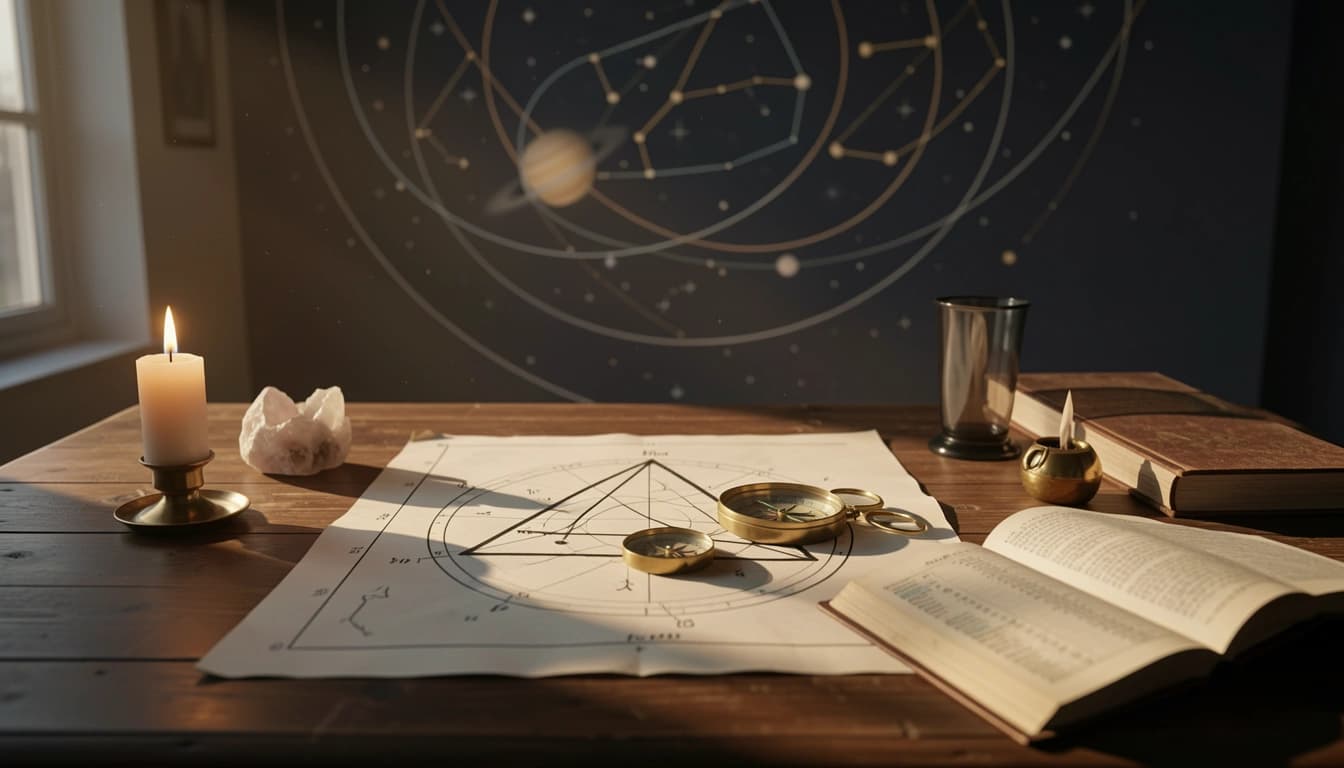
It is a digital natal chart report that identifies the major geometric patterns in your birth chart, such as stelliums, grand trines, T-squares, grand crosses and yods, and interprets what each pattern reveals about your personality, relationships, career and inner life.
Birth Chart Pattern Premium Analysis Report
Order your complete Birth Chart Pattern Premium Analysis Report. Detect major chart patterns including stelliums, grand trines, T-squares
Free calculator vs. premium report
Free calculator
🌱 FreeA focused first look at your calculation.
- ✓
Core result
A quick calculation and concise interpretation.
- ✓
Analysis depth
A focused overview for one question or chart factor.
- ✓
Personal guidance
General next steps based on the calculator result.
⚡ Instant calculation & quick overview
Premium report
🌟 RecommendedA connected, saved interpretation made for this report.
- ⚡
Core result
A complete, structured report built from your report inputs.
- 🔮
Analysis depth
Multiple connected sections, themes and practical context.
- 🎯
Personal guidance
Long-form guidance tailored to the inputs for this report.
🔒 Secure Payment⚡ Instant Lifetime Access🪐 Swiss Ephemeris Precision
On this page
A Birth Chart Pattern Premium Analysis Report is a detailed natal chart reading focused on the large-scale structures that organize your chart. Rather than looking at planets one by one, it maps the geometric patterns they form together: stelliums that concentrate energy in a single area of life, grand trines that describe natural talents, T-squares and grand crosses that mark points of tension and drive, and the rare yod that points to a specific life task. The result is a structural portrait of how your chart is built, not just a list of placements.
The value of this report lies in synthesis. Individual aspects tell you how two planets interact, but patterns show how entire sections of your chart work as a system. A stellium in one house explains where your attention naturally pools. A T-square explains where friction keeps pushing you to act. Reading these structures together gives you a coherent framework for understanding recurring themes in your personality, your relationships, your work and your inner life.
The interpretation follows a clear sequence. First, the report identifies which patterns are present in your chart and where they sit by house and sign. Next, it explains the core meaning of each pattern type and the planets involved. Finally, it applies those findings to the practical areas most readers ask about: love and relationships, career and purpose, and the subconscious patterns that shape how you express yourself. The report closes with guidance on how to work with what you find, so the analysis leads somewhere useful rather than staying abstract.
For further reading, you can also explore Home.
What Is a Birth Chart Pattern Premium Analysis Report?
A Birth Chart Pattern Premium Analysis Report is a detailed astrological document that detects and interprets the major geometric configurations in your natal chart — including stelliums, grand trines, T-squares, grand crosses, and yods — and explains how each pattern concentrates planetary energy across signs, houses, and aspect lines. Rather than reading planets one by one, the report shows how clusters of planets working as a single structure shape your motivations, tensions, and talents.
For example, a stellium of three or more planets in Capricorn packed into your 10th house career angle concentrates Saturn-ruled ambition into public life, while a grand trine linking Venus in Taurus, the Moon in Virgo, and Pluto in Capricorn in earth signs describes an easy, self-sustaining flow of emotional resilience and material instinct. A T-square with Mars in Aries squaring both Saturn in Cancer and Pluto in Libra, by contrast, identifies a fixed pressure point that pushes you toward decisive action under conflict.
The premium report goes beyond pattern detection to interpret each configuration in context: which houses the pattern spans (a grand cross touching the 4th house home axis versus one spanning the 7th–1st house relationship axis reads very differently), which planets anchor it, and whether the aspect dynamics are primarily harmonious trines and sextiles or challenging squares and oppositions. It also situates Chiron, the Lunar Nodes, and the angles — Ascendant, Descendant, Midheaven — within the pattern so you can see where wound, vocation, and partnership themes are structurally wired into your chart's blueprint.
This report is delivered as an auto-digital product through YesAstrology and is linked directly to the Birth Chart Pattern Calculator tool, so the patterns it describes are computed from your own birth data rather than from generic sun-sign descriptions.
How Does a Birth Chart Pattern Premium Analysis Report Work?
The report works by converting your birth date, time, and location into a natal chart, then running aspect and house-proximity calculations to flag any multi-planet configurations that meet established orb thresholds — typically within 6–8° for trines and squares, tighter for conjunctions inside a stellium — before interpreting each detected pattern against its sign, house, and planetary rulership.
Under the hood, house cusps are computed using a selectable system such as Placidus, Whole Sign, or Equal House. An exact birth time fixes the Ascendant degree and therefore every house cusp; without one, the calculator falls back to a solar-noon chart, which preserves planetary sign positions and aspect accuracy (a Sun in Scorpio square Saturn in Leo remains valid) while leaving house-based pattern placement approximate. Timing cycles — transits, solar arcs, and secondary progressions — are then layered on to show when Saturn return or a transit Uranus opposition activates a natal T-square that has been dormant for years.
Each detected pattern is reported with its component planets, the signs and houses involved, and an interpretation of the aspect dynamics at play. A yod formed by Pluto in Capricorn and Neptune in Aquarius quincunx a Moon in Leo, for instance, is read differently from a grand cross spanning Aries, Cancer, Libra, and Capricorn across the cardinal angles — the first describes a recurring adjustment pressure, the second a four-point push-pull across self, home, partnership, and career axes. You can explore related chart mechanics in the Tools section of YesAstrology.

Explore Your Personalized Birth Chart Pattern Premium Analysis Report
The Birth Chart Pattern Premium Analysis Report detects major geometric configurations in your natal chart — including stelliums, grand trines, T-squares, grand crosses, and yods — and explains how each pattern concentrates planetary energy across signs, houses, and aspect families. It reads your chart as a structured system: a stellium of three or more planets in one sign (such as four planets in Capricorn spanning the 10th and 11th houses) marks an area of life where expression is unusually concentrated, while a grand trine in Earth signs (Virgo, Capricorn, Taurus) describes a flowing circuit of talent between houses like the 2nd, 6th, and 10th that often operates without conscious effort.
Under the hood, the calculator computes house cusps using your selected house system — Placidus, Whole Sign, or Equal House — with exact birth time determining cusp degrees to the arc-minute. If birth time is unavailable, the engine defaults to a solar-noon chart, which preserves planetary sign placements, sign-based aspects (conjunction, sextile, square, trine, opposition), and stellium detection, while flagging house-dependent patterns such as a T-square involving the Ascendant or Midheaven as provisional. Orb allowances are tightened for pattern recognition: conjunctions and oppositions within 8°, trines and squares within 7°, ensuring a grand cross only registers when four planets genuinely form two opposing pairs squared to each other.
The report also maps how timing cycles activate these static configurations. Secondary progressions move the progressed Sun roughly one degree per year, gradually bringing progressed angles into orb of a natal yod's apex planet — for example, a progressed Moon crossing a natal Pluto apex in Scorpio in the 8th house. Solar arc directions sweep all points forward at a uniform rate, often bringing a directed Saturn to a natal T-square's square point within a two-year window, while current transits (Jupiter's 12-year cycle, Saturn's 29-year cycle, and the outer-planet Uranus-Neptune-Pluto transits) trigger the pattern's houses in real time. Each section of the report distinguishes natal potential from activated timing, so you can see which configurations are lifelong themes and which are currently being switched on.
For a hands-on way to test configurations yourself, explore the Tools directory, where the linked birth-chart-pattern-calculator lets you adjust house systems and orbs interactively before reading the full premium interpretation.
How to Find and Interpret Your Birth Chart Patterns
Finding your birth chart patterns means plotting the exact degrees of your planets and angles, then measuring the geometric relationships between them: conjunctions (0°), oppositions (180°), squares (90°), trines (120°) and sextiles (60°). A pattern forms when three or more of these aspect lines connect into a recognizable configuration — a stellium (three or more planets clustered in one sign or house), a grand trine (three planets roughly 120° apart in the same element), a T-square (two oppositions joined by a square), a grand cross (four planets forming two oppositions crossed by two squares), or a yod (two sextiles pointing to a quincunx apex). The Birth Chart Pattern Premium Analysis Report identifies these structures automatically from your natal data, so you can see at a glance which configurations dominate your chart.
Interpretation starts with the element and modality of the pattern. A grand trine in water signs (Cancer, Scorpio, Pisces) describes an easy, almost unconscious flow of emotional intuition, while the same grand trine in earth signs (Taurus, Virgo, Capricorn) manifests as practical, self-sustaining talent in material matters.

What Does Your Birth Chart Pattern Premium Analysis Report Reveal?
The Birth Chart Pattern Premium Analysis Report detects the major geometric configurations in your natal chart — stelliums, grand trines, T-squares, grand crosses and yods — and interprets what each pattern means for your temperament, life themes and developmental pressure points. It reads your chart's aspect structure as a whole, showing which planetary clusters and angular relationships dominate your chart rather than treating each planet in isolation.
The calculation begins with your birth date, time and location. An exact birth time fixes the Ascendant and the Placidus house cusps to the degree, so a Mars in the 10th house career angle reads differently from the same Mars sitting on the 6th house cusp of daily work. If the birth time is unknown, the report falls back to a solar-noon chart, which preserves planetary signs, house-independent aspects and pattern geometry while leaving the Ascendant and house placements flagged as approximate. From there the engine measures every conjunction, trine, square and opposition within orb, then assembles them into recognized configurations: three or more planets in one sign form a stellium; three planets in the same element at 120° form a grand trine; an opposition with a square on each side forms a T-square; two crossed oppositions form a grand cross; and a quincunx-linked trio forms a yod.
Beyond the static natal picture, the report layers timing cycles onto these patterns. Transits, solar arcs and secondary progressions show when outer planets re-activate a T-square or when a progressed Sun finally enters your stellium sign — the windows when a dormant configuration becomes lived experience. The result is a structured map of where your chart concentrates energy, where it leaks through hard aspects, and when each pattern is scheduled to come online.
To explore the underlying engine yourself, visit the Tools directory and open the linked birth chart pattern calculator.
Birth Chart Patterns Meanings and Core Insights
Each birth chart pattern carries a distinct signature: a stellium concentrates planetary power into one sign and house, a grand trine delivers easy elemental talent, a T-square drives friction and achievement, a grand cross multiplies that friction across two axes, and a yod marks a fated adjustment point called the finger of God.
A stellium — three or more planets within one sign — makes that sign's agenda unavoidable. If your stellium sits in Capricorn across the 10th and 11th houses, career status and long-term ambitions color nearly every decision, whereas an identical stellium in Pisces in the 4th house turns the same planetary weight toward family, roots and emotional undercurrents. The report names which planets participate: a Sun-Mercury-Venus stellium fuses identity, thought and desire, while a Mars-Saturn-Uranus stellium in Aquarius produces disciplined but rebellious drive.
A grand trine in fire (Aries, Leo, Sagittarius) grants spontaneous confidence and creative momentum that arrives without effort, but the same trine in water (Cancer, Scorpio, Pisces) can leave emotional insight unexpressed because nothing forces it out. T-squares are the counterweight: an opposition between Moon in Aries and Pluto in Libra, both squared by Saturn in Capricorn, generates relentless pressure between personal needs, relational depth and duty — pressure that historically produces the chart's highest achievements. A grand cross doubles this, wiring two oppositions through shared squares so the native lives inside a permanent four-point tension, often visible as someone who thrives under simultaneous demands in career (10th), home (4th), partnership (7th) and self (1st).
The yod is rarer and more pointed. With Jupiter and Neptune in Aquarius quincunx to a Sun-Saturn conjunction in Cancer, and both ends inconjunct to a Leo Midheaven, the report highlights a vocation that must continually be adjusted — never quite comfortable, yet unmistakably directional. The calculator also notes aspect quality: a trine to the Midheaven smooths public standing, while a square from Mars to the 10th house cusp adds combative ambition that must be consciously managed. Timing cycles then show when transiting Uranus squares your grand cross or when a progression activates the yod, converting static geometry into dated life chapters.
Birth Chart Patterns and Love and Relationships
Birth chart patterns shape love and relationships by concentrating relational expectations into specific planetary clusters, elemental triangles, and aspect configurations that determine how you bond, pursue, and commit. A stellium of three or more planets in Venus-ruled Taurus or Libra in the 5th or 7th house intensifies romantic desire and aesthetic attraction, while a T-square involving Mars, Venus, or the Moon generates recurring friction that demands conscious negotiation rather than passive harmony.
The Birth Chart Pattern Premium Analysis Report identifies these configurations directly from your natal data: grand trines in water signs (Cancer, Scorpio, Pisces) often indicate emotional fluency and intuitive empathy with partners, whereas a grand trine in earth signs (Taurus, Virgo, Capricorn) favors practical devotion and stability but may resist the vulnerability required for deep intimacy. A yod — two quincunxes converging on a focal planet such as Venus or the Moon — frequently marks relationships that feel fated yet require ongoing adjustment between desire and circumstance.
House placement refines interpretation further. Venus in the 7th house of partnership amplifies the need for one-to-one union, while Venus in the 11th house of friendship groups suggests attraction develops through community and shared ideals. Saturn square Venus introduces caution and delayed commitment, contrasting with Jupiter trine Venus which expands social warmth and generosity in love. The Moon's sign and house reveal emotional needs: Moon in Capricorn in the 4th house seeks security through structure, while Moon in Gemini in the 7th house craves mental stimulation and conversational intimacy.
Timing activates these patterns. Transiting Uranus conjunct natal Venus can suddenize an existing relationship or catalyze an unexpected encounter, while progressed Moon entering the 7th house often coincides with heightened partnership awareness. The report synthesizes pattern detection with these activation cycles so you can see not only what your chart predisposes in love, but when relational themes intensify. Without an exact birth time, planetary signs and aspect patterns remain accurate through solar-noon chart defaults, though house cusps and Ascendant-dependent configurations are marked as approximate until birth time is confirmed — a limitation addressable through the Birth Time Rectification Calculator.
Birth Chart Patterns and Career and Purpose
Birth chart patterns reveal career and purpose by concentrating professional drive, public reputation, and vocational aptitude into identifiable configurations — most notably stelliums, grand crosses, and T-squares involving the 10th house cusp (Midheaven), Saturn, Mars, and the Sun. A stellium of three or more planets in Capricorn or in the 10th house signals sustained ambition and a life organized around achievement, while a T-square with its apex in the 10th house generates career pressure that forces decisive action under constraint.
The Birth Chart Pattern Premium Analysis Report detects these structures precisely. A grand trine in fire signs (Aries, Leo, Sagittarius) connecting the Sun, Mars, and Jupiter often confers natural leadership visibility and entrepreneurial confidence, whereas a grand trine in air signs (Gemini, Libra, Aquarius) favors intellectual collaboration, communication, and advisory roles. A grand cross involving Saturn, Pluto, the Midheaven, and an angular planet marks a life of repeated professional tests that build durable mastery — Saturn in the 10th brings responsibility and earned authority, whereas Jupiter in the 10th expands public recognition and opportunity.
House distinctions matter: the 10th house governs career reputation and vocation, the 6th house governs daily work and service routines, and the 2nd house governs income and material resources. Mars in the 6th house drives productivity and technical skill, while Mars in the 2nd house directs competitive energy toward earning capacity. A yod with Saturn as the focal planet often indicates a calling that unfolds gradually through duty, contrasting with a yod focused on Uranus which favors unconventional or technology-driven paths. If your Midheaven is in Aries and Mars sits in your 2nd house, for example, initiative in career directly translates to self-generated income.
Calculation mechanics underpin these readings: house cusps are computed using the Placidus system by default, with Whole Sign and Equal House options available, and exact birth time determines cusp degrees precisely. Missing birth time defaults to a solar-noon chart that preserves planetary sign and aspect accuracy while flagging house-dependent patterns as provisional. Timing cycles — transits of Saturn and Uranus to the Midheaven, solar arc progressions of the Sun, and secondary progressions of Mars — activate latent vocational patterns across decades, marking periods of promotion, career change, or public culmination. The report maps these activations alongside your natal pattern structure so professional timing becomes legible rather than reactive.

Birth Chart Patterns and Your Subconscious Inner Life and Expression
Birth chart patterns reveal your subconscious inner life and expression by showing how planetary energies cluster, oppose, or flow into geometric configurations that operate beneath conscious awareness. A stellium of three or more planets in one sign — such as the Moon, Neptune, and Pluto all in Scorpio — concentrates emotional and psychological processing in that sign's domain, making its themes (in this case, deep emotional bonding, shared resources, and transformative intimacy) the default lens through which you interpret experiences you may not even realize you are filtering.
The Birth Chart Pattern Premium Analysis Report detects major configurations including stelliums, grand trines, T-squares, grand crosses, and yods from your natal chart, then interprets how each pattern shapes instinctive behavior. A grand trine in Earth signs (for example, Saturn in Taurus trine Venus in Virgo trine Pluto in Capricorn) creates an easy, self-sustaining flow of practical talent that can remain unconscious and underused unless activated, whereas a T-square — say, Mars in Cancer square Saturn in Libra opposing Jupiter in Aries — generates friction that forces awareness precisely because the tension is impossible to ignore.
Under the hood, the calculator computes house cusps using your chosen house system (Placidus, Whole Sign, or Equal House), with exact birth time determining cusp degrees to the arc-minute. If birth time is unavailable, the tool defaults to a solar-noon chart, which preserves planetary sign placements and aspect accuracy while leaving house assignments approximate. Timing cycles — transits, solar arcs, and secondary progressions — then activate these latent patterns over time: a progressed Moon crossing your natal Sun, for instance, can surface a previously unconscious stellium theme into deliberate life choices.
For a concrete example, if your Midheaven sits in Aries with Mars in your 2nd house of income and Venus trining it from the 6th house of daily work, the pattern links career visibility (10th house) to self-worth through money (2nd house) and service routines (6th house) — a configuration you may express instinctively as restless ambition around earnings without recognizing the underlying structure. The Premium Report maps these connections so subconscious patterning becomes legible, allowing you to work with the configuration deliberately rather than being worked by it.
Key Chart Patterns Explained Stelliums Grand Trines T-Squares Grand Crosses and Yods
A stellium is a cluster of three or more planets or points concentrated in a single zodiac sign or house, a grand trine is three trines forming an equilateral triangle across one element, a T-square is two squares plus an opposition forming a tense T, a grand cross is two oppositions crossed by two squares, and a yod is two quincunxes pointing to a single apex planet. These five configurations are the structural signatures the Birth Chart Pattern Premium Analysis Report detects from your natal data, and each one concentrates planetary energy differently — through fusion (stellium), flow (grand trine), friction (T-square), maximum pressure (grand cross), or restless adjustment (yod).
The calculator reads your exact birth date, time, and location, computes house cusps using the Placidus system (with Whole Sign and Equal House available as alternates), and then scans for aspect orbs — typically 6° for conjunctions and oppositions, 5° for squares and trines, and 3° for quincunxes. If your birth time is unknown, the report defaults to a solar-noon chart, which keeps planetary signs and aspect-based patterns accurate while marking house-dependent readings (such as whether a stellium sits in the 10th house career sector versus the 4th house roots sector) as provisional.
Stellium: concentrated planetary fusion
A stellium fuses the agendas of its member planets into a single operating center. For example, Sun conjunct Mercury conjunct Venus in Capricorn in the 9th house produces a mind-identity-values complex oriented toward structured belief systems, publishing, or teaching — far more focused than those same planets scattered across three signs. The report lists each stellium by sign, house, and participating planets, noting whether the cluster sits in cardinal signs (Aries, Cancer, Libra, Capricorn — initiating), fixed signs (Taurus, Leo, Scorpio, Aquarius — sustaining), or mutable signs (Gemini, Virgo, Sagittarius, Pisces — adapting).
Grand Trine vs T-Square: ease versus friction
A grand trine links three planets roughly 120° apart in the same element — for instance Mars in Leo trine Moon in Sagittarius trine Jupiter in Aries forms a fire trine, granting confident emotional momentum and creative courage that often feels effortless. A T-square, by contrast, places two planets in opposition (Saturn in Aries opposite Moon in Libra) with a third planet squaring both (Jupiter in Cancer), generating chronic internal tension that demands resolution through the empty leg — the sign and house opposite the apex planet. Where a grand trine can become complacent, a T-square compels action; the report identifies which of the two dominates your chart and where the release point falls.
Grand Cross and Yod: maximum pressure and precise adjustment
A grand cross stacks two oppositions and two squares into a rigid rectangle — say Sun opposite Saturn, both square Moon opposite Uranus — producing four-way tension that touches multiple life areas simultaneously and often correlates with high-output, high-friction life patterns. A yod, sometimes called the "finger of God," combines two quincunxes (150°) with a sextile base: Saturn sextile Uranus, both quincunx a Mercury apex, signals recurring situations demanding precise, uncomfortable recalibration of communication style. The report pinpoints the apex planet of each yod and the houses involved, so you can see whether the adjustment pressure lands on career (10th house), partnership (7th house), or daily work and health (6th house).
Once your natal patterns are mapped, the report also shows how timing cycles activate them: transit Saturn squaring your natal grand cross, solar arc progressions moving toward a stellium conjunction, or secondary progressions igniting the apex of your yod. These activations turn a static pattern into a lived event window, and the report flags the dates when each configuration is most strongly triggered.

Birth Chart Patterns vs Planetary Aspects
Birth chart patterns are large-scale geometric structures formed by three or more planets linked through multiple aspects, while planetary aspects are the individual angular relationships between any two planets measured in exact degrees. A single trine between Jupiter and the Sun is one aspect; when that trine is joined by a Saturn trine and a Venus trine forming a closed triangle across three signs of the same element, the three separate aspects combine into a grand trine pattern. The Birth Chart Pattern Premium Analysis Report identifies these emergent structures — stelliums, grand trines, T-squares, grand crosses, and yods — by first computing every conjunction, sextile, square, trine, and opposition between the Sun, Moon, Mercury, Venus, Mars, Jupiter, Saturn, Uranus, Neptune, Pluto, Chiron, and the lunar Nodes, then testing which combinations close into recognizable formations.
The distinction matters interpretively because a single aspect describes one relationship, whereas a pattern concentrates planetary weight into a repeating theme. A Mars square to Saturn in isolation produces one friction point between drive and restraint; but when Mars, Saturn, and the Midheaven form a T-square with an apex planet in the 10th house, career pressure becomes the chart's dominant engine rather than one of many background notes. Similarly, a stellium of four planets in Capricorn in the 10th house amplifies Saturn-ruled ambitions far beyond what any one of those planets would express alone, while a grand trine in Water signs (say, Moon in Cancer in the 4th, Neptune in Scorpio in the 8th, and Jupiter in Pisces in the 12th) channels emotional and intuitive material through an easy but often under-expressed circuit. The report reads both layers: the individual aspect mechanics and the way those mechanics lock into whole-chart architecture.
Under the hood, the calculator converts each planet's ecliptic longitude into precise degrees, applies standard aspect orbs (tighter for conjunctions and oppositions, wider for trines and sextiles), and then runs pattern-recognition logic across the resulting aspect grid. House placement is derived from the cusp method in effect — Placidus, Whole Sign, or Equal House — using your exact birth time, which fixes the Ascendant degree and therefore every house cusp. When birth time is unknown, the tool defaults to a solar-noon chart so planetary signs and aspect patterns remain accurate even though house assignments become approximate. Once your natal pattern set is fixed, timing layers — transits, solar arcs, and secondary progressions — activate it: a transit Uranus conjunct the apex of your T-square can trigger the exact life area the pattern describes, while a progressed Sun crossing your stellium marks a multi-year phase of concentrated expression.
How Accurate Is Your Birth Chart Pattern Premium Analysis Report?
The Birth Chart Pattern Premium Analysis Report is accurate to the precision of your birth data and the ephemeris it runs on: planetary positions are computed to fractions of an arcminute, so sign placements, aspect orbs, and pattern detections (stelliums, grand trines, T-squares, grand crosses, yods) are astronomically exact for the moment and location you supply. The variable is not the calculation — it is the birth time. An exact birth time locks the Ascendant, Midheaven, and every house cusp, which determines whether your stellium sits in the 10th house of career or the 11th house of community, and whether a T-square apex lands on the 7th house cusp of partnerships. Without a recorded time, the report defaults to a solar-noon chart: planetary signs, degrees, and inter-planetary aspects remain fully reliable, but house cusps and angles are treated as unspecified rather than guessed.
House system choice introduces a second, smaller layer of variation. The calculator supports Placidus, Whole Sign, and Equal House cusps; these agree on planetary positions but can disagree on house boundaries, especially at high latitudes where Placidus houses become highly unequal. A planet at 29° Pisces might fall in the 1st house under Equal House but in the 12th under Placidus, shifting the interpretive frame without changing the pattern itself. The report states which system was applied so you can cross-check against any other chart you cast. Aspect orbs are also fixed and transparent: conjunctions and oppositions use tighter orbs than trines and sextiles, and a pattern is only reported when every constituent aspect clears its orb — a grand trine with one leg at a 6° orb in a 5° allowance simply will not be flagged, preventing false positives.
Timing accuracy follows the same principle. Transits are computed from current planetary positions against your natal degrees, solar arcs are derived from the progressed Sun's offset from its natal position, and secondary progressions advance the chart by the standard one-day-per-year ratio. These cycles do not alter your natal pattern — they activate it. A Saturn return transit crossing your 10th-house stellium, or a progressed Venus trining the apex of your yod, marks a real, datable window in which the pattern's themes become concrete events. Because the underlying positions come from standard astronomical ephemerides, the report's pattern detection and its timing windows are reproducible: re-run the same birth data and you will receive the same stelliums, grand crosses, and T-squares every time. For related chart work, you can also explore the broader Tools directory.

Practical Advice and Next Steps for Reading Your Chart Patterns
To read your chart patterns effectively, start by identifying which configurations the calculator has flagged—stelliums, grand trines, T-squares, grand crosses, and yods—then trace each pattern back to its component planets, signs, houses, and aspect types before drawing interpretive conclusions. A grand trine in Earth signs (for example, Saturn in Capricorn trine Venus in Taurus trine Pluto in Virgo) describes a natural flow of material stability, whereas a T-square involving Mars square Moon square Saturn concentrates friction that demands conscious effort. Note which houses anchor the pattern: a stellium in the 10th house career sector carries different weight than the same stellium in the 4th house home and roots domain.
Next, check how the pattern's planets relate by dignity and speed. Slow outer planets—Uranus, Neptune, Pluto—form the structural backbone of generational patterns like grand crosses, while personal planets (Sun, Moon, Mercury, Venus, Mars) determine how the pattern expresses in daily behavior. If your yod links Pluto, Neptune, and a personal planet through quincunx aspects, the adjustment demanded is ongoing rather than episodic, unlike a T-square whose apex planet periodically releases tension through transit activation.
Under the hood, the calculator derives house cusps using the Placidus system by default when an exact birth time is supplied; cusp degrees shift minute by minute with birth time, which is why an accurate time matters for house-based pattern detection. Whole Sign and Equal House modes are available for comparison, and if birth time is unknown, the tool defaults to a solar-noon chart—planetary signs and aspect patterns (conjunction, trine, square, opposition) remain reliable, but house placements and angles should be treated as provisional.
Finally, layer timing cycles onto your natal patterns to see when they activate. Transits to pattern planets (for example, transiting Saturn crossing your T-square apex), solar arc progressions, and secondary progressions each operate on different timescales—progressions unfold gradually over years, while transits can trigger a pattern within weeks. Cross-reference your findings with the broader toolset at YesAstrology tools to track these activations as they occur, and revisit your report whenever a major transit re-activates a natal configuration.
Frequently asked questions
Share this page
Recommended reports
Discover three more reports selected for this reading.
Astrology Calculators
 Calculator
Birth Chart Pattern Calculator
Detect major chart patterns including stelliums, grand trines, T-squares, grand crosses and yods from your natal chart with YesAstrology's free calculator.
Open calculator Calculator
Astrocartography Chart Calculator (Astro Map) Calculator
Generate your free astrocartography chart to see how locations worldwide influence your natal chart. Calculate your astrology chart online for instant.
Open calculator- Astrocartography City Finder CalculatorCalculator
Astrocartography City Finder Calculator
Rank 2–5 selected cities by the closest planetary MC/IC meridian and compare their relocated chart angles and house assignments.
Open calculator
Astrology Guides
 Blog
BlogWhat Is an Astrology Grand Trine?
Discover what an astrology grand trine is, how it forms in your birth chart, and what it means for your personality, talents, and life path. Learn to...
Read more Blog
BlogWhat Your Birth Chart Says About Your Career Success
Discover how your birth chart reveals career success through the 10th house, 2nd house, planetary dignities, and vocational indicators. A complete guide.
Read more Blog
BlogWhy You Feel Different After Moving: Astrocartography and Relocation Astrology
Discover why moving changes how you feel. Learn how astrocartography and relocation astrology map planetary lines to your new home, identity, and life...
Read more